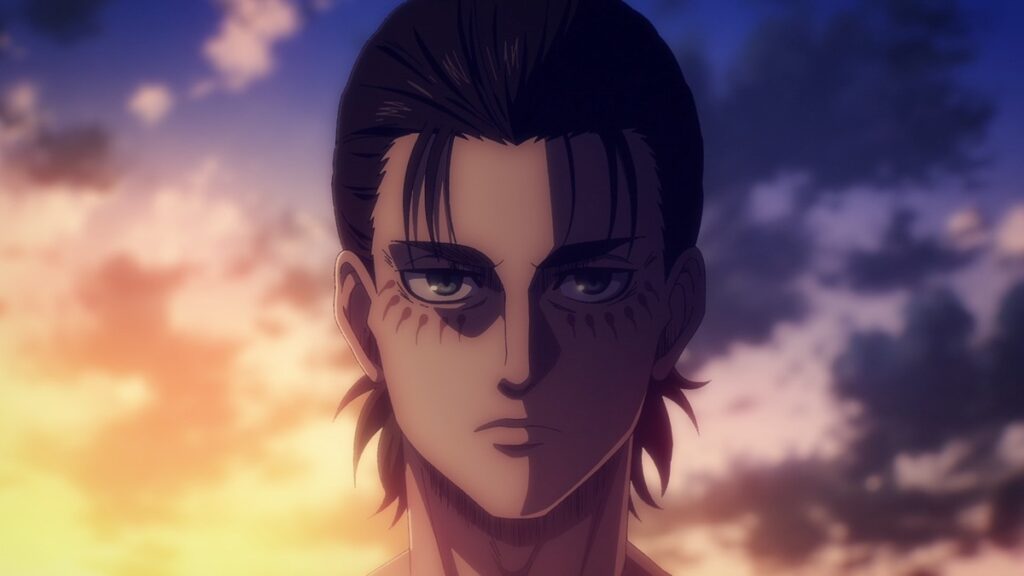
The Attack on Titan ending is not badly written. It is badly earned, and those are different failures with different fixes.
That distinction is where most of the argument about this ending gets stuck. One side says the conclusion betrays everything the series built. The other says it was foreshadowed from the first chapter and people simply did not like where the foreshadowing led. Both are describing something real, which is why the argument never resolves.
Here is what I think is actually going on.
The case that the ending was always the plan
This side has the stronger textual evidence and it is worth laying out honestly before disagreeing with any of it.
The series opens with Eren waking from a dream, crying, saying he has been gone a long time. That scene means almost nothing on a first read. On a reread it is the entire ending, sitting in the first pages.
The theme is stated repeatedly and early. Eren wants freedom. He does not want justice, or safety, or peace, and the series never says he does. He wants the world outside the walls to be open and empty. When the walls come down and he learns the world is full of people who want him dead, the same desire produces a monstrous conclusion. That is consistent. It was never a story about a boy who wanted to protect people.
The Reiner and Bertholdt reveal is the structural rehearsal for it. The series teaches you, quite early, that the people committing atrocities have coherent reasons and think of themselves as ordinary. Once you accept that framework, applying it to Eren is not a betrayal. It is the framework working as designed.
So the people saying the ending fits are not wrong about the text. It fits.
The case that it does not land anyway
Fitting and landing are separate problems, and this is where I come down.
The issue is the compression. The final stretch has to do an enormous amount of work: complete Eren’s turn, resolve the Ymir mythology, deliver the Founding Titan’s mechanics, give nine characters emotional conclusions, and stage a final battle. It does all of this at once, at speed.
The Ymir material is where this hurts most. The explanation for why she stayed, and what she wanted, arrives very late and carries an enormous load. It is asked to retroactively explain the mechanics of the entire titan system and to serve as the emotional key to Eren’s actions. A revelation doing that much work needs room to breathe, and it does not get any.
Compare that to how the series handled the basement reveal. That answer was seeded for years, arrived at the right moment, and reframed everything without requiring a lecture. The ending’s revelations are structurally similar but delivered in a fraction of the space, and you can feel the difference.
The Eren problem specifically
Here is the part I find genuinely difficult.
Late in the series, Eren gives an explanation of his own motives that reduces a great deal of what he did to something small and personal. Whether you read that scene as tragic self-awareness or as the story deflating its own antagonist depends almost entirely on how much credit you extend.
The generous reading is that this is the point. Eren is not a grand ideological figure. He is a young man who wanted one thing very badly, got it, and destroyed most of the world in the process, and the smallness of his reasoning is precisely the horror. Stories about mass atrocity that give the perpetrator an impressive philosophy are, arguably, doing something worse.
The ungenerous reading is that after building a character with real ideological weight, the series retroactively shrinks him, and shrinking a character in the last stretch reads as the author losing confidence rather than making a point.
I lean toward the generous reading and I hold it loosely. What makes me hesitate is that the scene is written in a register that feels apologetic rather than horrified, and tone matters here.
What the ending gets right and nobody discusses
The final image, the one about the cycle not ending, is the strongest choice in the whole conclusion and it gets buried under arguments about Eren.
The series spends its entire length arguing that violence is generational, that every side has a grievance that was itself caused by an earlier atrocity, and that this pattern does not have an obvious exit. An ending where peace arrives and holds would have contradicted the thesis completely.
So the story refuses it. The peace is temporary. That is the honest conclusion of the argument the series was making, and it is a much braver choice than the alternative.
Most stories that set up a cycle of violence eventually break it, because breaking it is satisfying. This one does not, and it is right not to.
The adaptation question
The anime’s final part had more room than the manga’s final chapters and used some of it to smooth the roughest edges. Extra scenes, more space for reactions, a slower pace through the material that felt most rushed on the page.
It helps. It does not solve the underlying issue, because the underlying issue is that the last act is being asked to carry more than any last act reasonably can. Extra minutes soften compression, they do not remove it.
If you read the manga and disliked the ending, the anime version is worth watching and will probably move you slightly. It is unlikely to change your position.
Where I actually land
Attack on Titan is one of the best-constructed stories in the medium for roughly ninety percent of its length, and its ending is a compressed version of the correct ending rather than a wrong one.
That is a much smaller criticism than the internet consensus suggests, and it is still a real one. The gap between a conclusion that is thematically right and a conclusion that feels right is mostly a gap in pacing, and pacing is not a minor thing. It is how meaning gets delivered.
I would rank the ending as a disappointment rather than a failure. The series remains excellent. It just does not stick the landing with the precision it stuck everything else.
The question worth arguing about
If Isayama had been given another twenty chapters, does the ending become good, or does it just become longer?
I think it becomes good, because I think every problem here is a space problem. But there is a real counterargument that the conceptual issues with Eren’s late characterisation are not fixable with room, and that more chapters would have made the deflation more obvious rather than less.
If you think the ending is conceptually wrong rather than rushed, I want to hear that case, because it is the version of the argument I find hardest to answer.