Ranking these is harder than it looks, because Pirates of the Caribbean is a series where the quality of the films and the quality of the experience of watching them are not the same thing. Two of them are genuinely well-made. Several are a mess. One of the messy ones is more fun than one of the well-made ones.
So I am ranking them on a single question: how much of the thing you came for does each film actually deliver?
5. On Stranger Tides
The one that forgot what the series was.
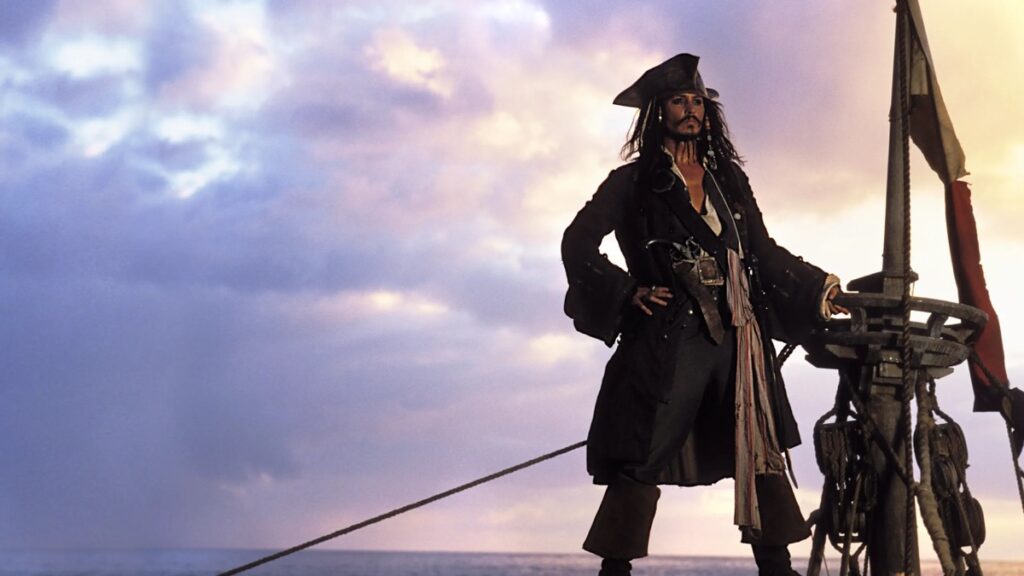
Pirates worked because it was an ensemble. Jack Sparrow is a supporting character who steals films, which is a completely different job from carrying one. Put him at the centre and the character stops functioning, because his entire comic architecture depends on there being a straight man in the frame to react to him.
Take away Will and Elizabeth and there is nobody for Jack to be strange at. The film substitutes Angelica, but the relationship is written as backstory rather than developed on screen, so the friction never gets going. Blackbeard is a decent villain with nothing to do. The mermaid sequence is the only part that feels like it belongs to the same series.
It is also the first one that feels contractually obliged rather than enthusiastic, and that is difficult to hide.
4. Dead Men Tell No Tales
Slightly better than Stranger Tides and mostly for the same reason it is still not good: it noticed the ensemble problem and tried to fix it by adding two young leads, without giving either of them anything interesting to do.
Javier Bardem is doing real work as Salazar and the visual design of the ghost crew is genuinely striking. The underwater and dry-seabed sequences are the best individual images in the back half of the franchise.
But the film is assembled from callbacks. It keeps referencing earlier entries in place of building its own material, and there is a lot of screen time devoted to reminding you of films you liked more. The bank heist opening is fun and then the film never reaches that energy again.
3. At World’s End
The most ambitious and the most exhausting.
This film is nearly three hours long and spends the first hour on a rescue mission in a metaphysical afterlife populated by multiple Jack Sparrows. It has nine factions, a shifting web of betrayals, and a plot about a pirate council that requires you to track who holds which piece of eight.
It is too much. It is also, unmistakably, a film with ideas. The maelstrom battle is one of the best action sequences in any blockbuster of that decade: two ships circling a whirlpool in the rain, with a wedding happening mid-fight. That sequence alone justifies the film.
What sinks it below the top two is that the emotional payoffs get lost in the plot machinery. Will and Elizabeth’s ending should devastate you and mostly does not, because you have spent ninety minutes tracking alliances instead of feeling anything.
2. Dead Man’s Chest
The best action design in the series and the best villain, held back only by being half a film.
Davy Jones is the franchise’s high point as a creation. The performance capture still holds up almost twenty years on, which is remarkable, and the character works because he is genuinely tragic rather than just menacing. His scenes have weight that nothing else in the series manages.
The three-way sword fight on the rolling water wheel is the purest expression of what these films do well: escalating physical comedy that is also a real fight, staged with total clarity so you always know where everyone is. It is choreographed like silent comedy and shot like an action film.
The problem is structural. It ends mid-story because it was made back to back with At World’s End, so it has a first act, a second act, and then a cliffhanger. As a standalone film it does not resolve. That is a real cost.
1. The Curse of the Black Pearl
Still the best by a wide margin, and the reason is that it is the only one that works as a complete film with no knowledge of anything else.
The plot is clean. There is a cursed crew, a stolen medallion, a girl taken, and a debt to settle. You can explain it in two sentences. Every subsequent film in the series would need two paragraphs.
The tonal balance is the thing nobody replicated. It is funny without being a comedy, and the supernatural material is played straight enough to be genuinely eerie. The moonlight reveal where the crew turns skeletal mid-fight is a horror beat in an adventure film, and it works because the film has not been winking at you.
Depp’s performance is famously the film’s engine, and it is worth remembering how much of it works because Geoffrey Rush is playing Barbossa completely straight. Barbossa is a real pirate captain in a real pirate film. Jack is a strange man wandering through it. The comedy comes from the collision, not from Jack alone, which is precisely the lesson the later films forgot.
The pattern across the series
The quality of these films tracks almost perfectly with one variable, which is how much the film needs you to remember.
Black Pearl needs nothing. Dead Man’s Chest needs one film. At World’s End needs two and a notebook. Stranger Tides needs you to have forgotten the previous one. Dead Men Tell No Tales needs you to be nostalgic for a series it is not confident enough to continue properly.
Blockbuster franchises tend to fail in this direction. Continuity accumulates, the entry cost rises, and eventually every film is a sequel to a sequel and none of them can stand alone. Pirates hit that wall faster than most because the second and third films were made together, which front-loaded the complexity before the series had earned it.
What the series still does better than anyone
Physical comedy in action sequences.
This is rarer than it sounds. Most action films are either funny between the fights or funny about the fights, with jokes layered over combat. Pirates makes the fight itself the joke, using props, geography and timing rather than dialogue. The water wheel, the church bell, the sword fight in the blacksmith’s shop in the first film.
That craft is why people still rewatch these despite the back half of the series being what it is.
The open question
Was the ensemble the actual engine, or was it Gore Verbinski?
He directed the first three. The two he did not direct are the two at the bottom of this list. That correlation is strong enough to be suspicious, and it is a different explanation from the one I gave above about Jack needing a straight man.
I do not know how to separate the two, since he left and the ensemble broke up at the same time. If you have a view on which mattered more, I would like to hear it.