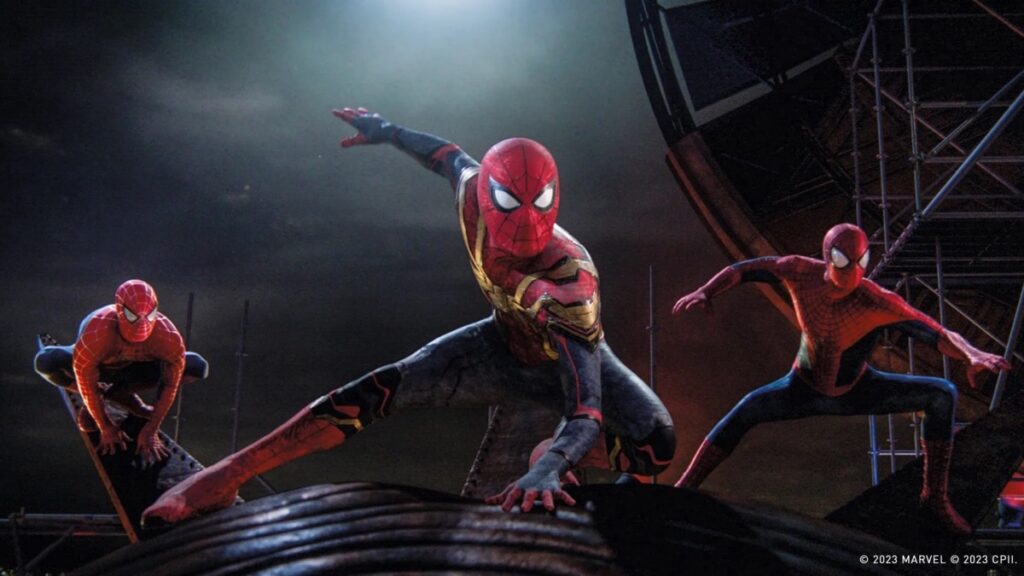
The complaint about Marvel is usually that the films got worse. I do not think that is the problem, or at least not the interesting version of it. Recent entries are roughly as competent as the ones people remember fondly. What changed is that nothing in them costs anything, and once an audience notices that, no amount of competence fixes it.
DC has close to the opposite problem, and comparing the two is more useful than ranking them.
What made the early MCU work
Not the quality of individual films. Several of the ones from the celebrated era are unremarkable on their own and everyone knows which ones they are.
What worked was that the individual films were building toward something with a deadline. There was an antagonist established early, a stated goal, and a countdown. Every reasonably self-contained adventure was also depositing into an account that would eventually be spent.
That structure produced a specific pleasure that most franchises never achieve, which is that watching a mediocre entry still felt productive. You were not just watching a film. You were accumulating.
Then the account was spent, in two films, and the spending was genuinely satisfying. Characters died and stayed dead. A decade of setup converted into payoff.
What happened next
The obvious problem is that there is no new deadline, and everyone points at that. The subtler problem is that death stopped functioning.
Once a franchise establishes multiverses, variants, timeline branches and resurrections as available tools, no on-screen loss is final. The audience learns this quickly, and once learned it cannot be unlearned. A character dying now prompts a calculation about which version might return rather than a reaction.
This is worse than it sounds, because stakes are not really about death. They are about permanence. A story can have enormous stakes with nobody dying, provided the changes it makes are irreversible. What the multiverse did was remove irreversibility as a category, and everything else followed from that.
The volume problem compounds it. When there were two or three releases a year, each one was an event. When there are many, across film and television, with an expectation that you have seen the relevant ones, the entry cost rises for everyone and the reward for keeping up falls.
DC’s opposite failure
DC never had the permanence problem. Its films kill people and mean it, and its tone has generally been willing to sit in consequence.
Its problem was that it tried to reach the payoff without doing the accumulation.
Marvel spent years and multiple solo films establishing characters before assembling them. DC assembled first. The result was a team-up where several members had never had a film, arriving at an emotional climax the audience had no relationship with. The structure was borrowed without the substructure.
Then came the repeated resets. Different continuities, recast roles, films that appear to be building something and then get abandoned. Every time an audience starts to accumulate, the account is closed.
Which is why DC’s best work is almost always the films that ignore the shared universe entirely. Standalone entries with a single director’s clear intention are consistently DC’s strongest output, and that is not a coincidence. Freed from continuity obligations, they can be about something.
The structural lesson
Shared universes require two things that are in tension, and each studio solved one while failing the other.
You need accumulation, meaning a reason for the audience to invest across entries. Marvel had this and DC did not.
You need permanence, meaning the accumulated investment can be spent on something irreversible. DC had this and Marvel lost it.
A franchise with accumulation but no permanence becomes an endless middle where nothing resolves. A franchise with permanence but no accumulation delivers consequences the audience has not been prepared to feel.
Only one film series has really held both at once for a full run, and it is the Infinity Saga, which is why it remains the reference point despite most of its individual entries being ordinary.
Whether this is fixable
For Marvel, only by re-establishing irreversibility, which is difficult once the multiverse toolkit exists. Announcing that deaths matter again does not work. The audience has to be shown a loss that visibly cannot be undone, and the studio has to then decline to undo it for a long enough period that the lesson takes.
That is a multi-year cost with no short-term benefit, which is why it probably will not happen.
For DC, the fix is easier and they appear to be attempting it: commit to one continuity, build it in order, resist the team-up until the individual pieces exist. The hard part is institutional patience, not creative difficulty.
The thing both franchises still get right
Casting. Whatever the structural problems, both have repeatedly found actors who defined characters so thoroughly that recasting them feels like a loss.
That is not a small thing. A great deal of what people are actually attached to in these franchises is a performance rather than a plot, and both studios have been consistently good at this even when everything around it wobbled.
Where I might be wrong
The strongest counterargument to all of this is that superhero fatigue is simply a genre cycle, and the structural analysis is a rationalisation of something simpler: people watched a lot of these films for fifteen years and got tired.
Westerns went through this. Musicals went through this. The genre dominates, saturates, declines, and returns decades later with fresh eyes. Under that reading, no structural fix matters because the problem is not structural.
I find this argument hard to dismiss and it would explain why competent recent entries have underperformed. If it is right, the interesting question is not how Marvel recovers but what genre replaces it, and I do not have a good guess.