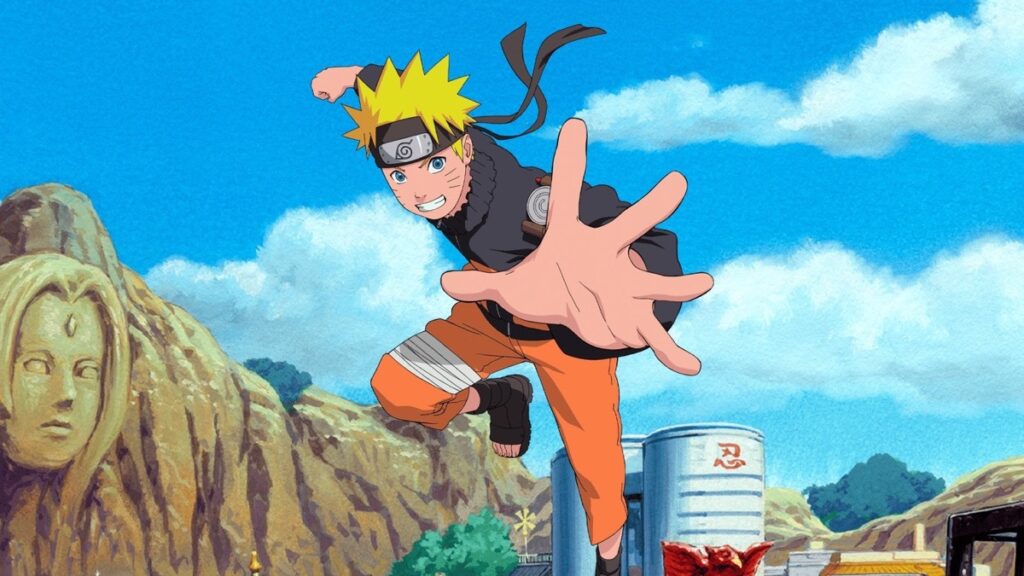
On 10 October, in a sold out room of about 3,000 people at New York Comic Con and on a livestream, Naruto got a birthday present on its own birthday. The panel was called “Naruto: What’s Next?”, and what came out of it was more interesting than the announcement suggested, for a reason almost nobody covered.
What was announced
| Announcement | What it is | Timing |
| NARUTO x NINKŪ | A four episode crossover with Koji Kiriyama’s 1993 manga, animated by Pierrot Films, directed by Noriyuki Abe, with the original voice cast returning | No date given |
| Naruto Shadow Rising | A new manga, written and drawn by Masashi Kishimoto | Details at Jump Festa, 19 to 20 December 2026 |
| Project Rasengan | A multi-year plan across manga, anime, games and events, running to 2029, with several projects still to be announced | Ongoing |
| Naruto Card Game | Worldwide release, three starter decks and a first booster pack already shown | June 2027 |
The long awaited new Naruto anime is a four episode crossover with a series from 1993, made by the original studio, with the original cast, supervised by the creator, released on an anniversary. The new story went somewhere else entirely, into a manga drawn by Kishimoto himself.
The deluxe version of a project announced three years ago
This is not a fresh idea. A new Naruto anime was announced in March 2023 for the twentieth anniversary, four episodes, planned for September of that year. It was delayed that August to “improve the quality”, with no replacement date. That silence lasted three years.
What finally arrived in October 2026 turned out to be a crossover with a property Kishimoto credits as the reason Naruto exists at all, rather than the new story people had assumed they were waiting for. The genuinely new material, a manga drawn by Kishimoto, was announced as a separate item on the same stage.
That is the safest possible way to release anything: an anniversary, a legacy name, the original studio, the original cast, four episodes, no canon risk, and a built in audience that will watch it out of curiosity alone. Every variable that usually kills a production has been removed on purpose.
The same maths is showing up everywhere
- One Piece. WIT Studio is remaking the series for Netflix. The teaser landed in June, and the run is reported as seven episodes in early 2027. A thousand plus episodes is a wall, and the remake exists so that nobody has to climb it.
- Attack on Titan. The most argued about ending of the decade keeps returning to cinemas, most recently as The Last Attack, a feature cut of the final specials, with a ScreenX run booked for 2027. The ending itself has not changed. That ending is rushed rather than wrong, and the difference still matters.
- Dr. Stone. A sequel anime announced within months of the series finale, which is less a revival than a release schedule that never fully stopped.
- The older wave. Fullmetal Alchemist got its faithful second run, Hunter x Hunter got its second adaptation, Fruits Basket got its third. The pattern has been running for nearly twenty years.
Why a remake is the rational choice
An original series bets on several unknowns at once. Will the source sell. Will this adaptation find an audience. Will anyone buy the discs, the figures or the subscription. A remake answers most of those questions before the first episode is animated, because they have all been answered once already.
The streaming era made this worse in a specific way. Platforms competing for subscribers want a catalogue that can be marketed on recognition, and recognition is something existing properties own by default. Nobody decided to have a remake boom. The incentives did it for us.
The ceiling you inherit
A remake cannot be watched as a first attempt. It arrives into an audience that has already had the emotional experience once, which means it has to beat a memory rather than a rival show. Memories are edited for free, and the original is remembered at its best rather than as the uneven thing it was.
That is why remakes tend to be praised for execution and criticised for feeling unnecessary. They are usually better made, and they are almost never bigger, because the size of the first experience was partly a function of it being first.
The slot is the real cost
Every remake takes a production slot that something new could have had. The pipeline is finite, the studios are finite, and the best directors and animators are exactly the people who get attached to a project that already has money behind it.
That is how a cautious decade becomes visible in hindsight, and the remakes are the least of it. What stands out is what is missing from the years around them.
What the panel tells us
The most revealing detail is the split. The new story went to manga, drawn by the creator, at his own pace, with no studio schedule attached. The anime got the anniversary crossover and a licensing roadmap that runs to 2029. When a franchise has something genuinely new to say, it says it on the page first.
None of this is a criticism of Ninku, which by Kishimoto’s own account earned its place in the lineage, or of a four episode crossover that will probably be lovely. It is an observation about where the appetite for risk currently sits, and it is the same observation that explains why a series like Demon Slayer gets funded to the last frame while new premises wait in a drawer. More anime arguments sit under Anime.
The next Naruto project has to answer 3 questions
- Whether Project Rasengan ever delivers a new canon arc, or whether the boxes turn out to be cards, games and limited runs.
- Whether the One Piece remake is pitched as a door for people who would never start episode one. That is a genuinely good use of a remake. A hedge against the original ageing is a worse one.
- Whether the next Naruto project is supervised by someone with a story to tell, rather than scheduled because the year needed a Naruto.
A remake is what an industry looks like when it has got very good at pricing risk. A known name is the cheapest insurance available, and a run of them follows from that arithmetic rather than from a shortage of ideas. Watch which titles get a second chance, and notice which stories never get a first.

Pingback: One Piece Earns Its 1,000 Episodes. Naruto Threw Its 700 Away. - Siddharth Vira
Pingback: AD Police Files Gets a 4K Release in January. Its 6.6 Rating Explains Why. - Siddharth Vira
Pingback: My Hero Academia Made Deku and Ochaco Canon Twice, Seventeen Months Apart - Siddharth Vira
Pingback: Infinity Castle Part 2 Has No Date. Demon Slayer Is Selling Two Hashira Instead - Siddharth Vira