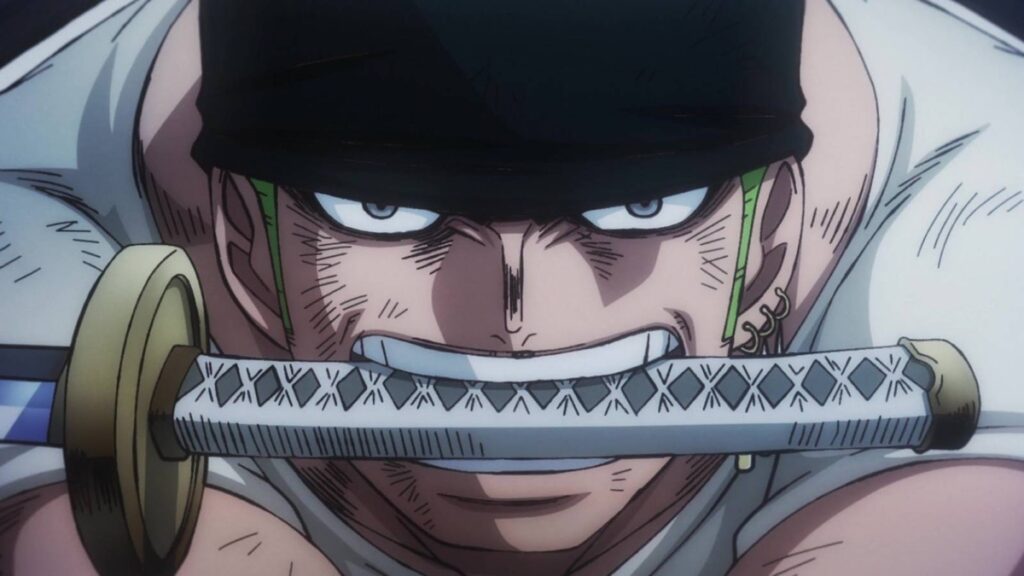
Zoro is the easiest Straw Hat to describe badly. Loyal, determined, strong, stoic, and every one of those words could belong to fifty other shonen characters. What makes him work is the price attached to each trait, and the show charges him for all of them.
He is also the one member of the crew with a destination. Luffy wants a title and the crew follows him into it. Zoro has a name he has to beat and a promise he made to a dead friend, which is a different engine.
The promise to Kuina is the engine behind everything else
Zoro and Kuina trained in the same dojo as children. She beat him, repeatedly, and she told him the reason: she would never be allowed to become the world’s greatest swordsman because she was a girl. He made her a deal instead. One of them would take the title and it would count for both.
Kuina died a short time later, from a fall down a flight of stairs. That is the detail the series gives and then refuses to soften. Zoro carries her sword, Wado Ichimonji, for the rest of the story, and every fight he takes is partly an argument with a person who cannot answer.
This is why his ambition reads differently from everyone else’s. A character who wants to be the strongest is a trope. A character who has to become the strongest because somebody else cannot be is carrying a debt.
Loyalty is what he does at Thriller Bark, not what he says
Zoro barely talks about loyalty. He demonstrates it in the one scene everybody remembers.
After the fight with Moria, Bartholomew Kuma offers the crew a trade: Luffy’s life for theirs. Zoro knocks Sanji out before Sanji can volunteer and takes the whole of Luffy’s pain and fatigue into himself. When he walks back out, he is standing upright in a pool of his own blood and tells the crew nothing happened.
That scene is a better argument for the character than a page of dialogue about crewmates. It also shows the shape of the trait. Zoro’s loyalty is not warmth, and he does not distribute it evenly. It runs downwards from the captain, and everybody else gets the version of it that keeps the ship moving.
The strength was bought with 2 years of bowing to Mihawk
Zoro loses his first fight against Dracule Mihawk at the Baratie, with a broken sword, in front of his crew. Mihawk tells him to learn who he is before coming back. Zoro survives, lifts his sword to the sky and makes the promise out loud where everyone can hear it.
Then he does the part most stories skip. He finds Mihawk again during the 2-year separation and asks the man who beat him to train him. He begs. The scene is uncomfortable on purpose: the world’s greatest swordsman tells him to go away, and Zoro stays on the ground until he agrees.
That is where the strength comes from, and the humility is what makes it credible. He is not a natural who out-trains everyone. He is a man who took his worst defeat and moved into the house of the person who gave it to him.
Zoro’s stoicism is a defence, and the crew leans on it
He is the one who says the thing nobody wants to hear. When Usopp leaves the crew over the Merry, Zoro refuses to let Luffy go and fetch him back quietly. A captain who begs a crewmate to return cannot lead the next one, and Zoro holds that line while Luffy sulks about it.
That is not coldness, and it is not loyalty to a rule either. He is the second in command doing the part of the job Luffy cannot do without losing face.
The cost is that he never explains himself. He takes the position, absorbs the bad feeling and moves on, which is why he reads as flat to some viewers and as the most adult character in the story to others.
His worst trait is played for laughs, and it should not be
Zoro cannot find his way anywhere. He walks in the wrong direction, gets lost on a straight path and once sailed off alone in the wrong boat. The show treats it as a running joke, and it lands, because a man this disciplined should not fail at walking.
The joke also does real work. It puts a hole in a character who would otherwise be a wall of competence, and it keeps him dependent on the crew in the small ways that make the loyalty mutual rather than one-directional.
His bluntness is the other half of the same thing. He tells people what he thinks of them, usually in one line, and he is wrong about the delivery as often as he is right about the content.
What the traits add up to is a man who is only interesting because he pays for them. The promise costs him a normal life. The loyalty costs him Thriller Bark. The training costs him his pride. The stoicism costs him being understood. Take away any of those bills and Zoro becomes the generic swordsman his worst scenes already resemble. The chapter where Sanji tries to pay with his own life makes the same argument: on this crew, the cost is the character.
Zoro’s arc sits inside the bigger argument about why One Piece earns 1,000 episodes, and the god-level material he is walking towards is covered in the 5 sun gods. More One Piece arguments sit in One Piece Explained, and the rest of the beat is in Anime.