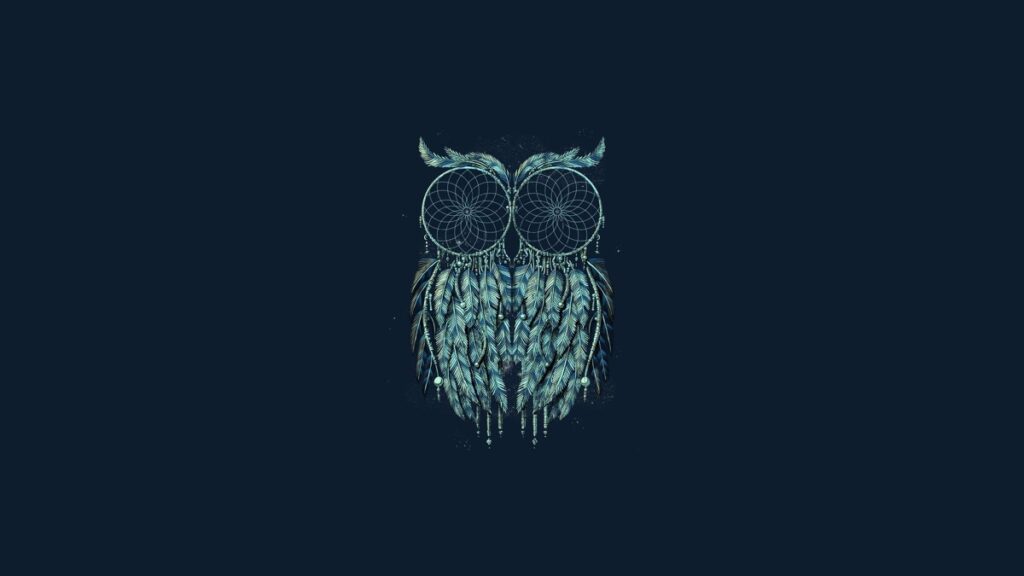
There is an owl on my phone screen and on my laptop wallpaper, and it has been there since about 2017. It is not a photograph. It is two dreamcatchers arranged into the shape of an owl, symmetrical, still, facing straight out.
I cannot tell you where I found it. Pinterest, most likely, during a year when I was reading a lot about mindset and very little about anything else. What I can tell you is that I tried other wallpapers and none of them lasted. This one kept coming back.
Two dreamcatchers, and nothing else stuck
At the time I read the return as manifestation. I had just stepped into network marketing, which meant mindset work, goals, visualisation, and a copy of The Secret that I took seriously. The idea that what you focus on grows was the whole frame I was working inside.
So when the image kept staying, I assumed it was aligned with the phase I was in. Something I liked the look of, nothing more.
Nine years is a long time for an accident. A wallpaper you change every month is a preference. A wallpaper you keep changing back to is closer to a habit, and habits usually have a reason somewhere underneath.
The one owl fact I knew was stillness
I knew nothing about owl symbolism then. No mythology, no folklore. The only thing I had was the behaviour everybody can see:
- An owl sits still for hours
- It does not burn energy it does not need to burn
- It waits for the moment instead of chasing one
- It moves once, and it is done
That read as personal because it is how I already worked. I watch before I move. I look for the pattern and I sit with it. If I can see that something will play out over two or three years, I am comfortable waiting for it rather than forcing an early version of the outcome.
Nobody had ever described that as patience. Most people described it as being slow, and I spent years wondering whether they were right.
My friend had the talent and I had the hours
The second dreamcatcher in the image is the part I only understood later.
In my early learning years my closest friend and I worked together as partners. He had the thing that cannot be taught. Charisma, quickness, the ability to walk into a room and be liked before he said anything useful. I did not have any of it.
I never took that badly, because it confirmed something I already believed. If I am not the most talented person in the room, I can still outwork everyone in it. Talent can be developed. Skill can be built. Effort was the one variable nobody else controlled.
Two dreamcatchers, not one, was the version of that idea I could look at every day:
- If someone can reach a goal with normal effort, double effort also works
- If someone works 8 hours, I can work 16
- If someone dreams once, I can dream twice and keep the plan
It was a little silly, and I knew it, and it did its job. Hard work was the part I could control, so it became the part I organised my days around.
The owl is Uluka, and it belongs to 2 goddesses at once
Only recently did I read up on what the owl carries in Indian symbolism, and the honest answer is stranger than a single meaning. The owl is Uluka, the vehicle of Lakshmi, the goddess of wealth and good fortune.
It is also linked to Alakshmi, her elder sister, who stands for misfortune and want. Devdutt Pattanaik makes the point that the barn owl carries both, which is why the same bird is revered in one house and called a bad omen in the next.
That contradiction is the most useful part. Wealth paired with awareness is Lakshmi. Wealth without it is Alakshmi. The bird does not change. What it means depends on the person looking at it.
The owl stayed through 9 years of work
I did not choose the owl knowing any of this. It stayed anyway, through years of learning, a few failures, a lot of work and several changes of mind about how the world operates.
What it reminded me to do has not changed much:
- Stay still until the moment is there
- Work harder than the room without announcing it
- Wait for timing instead of arguing with it
- Think in years, not weeks
- Keep the dream, even when it needs double effort
Maybe manifestation worked. Maybe patience and effort just produce the life that looks like it was manifested. Either explanation ends in the same place, and the wallpaper is still there.
The argument about what people around you can and cannot change is in why a good room does not upgrade anyone, and the version about money and childhood wants is buying a box set 16 years late.
More of this kind of writing sits in Career and Craft.





Pingback: You Are Not Who You Hang Out With - Siddharth Vira