Patrick Stewart’s favourite episode of Star Trek is “The Inner Light”, the twenty-fifth episode of The Next Generation’s fifth season, which first aired on 1 June 1992. He has said so himself. The episode puts Picard through forty years of a life that is not his, on a planet that no longer exists, and it won the Hugo Award for Best Dramatic Presentation in 1993.
That answer comes up whenever Stewart is asked, and it is worth taking seriously, because the episode he picks is the one with the least Star Trek in it. No ship battle. No negotiation with an alien power. One man, one village, one lifetime, and a flute at the end.
What is Patrick Stewart’s favourite Star Trek episode?
“The Inner Light” from The Next Generation season five. The Enterprise finds a probe that fires an energy beam at Picard, and he wakes up as a man named Kamin on a planet called Kataan. He lives an entire life there, marries, raises children, learns the flute, and discovers the planet is dying. Twenty-five minutes pass on the Enterprise while forty years pass for him.
| Detail | Fact |
|---|---|
| Series and episode | Star Trek: The Next Generation, season 5, episode 25 |
| First aired | 1 June 1992 |
| Story by | Morgan Gendel |
| Teleplay by | Morgan Gendel and Peter Allan Fields |
| Directed by | Peter Lauritson |
| Award | Hugo Award for Best Dramatic Presentation, 1993 |
What actually happens in The Inner Light?
The probe is a message from a civilisation that knew it was about to die. Kataan’s sun was going nova, and the people had no way to escape. They built the probe to carry their memories instead, so that somebody would remember them. Picard is the somebody. He spends the episode living a life he did not choose, and when he wakes up he keeps the flute the probe left him.
That is the whole plot. A dying planet asked to be remembered, and the ask worked, because one man on a starship now carries a world that nobody else can visit.
There is a detail worth knowing. Daniel Stewart, Patrick Stewart’s son, plays Kamin’s son Batai. A father and a son playing a father and a son in an episode about a life that has to be lived quickly is the kind of casting that costs nothing and does a lot.
Why does a quiet episode work better than a battle?
Because the episode spends its time on the one thing television can do cheaply and films cannot, which is time passing. Picard ages inside a single hour of television, and the audience feels the years because the show skips them honestly. There is no montage trick that hides the cost. He is young, then he is old, and the story does not soften it.
Here is what the episode gets for its restraint:
- A guest cast of a few actors carries half the running time, so the budget goes into writing rather than sets.
- The stakes are personal, so the episode does not need a villain to create tension.
- The ending is a man alone in his quarters with a flute, which is cheaper to shoot than any space battle and harder to forget.
- The consequences last. Picard comes back softer around children, and later episodes use that.
I have argued before that the tidy AI story in the MCU was there from the start and only became visible years later, which is the same trick this episode plays in reverse. The Inner Light plants its consequence in plain sight and lets the rest of the series find it.
There is a version of Star Trek that would have solved the probe with a reverse polarity trick in the last ten minutes. This one lets the trick be that a man was allowed to grieve for a place he had never heard of at the start of the hour.
Did The Inner Light win a Hugo?
Yes. It took the Hugo Award for Best Dramatic Presentation in 1993, the year after it aired. That award is voted on by science fiction readers and convention members rather than television critics, which makes it a reasonable signal that the episode landed with the people the genre belongs to.
CBR made the case for the episode again on 19 October 2026, and it is a fair case. The episode is thirty-four years old and still gets written about, which is more than most television manages in a month.
Why does the flute matter so much?
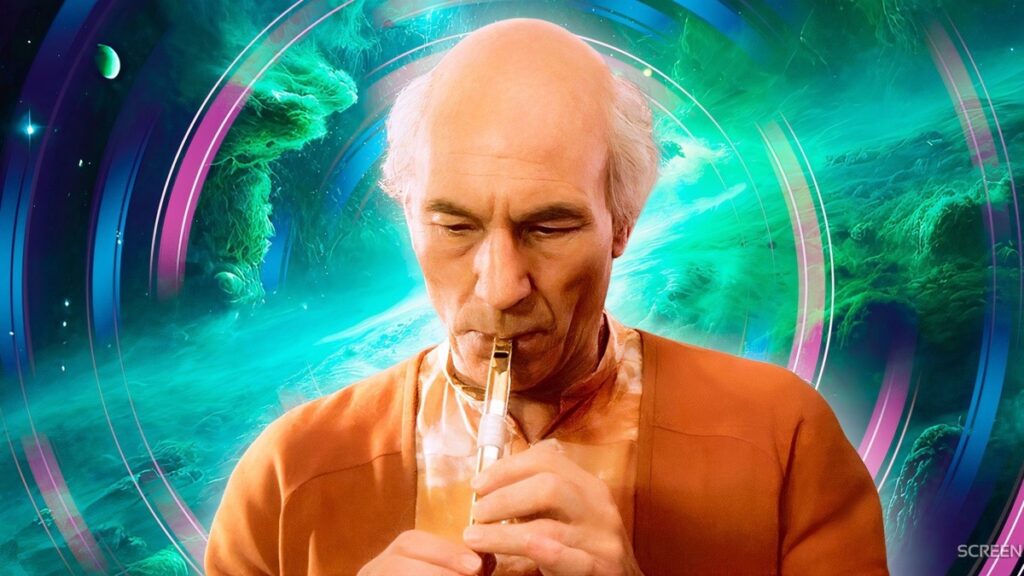
The flute is the only object that crosses from Kataan to the Enterprise. It is proof that the forty years happened, at a point in the episode when the audience has started to wonder whether they were a dream. The melody was composed by Jay Chattaway and has since been arranged for a full orchestra, so the tune has had a life outside the episode.
In the final scene Picard sits in the dark and plays it. Nobody says what he is thinking. The show trusts the object to carry the loss, and that is the part people remember twenty years later.
Is it really the best episode of The Next Generation?
Best is a claim I would only defend in a narrow way. “The Inner Light” is the best episode of The Next Generation at being about something other than Starfleet. “The Best of Both Worlds” is better at threat. “The Measure of a Man” is better at argument. The Inner Light is better at grief, and grief is the harder thing to make a viewer feel in forty-five minutes.
I wrote recently about how the “better than Lord of the Rings” argument tests the wrong thing, and the same caution applies here. Ranking episodes against each other tells you what a person values. It does not tell you which episode is good.
What I would say plainly is this. If somebody has never watched The Next Generation and wants one episode to see what the show was for, this is the one. It needs no prior knowledge, it has no continuity to learn, and it ends on a note that a sixteen-year-old can follow without being told what to feel.
Stewart has had a long career since, and he keeps coming back to this one. Watch the last two minutes and the reason is on the screen.