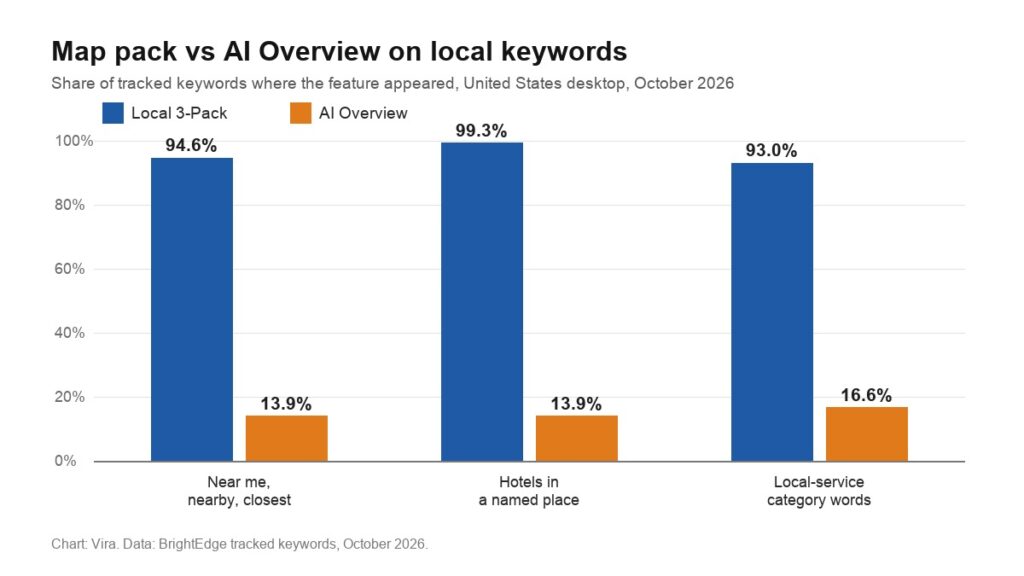
Type “dentist near me” into Google and the answer is still a map with three businesses on it. BrightEdge tracked local keywords in October 2026 and found the map pack on 94.6 per cent of the near-me cut, with an AI Overview on 13.9 per cent. The two features mostly did not share a page.
That is the first hard number I have seen on where AI answers have and have not replaced local results, and it changes what a shop should spend its time on.
What BrightEdge measured
BrightEdge published the finding in its weekly AI and search note on 26 November, from tracked keywords collected in October 2026. The set is United States desktop, gathered from one fixed collection location. It records whether a feature appeared on the results page. It does not record clicks, calls, direction requests or bookings.
The keyword cuts were made by wording rather than by topic, because wording is what tells Google somebody wants a business near them. Three cuts, and the same two features counted on each.
| Keyword cut | Local 3-Pack | AI Overview |
|---|---|---|
| Near me, nearby, closest | 94.6 per cent | 13.9 per cent |
| Hotels in a named place | 99.3 per cent | 13.9 per cent |
| Local-service category words | 93.0 per cent | 16.6 per cent |
The two columns are counted separately. Each one asks whether that feature appeared, so a keyword can carry both, one or neither. On the near-me cut, 9.6 per cent carried both.
Add a city name and the pattern flips
Across the city-modified keywords in the same set, 84.2 per cent carried an AI Overview with no map pack. Another 14.0 per cent carried a pack and no overview, and 1.8 per cent had neither. So a place name alone does not signal that somebody wants to buy something nearby.
“Things to do in Austin” and “best time to visit Rome” carry local words and informational intent, and both got an overview. “Dentist near me” signals a provider. The intent sits in the verb, not in the city.
That explains why published figures on AI Overviews in local search disagree so widely. Studies reporting high coverage are usually counting informational queries with a place name in them. Whitespark put AI Overviews on 15 per cent of local-intent queries against 92 per cent of informational ones in May 2025, using its own query set, and two independent sets landing in the same range is the part I trust.
What the AI answers cited instead
The same study read restaurant and travel prompts across ChatGPT and Google AI Mode in the same week. On restaurant prompts, ChatGPT cited TripAdvisor in 24.6 per cent of citations, OpenTable in 19.6 per cent and Yelp in 15.5 per cent. Google AI Mode cited google.com in 70.2 per cent of them, more than ChatGPT’s top three put together.
Travel prompts ran the same way. ChatGPT went to TripAdvisor for 45.3 per cent, Expedia for 19.9 per cent and Hilton for 16.0 per cent. AI Mode put 55.3 per cent on google.com and 11.2 per cent on TripAdvisor.
Those two groups include prompts with no local intent, so read them as category behaviour rather than local search. The useful part is the split. ChatGPT spreads citations across platforms a shop does not control. AI Mode leans on Google’s own surfaces, which is the profile and the site a business already manages. If Google takes 70 per cent of the restaurant citations, the work there is what Google already knows about you.
What a shop in India should take from a US desktop set
Not the percentages. The set is one country, desktop only, from one collection point, so it says nothing measured about Jaipur, Pune or Kochi. What transfers is the test, and it is cheap to run on your own terms.
- Pull your local keywords and split them by the wording. “Near me” and category words go in one pile. “Best time to visit” and “how much does it cost” go in the other.
- Check which pile carries a map pack and which carries an AI Overview. A blended average across both piles hides the only thing worth knowing.
- For the pack pile, fix the profile. Categories, hours, service area and photos come from Google Business Profile, not from your page copy.
- For the overview pile, read which domains get cited and check whether you appear on them.
One more piece moved on 10 November 2026. OpenAI opened Businesses in ChatGPT, with a claimable Business Hub for eligible businesses and Business Agents limited to US ecommerce and online service businesses. Claiming a profile is open to far more businesses than agent access is.
Report three numbers, not one
Whether you are in the map, whether an AI Overview appeared, and which sources the AI answer cited. Each answers a different question, and averaging them produces a figure nobody can act on. The rest of my marketing writing is in the Digital Marketing hub.
Also read:
- Ask Maps Books the Appointment. 3 Settings Decide Which Shop Wins
- 5 Google Business Profile Mistakes That Get Indian Businesses Suspended
- 58 Per Cent of Bing AI Citations Went to Pages No Content Team Was Writing For
Sources: BrightEdge, Local SEO and AI Search: Where the Map Pack Still Holds, 26 November 2026, with tracked keyword data from October 2026. Whitespark’s May 2025 local study and OpenAI’s 10 November 2026 announcement are quoted from the same note.