Fifty-eight per cent of the AI citations in a study of 26 brands landed on pages that were not blog posts, product pages or homepages. Support documents, PDFs, app pages and programme pages took the rest. The study is Jason Dodge’s at BlackTruck Media, published on Search Engine Journal on 24 November 2026, and it comes out of Bing’s own AI Performance Reporting inside Webmaster Tools.
The finding matters because the opposite is what most content teams are paid to produce. If the machine pulls its answer from a support article, an instruction manual or an admissions page, then the page that earns the citation is often one nobody has looked at since launch.
Who ran it and what they counted
Bing put AI Performance Reporting into public preview in February 2026. Dodge pulled three report views for each brand, the grounding queries, the cited pages and the daily overview, and ran the exercise twice, once in spring and again in the fall, keeping only the patterns that held across both seasons. The fall pull behind the headline numbers covers 1 August to 31 October 2026.
The sample covers 26 brands across nine verticals, including destination marketing organisations, resorts, ecommerce, B2B manufacturers, universities, an EdTech platform, regional healthcare providers and a financial institution. The overview totals came to more than 1.1 million citations. The page level export held 883,313 citations across 10,861 URLs, and the grounding query export held nearly 300,000 citations across 2,797 queries. Microsoft says grounding queries are a sample rather than the full set, and Dodge found the query export sums to between 5 and 39 per cent of each brand’s overview total.
The page type split
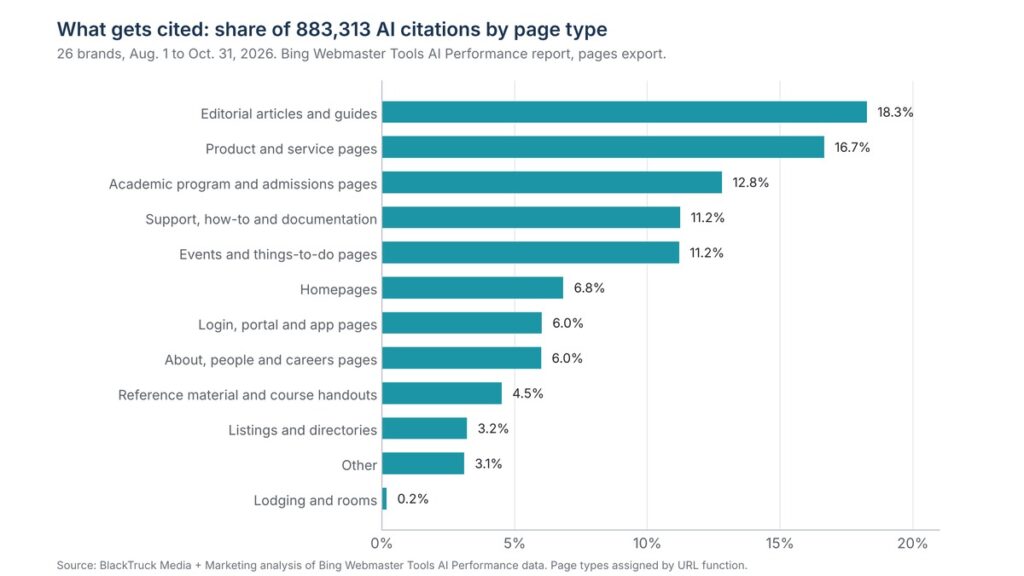
Grouped by what the page is for, across all 883,313 page citations, this is the order. Pooled numbers lean towards big sites, so the median brand in the study looks different, with product and service pages at 32 per cent and editorial at 15 per cent.
| Page type | Share of citations |
|---|---|
| Editorial articles and guides | 18.3% |
| Product and service pages | 16.7% |
| Academic programme and admissions pages | 12.8% |
| Support, how-to and documentation | 11.2% |
| Events and things to do | 11.2% |
| Homepages | 6.8% |
| Login, portal and app pages | 6.0% |
| About, people and careers | 6.0% |
| Reference material and course handouts | 4.5% |
| Listings and directories | 3.2% |
| Lodging and rooms | 0.2% |
Half the citations sit on 2 per cent of the URLs
Citations concentrate hard. Across the whole set, a little over 2 per cent of the URLs carry half of all citations, and it takes 1,441 URLs to reach 80 per cent. For a typical brand, the single top page takes 12.7 per cent of its citations, and about 40 pages take 80 per cent.
Three page types came up that no content calendar plans for. PDFs are more than 6 per cent of all citations, 17 per cent at the EdTech platform, 11 per cent at one university and 10.4 per cent at one ecommerce brand, all of them instruction manuals. Homepages are the single most cited page for nine of the 26 brands. People and about pages carry between 4 and 11 per cent by vertical, and 18 per cent at one university.
The spring to fall comparison caught one shift worth knowing. Login, portal and sign in queries were about 18 per cent of citations in February and just above 1 per cent in the fall pull. At one higher education brand the share went from 45 per cent to just under 1 per cent, and the EdTech platform went from 17 per cent to under 1 per cent. Dodge flags that the August to October semester start should have pushed that number up, and it did not.
What this looks like from India
The study carries no country split, and two of its biggest page types are American patterns. A destination marketing organisation’s attractions list and a US university’s admissions pages do not have a clean Indian equivalent on most sites I work on. What travels is the support and documentation number, and the PDF number.
On the Sovediq store I look after, the pages that answer a real pre-purchase question are product pages and three policy pages. When the same question is asked in an AI surface, the answer comes from whichever page states it plainly. A returns policy held in a PDF is the same risk Dodge describes. For an Indian store the problem is worse. The PDF is not indexed the way the page is, and it goes stale the first time a courier partner changes.
My read
I would open Bing Webmaster Tools before writing another brief. AI Performance Reporting is free and it is first party, which makes it the cheapest evidence available about what a machine actually pulled from a site. Sort the cited pages export, not the queries, because the query sample runs as low as 5 per cent of the citation total.
Then fix the top ten by page rather than by format. A support article that is already cited is worth more work than a new blog post on the same subject, and a manual that answers a setup question should be moved into HTML where it can be updated. The content calendar keeps producing editorial because that is what the team is measured on. Bing’s numbers say a quarter of the traffic is walking past it.
Also read
- Why Your Blog Posts Never Show Up in AI Answers
- 4 Checks Before You Change a Page That Lost an AI Citation
- 6.9% of 41,961 ChatGPT Conversations Showed Purchase Intent in a US Panel
Sources
- What Bing’s AI Actually Cites: 883,000 Citations Analyzed, Jason Dodge, Search Engine Journal, 24 November 2026
- Bing Webmaster Tools AI Performance Reporting