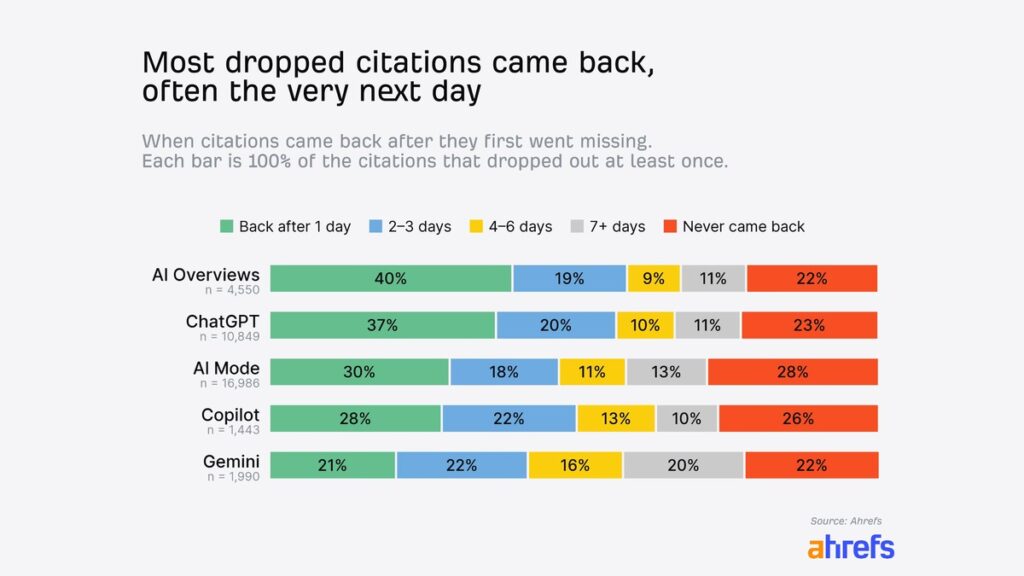
About three in four AI citation losses are temporary, so the first thing to do with a lost citation is nothing. Ahrefs tracked roughly 37,500 first-day citations across five AI products for 20 days and found that most sites that dropped out of an answer came back to some answer before the study ended.
That changes how a lost citation should be reported. I wrote down the four checks from that study in the order I would run them, because the wrong order turns a normal fluctuation into a page rewrite.
Xibeijia Guan collected the sites cited on day one, and Mateusz Makosiewicz wrote up the results. The set covers Google’s AI Mode and AI Overviews, ChatGPT, Gemini and Copilot, and each tool was asked the same group of questions every day for 20 days.
That is one organisation’s question set rather than a global panel, and the paper says so. Read those shares as a shape and not as a law of the internet.
Check 1: Did the Tool Cite Anyone at All?
On Gemini and Copilot, a citation often disappears because the answer stopped citing anything. There is no competitor in the slot and no page to win back that day.
| AI tool | Answers with no citation at all |
|---|---|
| Gemini | 64% |
| Copilot | 53% |
| AI Overviews, AI Mode and ChatGPT | Under 1% |
That split gives you a different job per tool. On Gemini and Copilot you track two numbers, how often your site is cited and how often the answer cites someone else. On AI Overviews, AI Mode and ChatGPT, a lost citation almost always means a competitor took the place, so open the answer and look at who is in it.
Check 2: How Long Had the Citation Lasted?
A citation that appeared once and vanished is a different event from one that held for ten days and vanished yesterday. The study split them, and the difference is large.
For citations that had lasted one day, 34 to 41 per cent never returned during the 20 days. For citations that had lasted eight to 14 days, that figure sat at or below 4 per cent. A long run that breaks is the signal worth acting on, and a short one is noise.
The practical version is a seven-day count per question. How many of the last seven days was this site cited is a steadier reading than a yes or no from today.
Check 3: Is the Brand Still Named?
A citation is a link. A mention is your brand name inside the answer text, with or without the link. The study found those two move at very different speeds.
Between 50 and 70 per cent of cited sites appeared on a single day. Only about one in five brands named in the answers were that fleeting. So the link can vanish while the answer still says your name, and that is a better day than the tracker headline suggests.
One trap on the way through. The tools write brand names in longer and shorter forms, so a mention that looks gone can be the same company under a different label.
Check 4: Does the Page Rank for the Question?
On AI Overviews and AI Mode, cited pages that also ranked in Google for the same question held their citations longer. The effect was weaker on ChatGPT.
The authors looked at 230 questions for this part. Ranking was not a requirement, and most pages that AI Mode and ChatGPT cited did not rank in Google for the question they were cited on. What ranking did was predict which citations stayed.
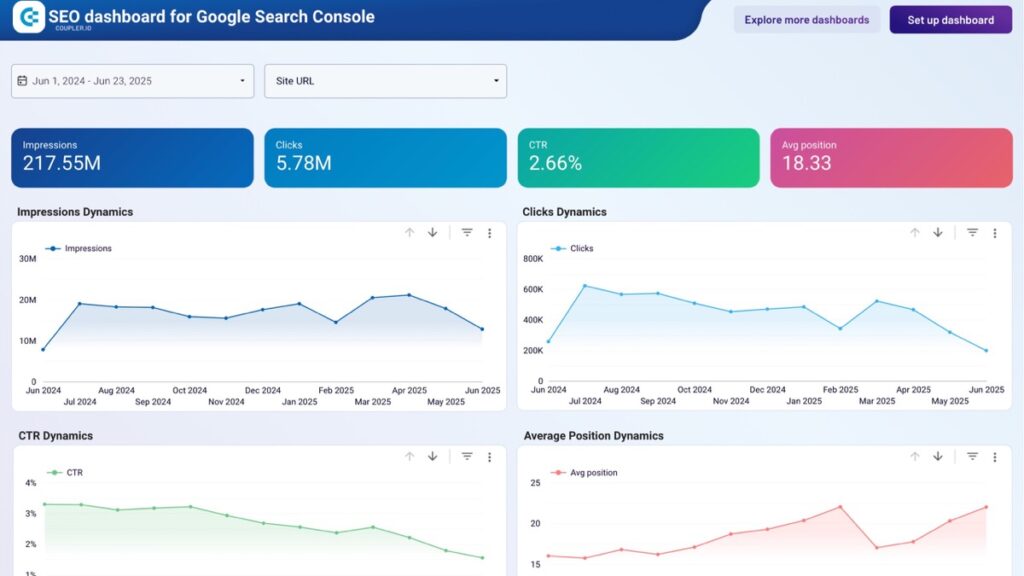
So when a citation is still missing after a while, the first thing to open is the Search Console query report for that question, not the page. 3 Filters the Search Analytics API Added on 16 November 2026 is the newer way to pull that split, and Google’s New Referrer Page Answers 3 Questions Your Analytics Gets Wrong covers where the visits land afterwards.
Do Not Credit the Edit
Most citations in this study came back on their own, and about half of the drops returned within three days. Half of the AI Overviews citations were already gone by day two.
That kills the before-and-after screenshot. If you edit a page on Monday and the citation returns on Wednesday, the study gives you a plain alternative explanation, and you cannot separate the two with one case. Makosiewicz writes that a page edit should not be credited for a single comeback.
His working rule is the one I would put in front of a client. One missing citation is no reason to change a page. A citation still missing after two or three weeks is.
My Read
The number I would report is days cited out of seven, not a count of mentions. It survives a bad Tuesday, it compares across tools, and it stops a team from rewriting a page that was never the problem.
There is no India cut in this study either, so an Indian account has one true benchmark and it is its own log. Start the daily record before the next scare, because a lost citation on a day with no history is just a screenshot.
The same patience applies to the vendors selling AI visibility, as 5 Numbers in Salesforce’s Own SEO Guide That Its CEO’s Post Leaves Out sets out. More of this beat is in the AI search hub.
Also read Open Web Traffic Fell 12% Since 2022. 3 Checks Before You Blame AI and 6.9% of 41,961 ChatGPT Conversations Showed Purchase Intent in a US Panel.
Sources: Search Engine Journal, 20 November 2026 and Ahrefs, How Stable Are AI Citations.