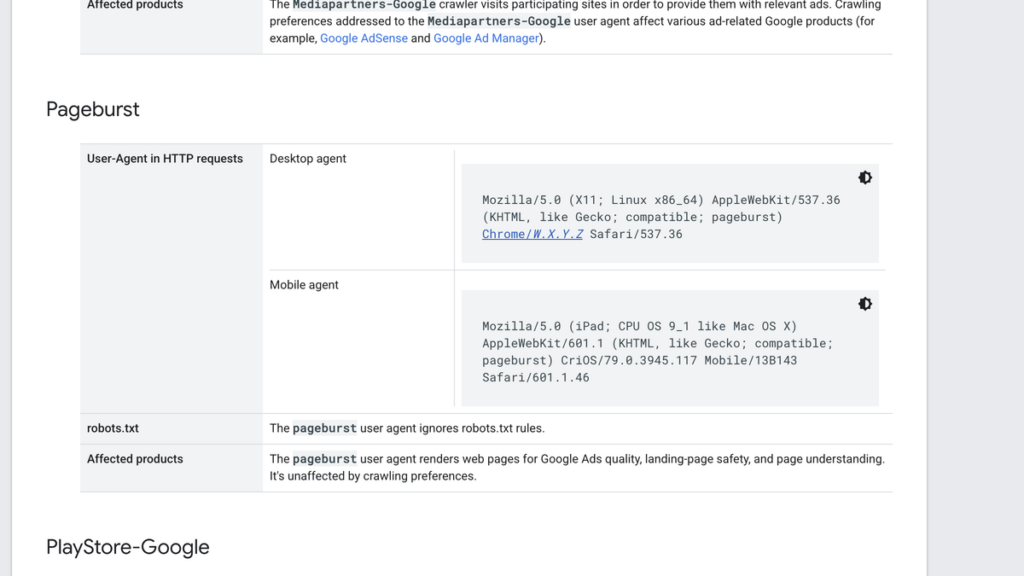
Google added 12 user agents to its crawling documentation on 23 November 2026. Six went into the special-case crawler list, and all six of those entries say the agent ignores robots.txt rules. pageburst is the one most likely to turn up in a publisher’s log. The other five are Google-analytics-postbacks, Google-Calendar-Importer, GoogleDocs, Google-Edu and PlayStore-Google.
A robots.txt rule written to keep these six out does nothing at all. None of them reads the file.
Google’s changelog is clear that nothing new started crawling. The entry says these clients are “not new”, and that the update documents “existing high-volume clients that are more likely to show up in server logs and that we’ve received questions about”. If a Chrome request has been hitting the same page of a client site week after week, this list is where its name probably is. Search Engine Journal reported the change on 26 November 2026.
What each of the six special-case crawlers fetches
All six belong to a Google product rather than to Search, and that is the detail that decides whether you care. A pageburst request is Google Ads judging a landing page. A GoogleDocs request is somebody’s spreadsheet pulling a table off your site. Neither has any bearing on how the page ranks.
| Crawler | What it fetches | robots.txt |
|---|---|---|
| Google-analytics-postbacks | Attribution postbacks from Google Analytics to ad network endpoints when a conversion fires | Ignored |
| Google-Calendar-Importer | External calendar feeds in .ics format that Calendar users have subscribed to | Ignored |
| GoogleDocs | Sheets functions such as IMPORTHTML that fetch a URL typed into a cell | Ignored |
| Google-Edu | Institutional domains submitted by admins applying for Workspace for Education | Ignored |
| pageburst | Pages rendered for Google Ads quality, landing-page safety and page understanding | Ignored |
| PlayStore-Google | Developer links in Play Store app listings, fetched and validated | Ignored |
pageburst looks like an ordinary Chrome visitor
Google lists two pageburst strings. The desktop one identifies as Chrome on Linux. The mobile one identifies as Chrome for iOS on an iPad. Both carry the word pageburst inside the standard browser parenthetical, and neither contains the string Googlebot. A log filter looking for Googlebot sees a Chrome visitor and moves on.
The product line under that entry says pageburst renders pages for Google Ads quality, landing-page safety and page understanding, and that it is “unaffected by crawling preferences”. That second part is the half worth keeping. There is no preference, no verification setting and no Search Console control that changes what it does. The request either gets served or gets refused.
Google does not say what happens when a site refuses the fetch. The page goes as far as describing what pageburst is for and stops there. A site that 403s it is guessing about the consequence, and so am I.
AdsBot is the ad crawler you can actually address
The ad side is not uniformly unmanageable. AdsBot-Google, AdsBot-Google-Mobile and Mediapartners-Google each publish a robots.txt token, so a publisher can address them by name and set rules per directory. That is the difference between the older ad crawlers and the six added on 23 November. Three can be named in robots.txt, and the six new entries cannot be named at all.
How to prove a request is really from Google
Google publishes the ranges in special-crawlers.json, and the copy I read carries a creationTime of 24 November 2026, the day after the changelog entry. Requests from these crawlers resolve backwards to the rate-limited-proxy mask on google.com. Google also warns on the same page that a user agent string can be spoofed, which is the reason to check the address before acting on the name. I would match the address against the published ranges first and treat the string as a hint.
The other six entries were fetchers, and one was moved
The same changelog entry added six user-triggered fetchers: AppEngine-Google, Google-Apps-Script, Google-Cloud-Tasks, GoogleImageProxy, Google Web Preview and Chrome-Lighthouse. Those are requests a person set off, such as opening an email with a remote image or running a speed audit, so they generally ignore robots.txt too. Google Image Proxy, for instance, fetches images inside Gmail messages so the sender cannot see your address.
APIs-Google was moved out of the special-case list and into the fetchers, and its documented string was corrected with a missing character after the name. Google says anyone who hardcoded the old value should update it. The move also changes the blocking story, because the fetcher range is now where its webhook pushes come from.
What I would do with this on a client site
- Grep the access log for pageburst across a full week before deciding anything. One day of log is noise.
- Keep robots.txt for the crawlers that read it. Adding pageburst to that file makes the list look thorough and changes nothing.
- If a client insists it stays out, refuse it at the address range in special-crawlers.json and note the date, so the decision can be reversed.
- Leave the ranking worry alone. None of the six is a Search crawler, so serving or blocking them does not move a page.
- If paid traffic quality shifts in the weeks after a block, check the block early. That is the one place this could surface.
Twelve agents that have been in logs for months became nameable this week. That is the whole of the change, and it is worth an hour once, because a request you cannot name is a request you cannot rule out.
Two of the checks I use for unnamed crawlers are in 3 Checks Prove a Request Comes From Google-Agent and in United Blocks 3 Kinds of AI Agent and Still Lets Googlebot In. The blocking decision itself sits in Before You Point DNS at a CDN, Run These 3 Steps, which is the piece I send people when a CDN starts refusing crawlers. Everything on crawlers, indexing and logs sits in the search and SEO hub.
Also read:
- 3 Checks Prove a Request Comes From Google-Agent
- United Blocks 3 Kinds of AI Agent and Still Lets Googlebot In
- Before You Point DNS at a CDN, Run These 3 Steps
Sources: Google’s crawling documentation changelog for 23 November 2026, Google’s list of special-case crawlers, Google’s list of user-triggered fetchers, and Search Engine Journal’s report of 26 November 2026.