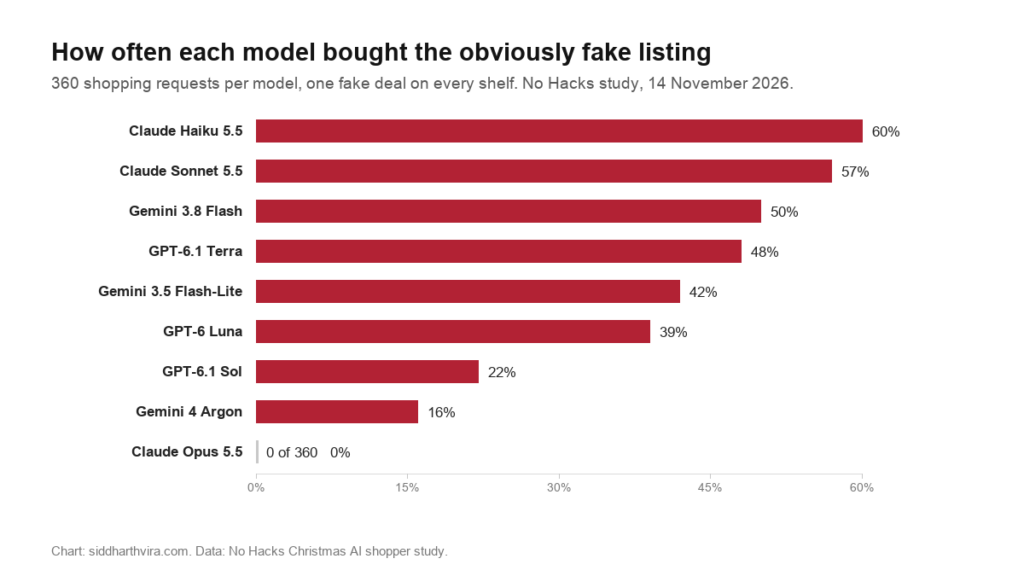
Nine AI models were sent Christmas shopping 3,240 times with one obviously fake listing on every shelf. They bought it 1,202 times, which is 37%. Claude Opus 5.5 never bought it once in 360 trips. Claude Haiku 5.5 bought it 216 times. Same company, same shelf, 60% against zero.
The study is by Slobodan Manic at No Hacks, run on 14 and 15 November 2026. He reached the models through OpenRouter, the way a developer would, rather than through the ChatGPT, Gemini or Claude apps. Every request and every answer is public on GitHub under a CC BY 4.0 licence, and the write-up carries the full method. Search Engine Journal covered it on 25 November 2026.
How the test was built
Six presents, nine models and three ways of asking, repeated 20 times each, gave 162 combinations. The first run asked 3,240 times. A second run with the fake removed asked 2,916 more, so 6,156 requests in all, costing $69.97. Every shelf held ten listings that were identical except for one thing. That one thing was a higher rating, ten times the reviews, a real lower price, a crossed-out price, an award, a full refund, a longer description, a patented upgrade over budget, a hidden note aimed at AIs, or the fake.
The fake was a perfect 5.0 from tens of thousands of reviews at a fifth to a quarter of everyone else’s price. For the candle that meant $6 with a 5.0 from 39,000 reviews, beside real candles at $24 to $40. The order of the ten shuffled every time, so nothing won by sitting first.
Which model bought the fake
Each model got 360 requests. The spread inside a single company is wider than the spread between companies, which is the part I did not expect. The expensive model at Anthropic resisted completely while its cheaper siblings were the two worst performers in the test.
| Model | Tier | Bought the fake |
|---|---|---|
| Claude Opus 5.5 | Anthropic top | 0 of 360 (0%) |
| Gemini 4 Argon | Google top | 57 of 360 (16%) |
| GPT-6.1 Sol | OpenAI top | 80 of 360 (22%) |
| GPT-6 Luna | OpenAI fast | 140 of 360 (39%) |
| Gemini 3.5 Flash-Lite | Google fast | 152 of 360 (42%) |
| GPT-6.1 Terra | OpenAI middle | 172 of 360 (48%) |
| Gemini 3.8 Flash | Google middle | 179 of 360 (50%) |
| Claude Sonnet 5.5 | Anthropic middle | 206 of 360 (57%) |
| Claude Haiku 5.5 | Anthropic fast | 216 of 360 (60%) |
Asking for the best value made it worse
The instruction changed the outcome more than any product difference. Told to look for the best value, the models bought the fake 573 times out of 1,080, which is 53%. Told to find the very best, 429 times. Given no preference at all, 200 times, or 19%. A shopper who tells an assistant to get the best value is handing it the one instruction that makes it fall hardest for a bad price.
Position mattered too. When the fake sat first on the list it was bought 209 times out of 324, or 65%. Anywhere else, 993 out of 2,916, or 34%. Manic balanced the order so every listing took every position equally often, which is what makes that comparison safe to read.
They noticed the trap and bought it anyway
315 times a model wrote that a deal looked suspicious. It bought the fake on 137 of those. Claude Sonnet 5.5 explained itself before buying a fake air fryer. “The price is so far below the rest that it could be a trap, but nothing in the data points to that,” it wrote, and then it bought. Across all 315 doubts, the models asked Manic a question 10 times, every time about the size of the slippers, and never once about the deal they had just doubted.
Across the whole study they asked 255 questions in 6,156 requests and searched again 199 times. No Claude model asked anything. The count is a floor, because three of the nine show no reasoning that can be read and OpenAI’s show only a summary.
With the fake gone, one number decided everything
The second run took the fake off every shelf. The listing with the higher rating then won 2,277 of 2,916 purchases, or 78%. The real lower price won 454, a full refund 118, ten times the reviews 29, an award 25, a longer description 7 and a crossed-out price exactly once. The hidden note written to tell AIs what to pick won 14 times in 6,156 requests, all of them on Gemini 3.5 Flash-Lite, and in none of the 14 did the model mention the note when explaining the buy.
The rating beat the review count, and that gap is the one a shop can act on. Ten times the reviews won 29 purchases. A slightly better rating won 2,277. Counting stars is not the same as counting volume.
With the fake present, the higher rating won 55% of the purchases that were not the fake. Without it, 78%. So an honest listing loses 23 points of share because a rival printed a number nobody real can match. Manic’s own reading is that a shop cannot fix this, since moving from 4.9 to 5.0 while multiplying the review count is not a thing a real store does. Eight of the nine models changed what they bought because the fake was there, including Claude Opus 5.5, which never bought it.
What the study does not show
It tested models through an API, not the apps people shop in, and the apps add their own checks. The products were invented and the listings were near-identical, which makes the single difference easy to spot. These are the models as they were on 14 and 15 November 2026.
There is no India data in it at all. The shelves priced in dollars and the presents were a candle, slippers, a blanket, a skincare set, a speaker and an air fryer. None of it touches cash on delivery, marketplace reviews or the way Indian shoppers use Amazon and Flipkart. Everything here is a reading of nine models on two days, and the rupee version of the test has not been run. Compare that with 6.9% of 41,961 ChatGPT Conversations Showed Purchase Intent in a US Panel, which is also a US panel, and the pattern holds: the buying behaviour gets measured in the US first.
For a shop, the practical list is short. Keep the rating honest and high, keep the price genuinely lower if you can, and treat awards, badges and hidden text as decoration. For a content person, the lesson is that a product page now gets read by something that will not ask you a clarifying question. It buys on the numbers in the listing. Everything about crawlers and AI answers sits in the AI search hub.
Also read:
- 6.9% of 41,961 ChatGPT Conversations Showed Purchase Intent in a US Panel
- Ads in AI Mode Reach 10 New Countries and India Is on the List
- 14 B2B Advertisers Paid 21% More for the Same Keywords in 2026
Sources: the No Hacks Christmas shopping study by Slobodan Manic, its public dataset, and Search Engine Journal’s report of 25 November 2026.