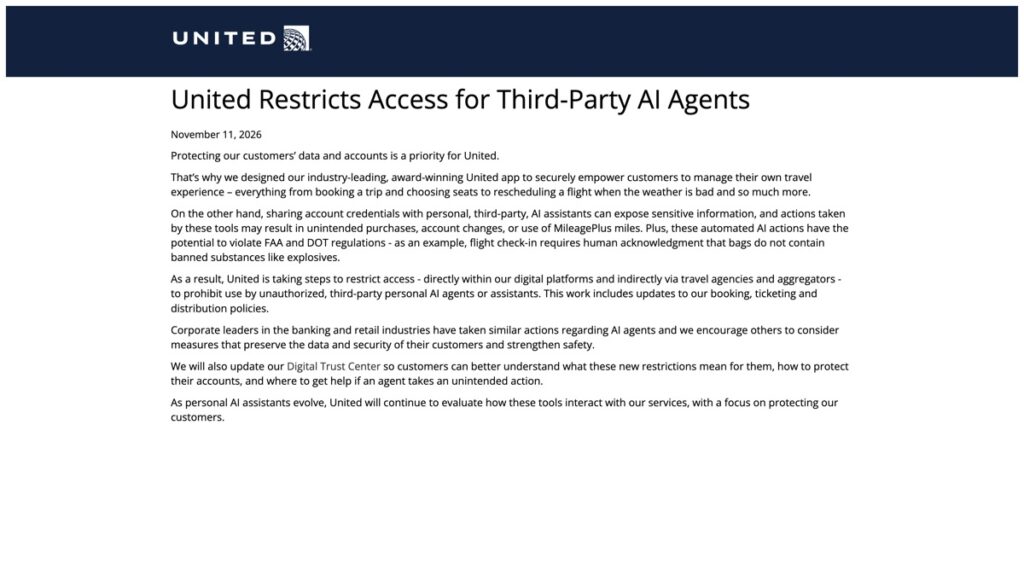
On 11 November 2026 United Airlines changed its website terms so that search engines may keep indexing united.com while any AI agent that searches, books or buys needs written permission first. The airline put that rule in its terms and its contract of carriage, not in robots.txt. That choice is the part other site owners should copy, because robots.txt can only name an agent that has a name.
What United changed on 11 November
United published a release called United Restricts Access for Third-Party AI Agents on 11 November 2026. It prohibits unauthorised third-party personal AI agents on its own platforms and, indirectly, through travel agencies and aggregators. The company says the change covers its booking, ticketing and distribution policies.
The terms split a site’s traffic into three groups, and only the first one is welcome.
- Search engines that index public pages keep that right, and standard browsers and assistive technology are exempt.
- Any automated agent that searches, books, buys or manages a booking needs prior written permission, including assistants a person supervises.
- Data pulled from the site or app cannot be used to train, fine-tune, ground, evaluate or develop an AI model.
Indexing is allowed and acting is not
The contract of carriage carries the rule further than the website does. United’s passenger agreement now lists bookings made, changed or serviced by an AI agent among the ones it can cancel without notice, and it applies to agents that a travel agency connects to United on a customer’s behalf. That is how a website term becomes a distribution policy.
That is the whole idea in one boundary. A crawler reading a page is a different act from a program pressing a button on that page, and United now sells the first while refusing the second. Search Engine Journal read the terms on 14 November and found the file naming no AI crawler for any agent, so the restriction lives in contract language rather than in a crawler directive.
This matters because the alternative was never available. A robots.txt rule works by naming a user agent, and a personal assistant that acts for one shopper has no stable user agent to name. I wrote about that gap when Cloudflare tried to separate ChatGPT’s crawler from everyone else, and again when Brave’s licensed index arrived under a crawler with no name. A terms clause binds the shopper who accepted it, which is why it reaches places a crawler rule cannot.
Grounding is the part that catches people out
Training and fine-tuning were expected. Grounding is newer in this kind of clause, and it is the step where an AI system pulls a live page into an answer to support what it says. Ban or license that, and you are ruling on citation and not only on copying. A site that wants AI answers to quote it has to think about which side of that line it sits on.
The safety argument in the release is concrete. United says automated actions can break FAA and Department of Transportation rules, and gives check-in as the example, since a person has to confirm that a bag holds nothing banned. That is a specific regulatory reason, and it is stronger than a general claim about protecting data.
There is a practical consequence for anyone publishing product data. A price, a seat map or an availability calendar is the most useful thing an assistant can lift from a page and the most expensive thing to hand over for free. United drew its line around exactly that material.
Amazon and eBay put the same clause in first
United is joining a pattern rather than starting one. Amazon blocked Meta’s Muse agent in September 2026 under Conditions of Use that bind the shopper rather than the agent maker. eBay added buy-for-me agents and LLM-driven bots to its User Agreement in an update posted in January. Three companies, one method, and the method is contract text.
| Company | What it restricted | Where the rule lives |
|---|---|---|
| Amazon | Meta’s Muse agent shopping on its behalf | Conditions of Use, September 2026 |
| eBay | Buy-for-me agents and LLM-driven bots | User Agreement, update posted in January |
| United | Agents that search, book or buy, plus use of its data for models | Website terms and contract of carriage, 11 November 2026 |
What a small site should copy from this
Most of us are not airlines, and the useful part is the shape rather than the scale.
- Write a definition of an automated agent in your terms that covers software a person supervises, because supervised is the normal case in 2026.
- Separate reading from acting. Let crawlers index, require permission for anything that submits a form, holds an account or changes a booking.
- Check that robots.txt, the terms and the bot protection on your server agree, because a page allowed in one place and blocked in another is how you get a mystery traffic loss.
- Date the change and keep the old version, so a client or a lawyer can see what applied when.
What United has not explained
Nothing in the release, the terms or the contract says how United detects an agent, which is the question that decides whether the rule does anything. The airline also says it works with no third-party AI agents today, and bookings an agent made before 11 November will not be cancelled. Chief executive Scott Kirby gave the plain version at an event in Chicago, as the Wall Street Journal reported, when he said he does not want to create another middleman.
That sentence is the honest summary of the whole trend. A company that has just watched a decade of traffic move into other people’s interfaces is protecting the one place where a customer still types its name. The AI Search and Getting Cited hub collects the rest of the material on this, including the shared robots.txt opt-out that Google, Microsoft and OpenAI backed in October, and why most blog posts never get cited in the first place.