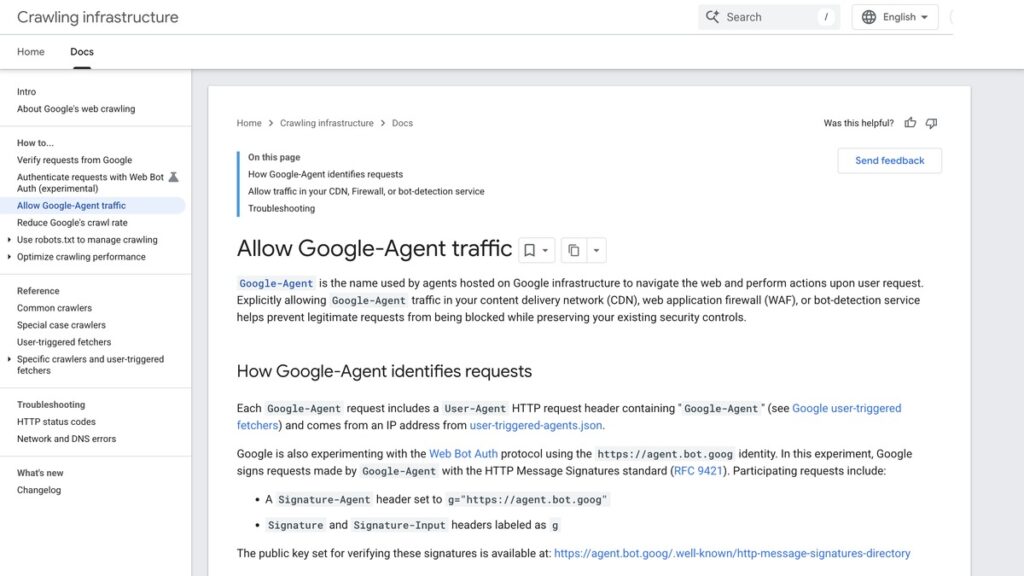
Google published a page on how to allow Google-Agent traffic, and it lists 3 signals that prove a request is really Google’s agent. Two of them are live today. The third, a cryptographic signature, is still an experiment.
If your firewall only checks the User-Agent string, you are trusting the one header any scraper can type. Google’s own documentation says so by putting the IP range and the signature check next to it.
What Google-Agent actually is
Google-Agent is the name for agents hosted on Google’s infrastructure that navigate websites and perform actions when a user asks them to. The documentation sits under Google’s crawling pages, next to the crawler and fetcher lists.
The page never says which Google products send Google-Agent traffic. Search, AI Mode and Gemini are not named on it, and Search Engine Journal checked the same gap on 23 November 2026. That silence matters, because it means a site owner cannot work out how much of this traffic to expect from the product list alone.
The 3 checks, strongest last
Each Google-Agent request carries a User-Agent header containing the string Google-Agent, and it comes from an address listed in Google’s file of user-triggered agent ranges. Those two are the baseline check everywhere.
| Signal | What it proves | What it does not |
|---|---|---|
| User-Agent contains Google-Agent | Nothing on its own | Any script can send that string |
| IP is in user-triggered-agents.json | The request left Google’s network | Whether the user asked for it |
| Signature under Web Bot Auth | Google signed this exact request | Anything, while it is experimental |
The signed path is the interesting one. Google is testing the Web Bot Auth protocol with the identity https://agent.bot.goog, signing requests with HTTP Message Signatures, the standard known as RFC 9421. A participating request carries a Signature-Agent header set to g="https://agent.bot.goog", plus Signature and Signature-Input headers labelled g. The public keys sit at a well-known JSON URL on the same host.
Google’s instruction for a verified request is short. Skip the bot challenges. Do not send a CAPTCHA to something you have just proved came from Google.
5 reasons an allow rule still fails
The troubleshooting section is the part most people will need, because an allow rule that sits under a broad block does nothing. Google lists five things to check, and I have kept their order.
- Priority. The allow rule has to evaluate before cloud or data-centre ASN blocks, managed bot rules and category-level AI agent blocks, or one of those overrides the verified result.
- Interactive challenges. A rule that skips HTTP blocks can still fire an in-page CAPTCHA widget on search or on a form submission.
- The rest of the journey. Allow it beyond the homepage: on-site search, filters, detail pages, add to cart, booking, and the XHR, GraphQL or api subdomain calls underneath them.
- Shared IP limits. Many users share one egress pool, so a per-IP rate limit will trip on traffic that is behaving correctly.
- Stale ranges and stripped headers. Keep the IP list synced with the JSON file, and check that load balancers pass the original client IP, the User-Agent, and the Signature headers when they are present.
What I would change on a site this week
Three things, all cheap. Pull the agent IP file into whatever your WAF reads, and diff it against what is there now. Then open one real user journey on a phone and watch the firewall log while a search, a filter and a form submit go through, because that is where allow rules usually stop. Then take CAPTCHA off the verified path only, and leave it everywhere else.
The order matters more than the settings. A site that blocks first and verifies later reads a verified agent as an attack, and the fix is not a wider blocklist. It is moving the allow rule above the block.
Why a site should care at all
An agent that finishes a booking or an add to cart is a visitor that did the work for its user. If your defences stop it at the third page, the visit still counts as a session and nothing converts. That is a quieter loss than a ranking drop and it is much harder to see in analytics, because the traffic looks like a bounce.
The same question runs through the rest of the AI search hub, where the crawler, citation and measurement posts sit together.
Also read:
- United Blocks 3 Kinds of AI Agent and Still Lets Googlebot In
- Before You Point DNS at a CDN, Run These 3 Steps
- Brave Sells 30 Billion Pages to AI Companies, and Its Crawler Has No Name
- Google, Microsoft and OpenAI Back a Shared robots.txt Opt-Out for AI Training
Sources: Allow Google-Agent traffic, Google Crawling Infrastructure documentation, and Google Publishes Guidance For Google-Agent Crawler, Search Engine Journal, 23 November 2026.