Thirty-eight studies have now measured how brands appear in AI answers. Five of them explain how they chose the questions they ran. One more came close, building its prompts from high-volume search keywords. That ratio is the first thing I would check before trusting a visibility score, including one of my own.
A score looks solid because it is a number. What sits behind it is a list of prompts somebody wrote in an afternoon, and almost nobody writes down why each line earned its place.
What the review actually read
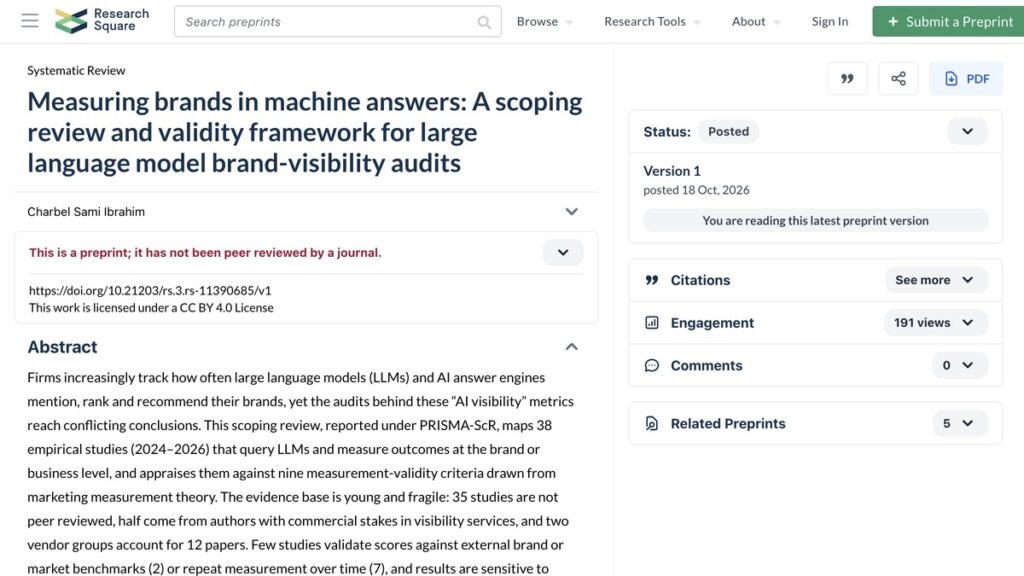
The review is a scoping review posted on ResearchSquare and reported under PRISMA-ScR, the checklist for this kind of map of a literature. It covers 38 empirical studies published between 2024 and 2026 that query a language model or an answer engine and record the outcome at the level of a brand or business.
The age of that evidence base is the first thing to know. Thirty-two of the 38 are from 2026. Three appeared in peer-reviewed proceedings, all at one computational linguistics venue. The other 35 are preprints, working papers or technical reports.
Nineteen of the 38 were written by people who sell visibility services, or whose own employer is one of the brands measured. One author affiliated with a vendor contributed eight papers and one vendor team contributed four, so two groups account for roughly a third of the field.
Five studies wrote down how they picked the prompts
Five studies justified their prompt source with something a reader could check. The review lists what they did. Persona-based generation with manual verification. Systematic paraphrase variation. Question sets translated and back-translated across languages. One further study built its prompts from high-volume search keywords, which the review calls the closest any of the 38 came to sampling real buyer questions.
Most of the rest wrote prompts by hand or had a model generate them, with no evidence the questions match what a buyer would type.
| What the review checked | Studies that passed |
|---|---|
| Prompt source justified with a sampling strategy | 5 of 38 |
| Prompts drawn from real search demand | 1 of 38 |
| Score validated against an outside benchmark | 2 of 38 |
| Measurement repeated over time | 7 of 38 |
| Authors selling visibility services | 19 of 38 |
None of that makes the numbers fake. It makes them local. A score built from a list nobody can trace is a measurement of the list.
A precise score can still be undefined
Sixteen of the studies measured inclusion, which is whether the brand appears at all. The same label covered at least three different denominators: the share of all answers, the share of runs for one prompt, and the share of prompts where the brand shows up at least once. Those are not interchangeable numbers, and a dashboard rarely tells you which one it is drawing.
Wording moves the result on its own. In one cited experiment, prompts asking for the most popular or best selling cola handed the major brands 56 to 68 per cent of the mentions, an answer the question partly asks for. A list built that way will show an incumbent winning and call it a finding.
Time is the other gap. Twenty-nine of the 38 measured once. Only seven repeated the measurement, and those seven are the ones that can separate drift from noise. One of them put the conversion from mention to recommendation at 25 to 41 per cent for category leaders and 37 to 52 per cent for challengers, so the two stages of an answer behave differently.
Then there is extraction. Brand-name matching inflated one firm’s count about sevenfold before somebody corrected it, and that error sat in a published number.
The method for this was written down in 1995
Grüninger and Fox at the University of Toronto built a methodology for designing ontologies as part of the TOVE project, and presented it at an IJCAI-95 workshop. Their page still lists the steps. Define the motivating scenarios. Write the informal competency questions the model must answer to support those scenarios. Define the terms in first-order logic. Restate the questions formally. Add the semantics and constraints.
A competency question is a requirement, written before the thing is built and used afterwards as the test. Duane Forrester, writing on Search Engine Journal on 26 November, traced that lineage into prompt tracking and pushed it one step further. The prompt is a test case. The competency question is what the test is for, so twenty phrasings of one question are still one requirement.
The sheet I would ask for
Start with ten questions rather than three hundred prompts. Each one gets four columns before anybody opens a tool.
- The situation. A real moment where somebody needs the answer, written as a sentence.
- The question, in the words a buyer would use.
- The expected answer, short enough that it can be called right or wrong.
- The owner. One person who will say the expected answer is correct.
Then run two tests in a fixed order. Check your own content first, because that test ends in a yes or a no and the fix is yours. Only then ask the model, in three to five phrasings, several times, and write down how often the expected answer came back. Two of those questions should be negative, asking for something you do not offer, because an answer that credits you with the wrong service is the expensive kind.
What this changes if you are buying the report
Ask for the prompt list and the person who owns each expected answer. A seller who cannot produce both has measured a market they invented, and you will get a trend line for it next month.
Most of my AI search work sits under AI Search and Getting Cited, and the extraction problem behind most missing citations is in Why Your Blog Posts Never Show Up in AI Answers.
Also read:
- 4 Things Google’s Sleep Paper Changes About Tracking AI Answers
- 58 Per Cent of Bing AI Citations Went to Pages No Content Team Was Writing For
- 4 Checks Before You Change a Page That Lost an AI Citation
Sources: the scoping review at doi.org/10.21203/rs.3.rs-11390685/v1, the Grüninger and Fox method page at the University of Toronto, and Duane Forrester’s 26 November piece on Search Engine Journal.