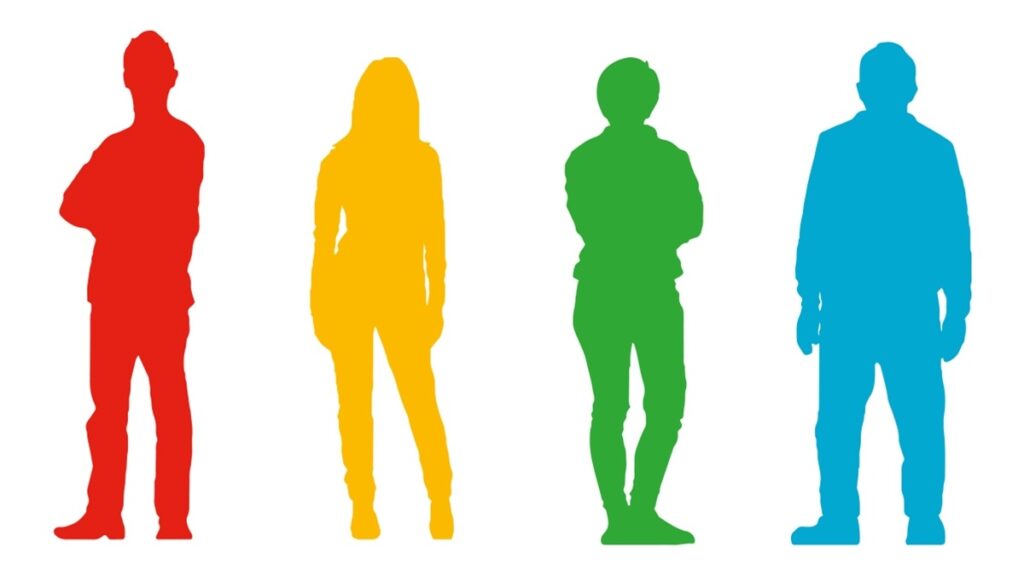
The four colours personality test in Surrounded by Idiots sorts people into red, yellow, green and blue, and those colours are the DISC words with paint on them. Red is dominance, yellow is influence, green is stability, blue is compliance. Nobody is one colour only. The label describes how someone behaves in a room, and it changes with the room.
The short version, in one table
Read the table as a set of working guesses. Red pushes for a decision, yellow pushes for a reaction, green protects the relationship, and blue protects the accuracy. Each one is doing something sensible under the surface, and each one drives the other three up the wall at some point in the week.
The table scrolls sideways on a phone.
| Colour | At work | Stressed by | How to talk to them |
|---|---|---|---|
| Red | Sets the target, cuts the debate, takes responsibility for the outcome | Slow answers, meetings with no decision, being second-guessed | Lead with the decision you need and the time you need it by, then the reason in two lines |
| Yellow | Starts conversations, pitches ideas, keeps morale up in a bad week | Working alone for days, silence, forms and trackers | Give them the room to talk, then send the agreement in writing the same day |
| Green | Holds the team together, absorbs pressure, stays loyal to people | Sudden changes, public disagreement, a manager who shifts the plan weekly | Ask in a small setting, give notice before change, and make it clear that nobody is in trouble |
| Blue | Checks the numbers, finds the error, keeps the writing honest | Vague briefs, guesses, anyone who says it is roughly fine | Bring the data, name the assumption, and say what would change your mind |
Red at work
Red walks into a review with the decision already made, and the meeting exists to confirm it. That can look arrogant from the outside. From the inside it feels efficient, because a room full of half-decisions wastes everyone’s afternoon. What stresses a red is being slowed down without a reason they can see.
Talk to a red with the headline first. Put the ask in the first line of the message, put the deadline next to it, and leave the background for a thread they can ignore. If you disagree, disagree with a number or a date attached, because a red hears a case and not a feeling.
Yellow at work
Yellow is the person who makes a bad quarter bearable. They open the meeting, they bring the client into the conversation, and they will happily talk through an idea that does not exist yet. The risk sits in the gap between the energy and the follow-through, and everybody who has worked with a yellow has a story about a promise made in a corridor.
Talk to a yellow with warmth and a short leash. Let them talk first, because cutting them off early costs you the idea. Then write the agreement down and send it within the hour, while the enthusiasm is still real.
Green at work
Green is the one who notices that the team has not eaten and that the new joiner has said nothing for forty minutes. They absorb a lot of other people’s stress and rarely announce it. What stresses a green is abrupt change, especially change announced in a group where they cannot ask a question without an audience.
Talk to a green one to one, in advance, with the reason attached. Give them time to think before you ask for a view. Silence from a green is not agreement, so ask a second time and wait for the reply.
Blue at work
Blue reads the annexure. They will find the broken formula in row 63 and mention it quietly, and they will keep finding it after you have stopped being grateful. What stresses a blue is a brief that could mean three different things and a manager who treats a guess as a fact.
Talk to a blue with evidence and a stated tolerance. Tell them what is being decided, what accuracy is good enough, and when the answer is needed. A blue will accept a rough estimate if you say it is one and say why.
Where the colours come from
The letters come from a theory William Moulton Marston published in 1928 in Emotions of Normal People. He described four behaviour types, dominance, inducement, submission and compliance, and he never built a test around them. Later organisations built the assessments, which is why DISC tools vary so much from one vendor to the next.
The honest caveat: the science is thin
This is a communication shortcut and not a diagnosis, and the research record says so. Wikipedia’s entry on DISC assessment describes the tools as pseudoscientific, with no demonstrated validity. A 2013 German review of one DISC instrument, Persolog, found it largely met reliability standards and did not meet validity standards. A 2003 study in the Scandinavian Journal of Psychology found acceptable internal consistency but concluded the DISC dimensions were not independent and fitted better as combinations of the Big Five traits.
None of that makes the four colours useless in a meeting. It does change what you can claim. A colour is a hypothesis about how someone likes to receive a message, and one meeting is a sample of one. Treat a wrong guess as a wrong guess and move on.
Three rules I use
- Watch behaviour, not the person. Colour the action in front of you, not the human being.
- Say the guess out loud only when it helps. Nobody wants to be sorted in a team call.
- Change your own delivery first. That is the only part you control, and it usually moves the conversation.
If you want the wider argument, the Surrounded by Idiots summary covers the five points the book makes. The first ten minutes page turns the table above into signals you can actually watch. And when the model gets something wrong, the criticism page is where I have put it.







Pingback: Surrounded by Idiots: What Thomas Erikson Actually Says - Siddharth Vira