Professor Snape referees Gryffindor’s Quidditch match against Hufflepuff in chapter 13 of Philosopher’s Stone. Harry spends the week before it convinced the man wants him dead, plays anyway because the team has no reserve Seeker, and catches the Snitch in five minutes. Chapter 17 explains the whistle. Snape wanted to be up where he could watch the crowd for whoever was cursing Harry. The 2001 film stages one match, at the start of November, and the referee never enters it.
That gap is worth a post because the referee chapter does three jobs at once, and the film had to give all three up.
The whistle arrives halfway through the book
Wood tells the team who is taking the match, and Harry’s reaction has nothing to do with Quidditch. He has already decided that Snape tried to kill him in November, so a teacher with a whistle and a view of the whole pitch is the worst arrangement he can imagine. The Lexicon pulls out the one line that carries the scene.
“Which was all very well, thought Harry, but he had another reason for not wanting Snape near him while he was playing Quidditch….” Harry, chapter 13, as transcribed on the Harry Potter Lexicon page for Nicolas Flamel
The stakes sit in the same chapter. A win over Hufflepuff takes Gryffindor above Slytherin in the house championship for the first time in seven years. Harry tells Hermione he cannot pull out either, because there is no reserve Seeker and Gryffindor would forfeit. So an eleven-year-old flies a match with a teacher he believes is hunting him, because the alternative is letting the team down.
Chapter 17 gives the whistle a reason
Dumbledore takes Harry’s theory apart in the hospital wing, in two moves. He says Snape was muttering a counter-curse during the first match, trying to save him, and then asks the question Harry never asked himself.
“Why do you think he wanted to referee your next match?” Dumbledore, chapter 17, Harry Potter Lexicon
The other half of the answer comes from Quirrell in the final chamber, who admits the broom was his work and says one line about how close it came. Put the two together and the referee job is protection, not ambush. Snape could not guard Harry from the staff seating, so he took the only job that put him in the air with a view of the crowd.
It is also a poor plan, and the Lexicon says so. If Snape knew who was cursing the broom, the sensible move was to tell Dumbledore and let the headmaster deal with it. Instead he turned it into a private contest with Quirrell and kept the evidence to himself. That is a character note rather than a strategy, and it is the sort of thing a book can afford to leave unresolved for a hundred pages.
The match itself lasts five minutes
Gryffindor wins almost immediately. Harry catches the Snitch after five minutes, which makes this the shortest match in the book and the only one where nothing athletic happens. The moment that reads as a clue is a penalty Snape gives Hufflepuff for no visible reason. The Lexicon’s note on chapter 17 takes that at face value, as the behaviour of a man watching the crowd instead of the game.
A referee who gives away a penalty he cannot justify is a referee watching something else. Nobody in the stands can see that. Harry certainly cannot, and the chapter is told from his side of the pitch, which is why the reader ends it more suspicious than they started.
What the 2001 film does with the same suspicion
The film builds Snape as the suspect inside a single match. Ron and Hermione see him muttering and act on it, which Wikipedia’s plot summary of the film records as Snape appearing to jinx Harry’s broomstick. That is the same evidence with the explanation removed, and it works on screen, because a film needs a suspect in the first hour and cannot spend twenty minutes on a second match nobody is asking for.
| What happens | Philosopher’s Stone (book) | The 2001 film |
|---|---|---|
| Matches Harry plays | 2, against Slytherin and Hufflepuff | 1, against Slytherin |
| Who referees the second one | Professor Snape | The second match is not filmed |
| How the second one ends | Snitch caught after five minutes | No equivalent scene |
| Snape during match one | Muttering a counter-curse, per chapter 17 | Muttering at the broom, which looks like a jinx |
None of this is a complaint about the film. Its version is tighter, and a viewer who loves it is not missing a plot point. What a viewer misses is the shape of the trick, because the book lets Harry be wrong about Snape for five chapters and gives him a referee to be wrong about. The film compresses that into one bad look from the stands.
A weekly series has the room for it
The show arrives on 25 December 2026 with the opposite problem. It has a term to fill and a character to build across it, and the referee chapter is cheap to shoot and expensive to replace. It gives Harry a reason to hate a man who is protecting him. It gives Snape a public job that looks like an ambush. It puts a crowd and a height between them so neither can see what the other is doing.
A scene that does three jobs in one chapter is what a long series is short of. The film could drop it and lose a beat. A series that drops it has to invent something else to keep Snape suspicious for six more hours, and invented suspicion is where adaptations usually go wrong.
So Harry plays a match with a teacher he thinks is hunting him, wins it in five minutes, and gets the correction eleven chapters later. Take the whistle out and the correction has nothing to reverse.
The Movies and TV hub holds the rest of the Harry Potter writing, including the chapter pieces from earlier this week.
Also read:
- The 2001 Harry Potter Film Keeps the Troll and Drops the Bad Blood
- The Philosopher’s Stone Film Cuts the 7-Bottle Riddle Only Hermione Solves
- Quidditch Rules: 7 Players, 4 Balls and 1 Catch That Ends It
Sources: the Harry Potter Lexicon chapters 13 and 17 at hp-lexicon.org, and Wikipedia’s plot summary of the 2001 film.
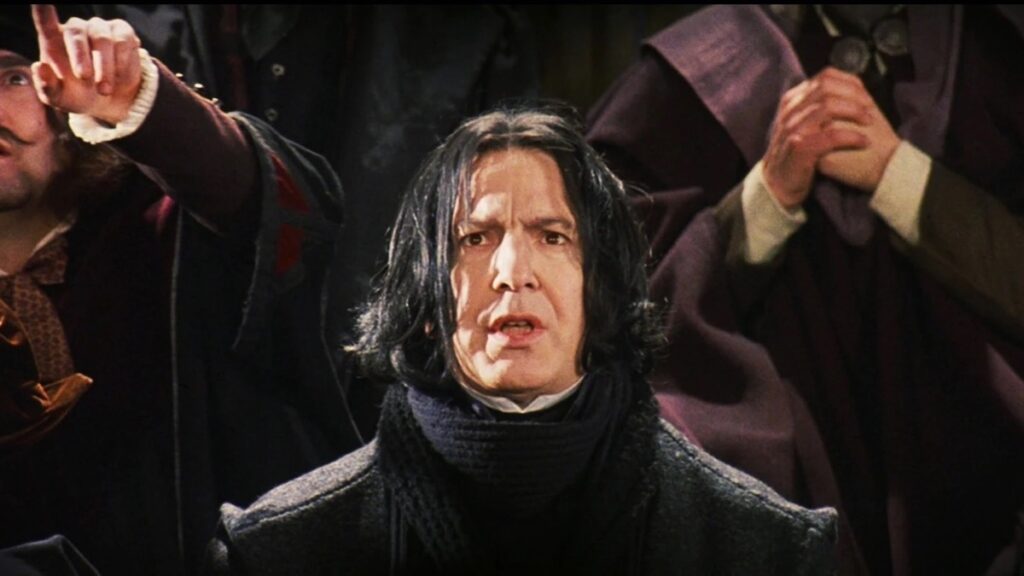
Image: Alan Rickman as Severus Snape in the 2001 film, in the stands at the first Quidditch match. Still via the Harry Potter Wiki.