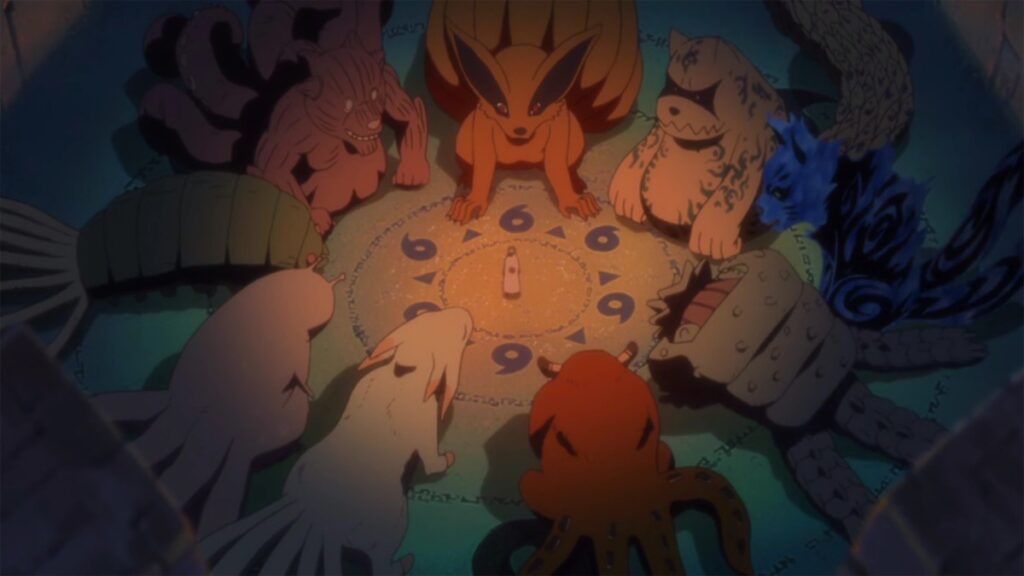
Naruto’s nine tailed beasts are not a power ladder. They are one creature cut into nine pieces, and the tail count is the label the Sage of Six Paths gave each piece. That single detail explains the order, the jinchūriki who carried them, and why killing a beast in this story never quite works.
The manga ran from 21 September 1999 to 10 November 2014 across 72 volumes, and the tailed beasts carry most of its late reveals. Here is the list in order, the host each one is shown with, and the rule underneath both.
The 9 Were 1 Beast First
The Sage of Six Paths sealed the Ten-Tails inside himself, then divided its chakra into nine living entities. The wiki cites chapter 510 for the division and chapter 467 for the Sage explaining it to the beasts he had just named.
So the numbering is a filing system. A beast with more tails is not automatically the better fighter, and the story is careful about this. Shukaku, the one-tail, is the loudest and the least stable of the nine. Kurama, the nine-tail, spends its first appearances losing to a Sharingan.
The Order and the Jinchūriki
The wiki lists the beasts by tail count, from one to ten, with the Ten-Tails last. These are the nine that came out of the split, with the host each one is shown with in the manga.
| Tails | Beast | Jinchūriki shown in the manga |
|---|---|---|
| 1 | Shukaku | Gaara |
| 2 | Matatabi | Yugito Nii |
| 3 | Isobu | Rin Nohara, later Yagura Karatachi |
| 4 | Son Gokū | Rōshi |
| 5 | Kokuō | Han |
| 6 | Saiken | Utakata |
| 7 | Chōmei | Fū |
| 8 | Gyūki | Killer B |
| 9 | Kurama | Mito Uzumaki, then Kushina Uzumaki, then Naruto Uzumaki |
The order also tells you who was hunted first. Akatsuki works down the list to pull all nine out and seal them in the Demonic Statue of the Outer Path, and the wiki names the technique it uses for that extraction.
The 1 Rule That Decides Everything
Tailed beasts cannot permanently die. They are pure chakra, so if the beast or its host dies, the chakra re-forms in time. Chapter 503 is the citation for that, and it is the line that makes the Fourth War survivable for the reader.
A host usually does not come back. Removing a beast kills the jinchūriki in almost every case, and the two exceptions the wiki records are both Uzumaki, Kushina and Naruto, who survive extraction in a critical state. That is a clan trait doing the work, not a general rule.
The Beast’s own chakra is also the reason a fight can end without a corpse. If a host keeps a sliver of the beast’s chakra, the extraction stops being fatal, which is exactly the loophole Naruto and Killer B live through.
Kurama Breaks the Pattern Twice
Kurama is the only one of the nine that gets split. Minato seals the Yin half inside himself and leaves the Yang half in Naruto, and the wiki tracks both halves separately in its jinchūriki list.
The second break happens after the main story ends. In Boruto: Two Blue Vortex, chapter 11, Kurama re-forms inside Himawari Uzumaki without her knowing until he speaks. The rule from chapter 503 still holds in a sequel series, and it holds with a child as the host.
My Read
The tail count is the part everyone remembers and the least useful part. What actually drives the plot is the re-forming rule, because it turns every beast death into a delay rather than an ending, and it lets the story kill hosts without writing the beasts out.
It also means the nine names have to be read as one character in nine bodies. The Sage tells them there is a link between them despite the separation, and the final act is that link being used.
The other Naruto rules sit at the same level of detail, and Naruto’s 8 Gates and the Rule Might Duy Wrote for His Son works through the one that kills its users. For a power system built the other way round, 3 Stages of the Sharingan and What Each One Costs the User prices every upgrade.
More of this beat is in the anime hub, which sorts the explained posts by series.
Also read Attack on Titan’s Founding Titan Has 3 Rules and 1 Loophole and One Piece Has 3 Types of Haki and Each One Answers a Different Question.
Sources: Naruto Wiki, Tailed Beast, Naruto Wiki, Jinchūriki and Wikipedia, Naruto.