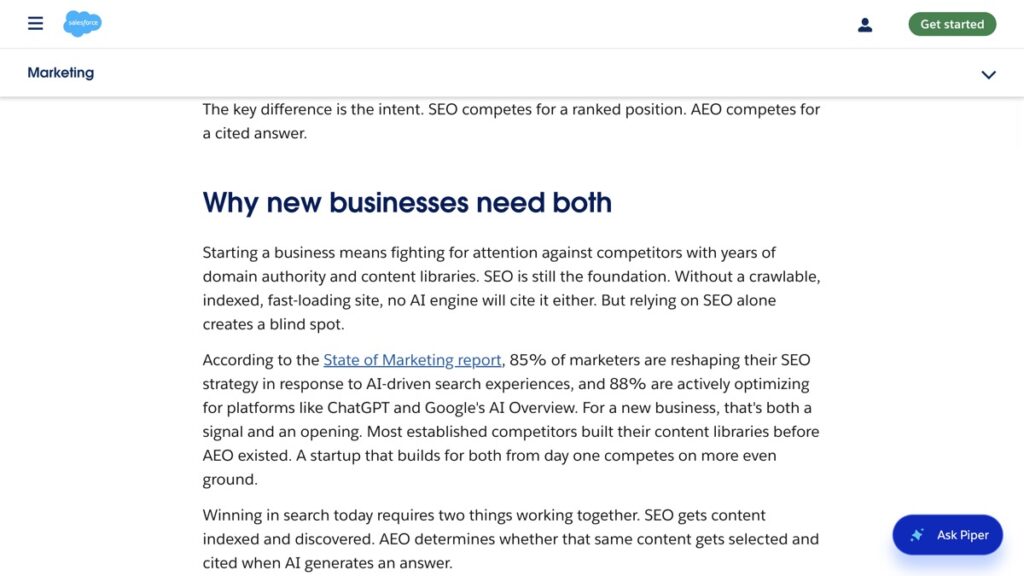
Marc Benioff said goodbye to SEO on 18 November 2026. Salesforce published a guide on 11 September 2026 that says SEO “is still the foundation”, and the product page he was promoting links to that guide from its own FAQ.
I read both pages. The post is a pitch for Palmata, a tool that watches what AI assistants say about a brand. The guide is a proper explainer written by Salesforce’s SEO Senior Director, and it carries five numbers the post never mentions.
1 Post and 1 Guide From the Same Company
The X post says customers “aren’t searching anymore” and now ask Claude, ChatGPT and Gemini which brands to buy. Then it lands the line that got shared: “No click. No referral. Nothing in your analytics.”
Palmata monitors what AI assistants say about a business, suggests fixes, and simulates the effect of those fixes before publication. Contentful launched it in June 2026. Salesforce closed its purchase of Contentful on 1 September 2026, three weeks before the guide appeared.
That timing is the argument. A tool that sells AI visibility has to be sold against the channel it is paid to watch, and the CEO’s post does that job well.
The 5 Numbers the Guide Carries
Graham Hardt, listed as SEO Senior Director, wrote the guide. Its figures come from Salesforce’s own State of Marketing report.
| Number | What it measures |
|---|---|
| 85% | Marketers reshaping their SEO strategy because of AI-driven search |
| 88% | Marketers actively optimising for ChatGPT and Google’s AI Overviews |
| 40 to 80 words | The passage length the guide calls best for AI extraction |
| 20% | Lift in marketing ROI that marketers using AI agents report |
| 19% | Lift in conversion rate that the same group reports |
Four of the five come from a survey, so they measure what marketers say they are doing. The fifth is a house rule about paragraph length, not a finding.
2 Lines That Answer the Post
“SEO is still the foundation,” the guide says. It goes further a sentence later. Without a crawlable, indexed, fast-loading site, “no AI engine will cite it either”.
The closing section states the position plainly. SEO gets content indexed, AEO decides whether that content gets cited, and the two are layers over one audience.
Read the goodbye post and then click through to the guide, and one company has told you two different things inside one quarter.
The Bit I Would Send a Client
The guide’s advice is to track both sets of numbers, organic traffic and rankings on one side, AI citations on the other. That is the professional answer and it costs a client nothing to adopt.
I would not repeat “nothing in your analytics” either. AI referrals are a small share of sessions and they do show up, which is why Google’s New Referrer Page Answers 3 Questions Your Analytics Gets Wrong is worth reading before anyone writes off the channel.
What the Numbers Cannot Tell You
The State of Marketing figures are global aggregates. The guide carries no India cut, so I cannot tell you how Indian small businesses answered or how many of them sat in the sample.
The 20 per cent ROI lift and the 19 per cent conversion lift belong to marketers using AI agents. They are not a measurement of AEO. Quoting them as one would be the same move the CEO’s post made, in the other direction.
The page also ends with a disclosure. “AI supported the writers and editors who created this article.” A vendor selling AI visibility used AI to write the page defending technical SEO, and the page still reads correctly.
My Read
Benioff is right that the click is not the only way a buyer meets a brand. A company with no presence in AI answers loses a conversation it never saw, and no rank tracking report will show it.
That is an argument for adding a channel. It is not an argument for dropping the site the channel reads from.
So keep the technical work, put plain answers at the top of each section, add FAQs where buyers ask, and measure citations next to rankings. Then let the numbers argue with the post.
More of this beat is in the search and SEO hub, which covers the crawl side of the same question.
Also read Open Web Traffic Fell 12% Since 2022. 3 Checks Before You Blame AI, 97% of llms.txt Files Get No Requests, So Publish One for Coding Agents and 5 Structured Data Properties That Still Change a Google Result.
Sources: Search Engine Journal, 20 November 2026 and Salesforce’s SEO and AEO guide, 11 September 2026.