Attack on Titan’s Founding Titan runs on three rules and one loophole, and Eren Yeager used both to end the world. The Founding Titan, called the Founder or the Coordinate, is one of the Nine Titans and the first of all Titans. Its screaming powers could create Titans, command them, rewrite the memories and bodies of the Subjects of Ymir, and reach every one of them at once.
None of that was available to whoever happened to inherit it. Who may use the power, and what they are allowed to do with it, was settled by a bloodline and by a promise made a century before the story starts.
What the Founding Titan can do
Six abilities are documented for the Founder, and four of them were used by a king to build the Walls.
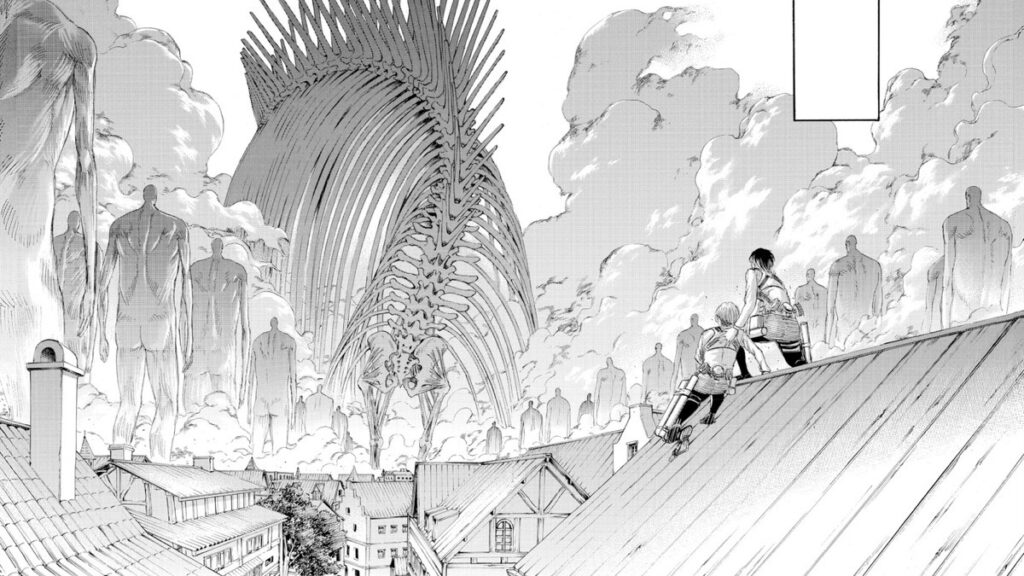
- Titan creation. Karl Fritz turned thousands of Subjects of Ymir into the Colossus Titans that became the Walls.
- Titan control. One scream can order nearby Pure Titans to do almost anything, and the range has never been established.
- Memory manipulation. Whole populations can be made to forget. Karl Fritz used it to erase the history of the world outside the Walls.
- Body manipulation. An Eldian king 600 years ago made Subjects of Ymir immune to an epidemic. Zeke Yeager wanted it to make every Subject of Ymir sterile.
- Telepathy. The holder can speak to every Subject of Ymir through the paths, which is how Eren announced the Rumbling in chapter 123.
- Non-linear sight. The holder can see past, present and future at once, and can nudge the past only where it already leads.
Two groups sit outside the memory power. Ackermans resist it, and anyone who is not a Subject of Ymir is unaffected by it. That detail is why the Ackermans were never part of the memory wipes, and it stays useful in the final act.
Rule 1, the power needs royal blood
Only the Fritz and Reiss royal families could use the true power of the Founding Titan. That is the rule the story leans on for most of its length, because it turns the strongest weapon in the world into something a usurper cannot simply take.
Grisha Yeager killed Frieda Reiss and took the Founder, and as a common Eldian he could not use it. He passed it to his son instead. The Reiss family had held it for generations, which is why Rod Reiss believed the power belonged to his bloodline and not to whoever was holding it.
Rule 2, the vow stops a royal holder from fighting
If royal blood alone were the rule, Eldia would have flattened Marley long before chapter 1. It did not, because Karl Fritz made a vow renouncing war and the vow took hold of everyone who inherited after him.
The vow does more than forbid a decision. It rewrites the holder’s personality. Successors become peaceable, they preach love among mankind, and they refuse to use the Founder in combat even in self-defence. Frieda Reiss called the people inside the Walls sinners and suffered fits of madness, and the vow overpowered her wish to save the citizens of Wall Maria when the Titans came.
Karl Fritz knew the paradise was temporary and accepted the world’s revenge as fair punishment for the Eldian Empire. His vow made sure his successors would agree, including the part where Eldians might be exterminated.
Rule 3, the power runs through Ymir Fritz
The Founder does not obey its holder directly. It works by commanding the soul of Ymir Fritz, the first Titan, and her slave mentality survived her death.
The first Fritz king owned her as a slave and was the father of her children, so she stayed in submission for roughly 2,000 years. Every royal holder was giving orders to a person, and the person had never been asked whether she wanted to obey. Chapter 122, from You, 2,000 Years Ago, is where Eren asks her.
The loophole, touch a Titan of royal blood
A non-royal holder can use the Founder’s power while in physical contact with a Titan that has royal blood. It does not have to be one of the Nine. Zeke Yeager implies a Pure Titan works just as well, and that is how he planned to use Eren.
The story showed this in chapter 50, Scream, released in Japan on 9 October 2013. Eren, with no royal blood, touches Dina Fritz’s Pure Titan and, without meaning to, orders the Pure Titans around him to eat her and attack the Armored Titan. The vow also only binds members of the royal family, so the same contact that unlocks the power also sidesteps the vow. Zeke later says he learnt to nullify the vow during his own time inside the paths.
What each holder could actually do, and what stopped them:
| Holder | Royal blood | What stopped them |
|---|---|---|
| Ymir Fritz | Yes, the source | Never free of her master until chapter 122 |
| Karl Fritz | Yes | Chose the Walls and bound his successors with the vow |
| Uri and Frieda Reiss | Yes | The vow, which blocked combat even in self-defence |
| Grisha Yeager | No | No royal blood, so the power would not answer him |
| Eren Yeager | No | Nothing, once he spoke to Ymir directly |
The last row is the whole ending. Eren did not break the bloodline rule and he did not beat the vow in a fight. He used the loophole to reach Ymir, then gave her a reason to stop serving a king.
What the Founder cost Eren
The non-linear sight is the part that reads as a power and behaves like a debt. The holder can see everything at once, and can influence the past only to keep history on the path it has already taken. The wiki records the drawback plainly. The holder thinks incoherently and goes along with events already seen, even when they are against what the holder wants.
Eren tells Armin in the paths that he pushed Dina Fritz’s Pure Titan away from Bertolt and toward Shiganshina, which is how his mother died. He had already seen it happen, so he made it happen. A power that only preserves what it has seen is not a choice, and the ending is easier to argue about once that is on the table.
Attack on Titan’s ending gets called rushed more often than wrong, and the case for rushed rests on how quickly the story moves after chapter 122. Read the rules first and the last act has less missing than it looks. For a cleaner comparison of how a power system earns its final fight, Dragon Ball’s scaling problem is the other side of the argument, and the Sharingan’s price is the same idea built as a cost from the first chapter.
The Founder is the rare power system where the limit is a person rather than a number, and the final act works because Eren finally talks to her. More on the show sits in the anime hub, and the length argument between One Piece and Naruto covers the other long-running comparison readers ask about.