The Sharingan is described as a copying eye, which is the least interesting thing it does. In the manga it arrives in three stages, and each stage charges the user differently. The first costs chakra. The second costs eyesight. The third costs another Uchiha’s eyes, usually a brother’s.
What the Sharingan is before it copies anything
A Sharingan is a dōjutsu, an eye technique, and a kekkei genkai, an ability inherited through blood rather than learnt. It belongs to the Uchiha clan and appears selectively among them. It is one of the three great dōjutsu, alongside the Byakugan and the Rinnegan, and it first appears in chapter 12 of the manga.
The eye wakes up through feeling rather than training. Chapter 619 describes the brain of an Uchiha releasing a special chakra that affects the optic nerves when they feel something powerful for a person precious to them. That is why the Sharingan is called the eye that reflects the heart. Loss and stress trigger it most often, and love works as well, which explains why almost every Uchiha who has one also has a funeral in the story behind it.
The 3 stages and what each one costs
Stage 1: the tomoe Sharingan and 2 abilities
A new Sharingan usually shows one tomoe, the comma-shaped mark inside the iris, and matures to a third through further emotional shock. All of its abilities are available from the first stage. The extra tomoe buy proficiency rather than new powers, so a three-tomoe user reads a fight faster than a one-tomoe user with the same eyes.
The abilities sit in two groups, and the names describe them well enough.
- Eye of Insight. The user sees chakra as colour, which shows whether a person is under a genjutsu or is a clone. Perception sharpens to the point where a fully developed Sharingan predicts a movement from muscle tension and reads hand seals before the technique lands.
- Eye of Hypnotism. Through eye contact the user plants a suggestion, pulls information out, or takes control of a body outright. The Uchiha are known for doing this to tailed beasts.
- Copying. Ninjutsu, genjutsu and taijutsu seen once can be reproduced almost exactly. It is one ability inside the first group rather than the whole eye.
The cost at this stage is the cheapest of the three and it is still real. Seeing a movement and having the body to answer it are separate problems, and the anime shows newly awakened users overworking themselves by moving faster than their muscles can cope with.
Stage 2: the Mangekyō and the eyesight it burns
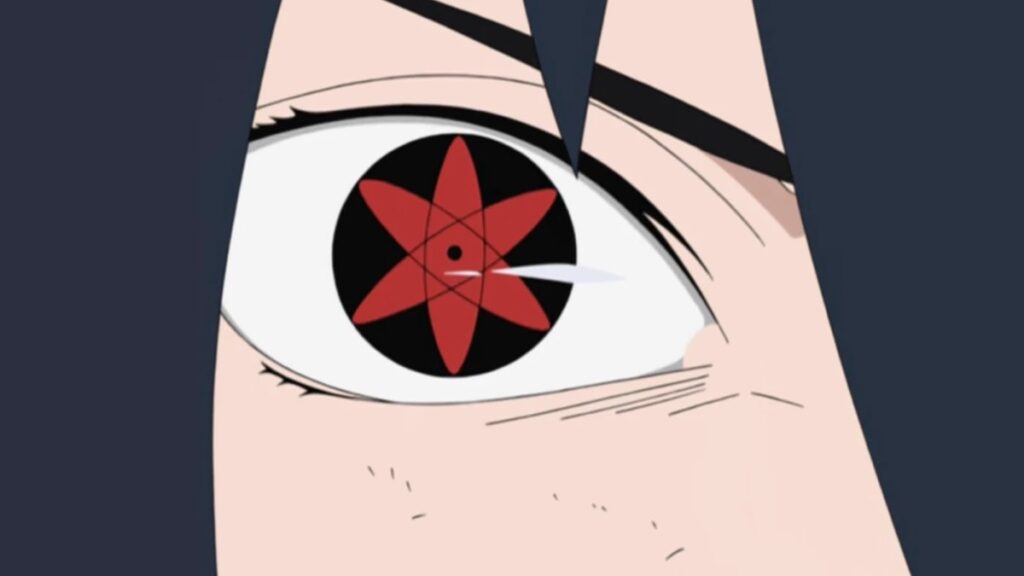
A Mangekyō Sharingan, the kaleidoscope copy wheel eye, arrives through the trauma of losing someone dear, and every design is different while all of them turn the tomoe into a pinwheel. Chapter 142 is where it first appears. It keeps everything the normal Sharingan does and adds one or two unique techniques per eye, so a fight between two Mangekyō users is not a fight between two users of the same power.
Itachi’s eyes gave him Tsukuyomi and Amaterasu. Sasuke’s left eye could cast Amaterasu while his right controlled the flames. Susanoo, the armoured construct, needs the Mangekyō awakened in both eyes. The same ability can land in different users with different limits, which is the reason arguments about which eye is stronger never settle.
This is where the price changes. Activating a Mangekyō drains a large amount of chakra, every technique drains more, and the strain damages the body and the eyes. Overuse eventually leaves the user blind, and the blindness is the part the story treats as permanent.
Stage 3: the Eternal Mangekyō needs a relative’s eyes
One transplant fixes the blindness, and only one. The eyes of an Uchiha with strong blood ties, ideally a sibling, merged into the user’s own produce the Eternal Mangekyō Sharingan. The vision damage stops, the body pain and chakra drain drop to almost nothing, and the design of both eyes merges into one pattern that never fades.
Sasuke took Itachi’s eyes after Itachi’s death and gained that version. Madara described the Eternal Mangekyō as proof that an Uchiha kept moving forward after great loss, which is a generous reading of an eye that requires a dead relative to complete.
Transplanted eyes behave differently from born ones, and that detail explains a lot of what looks like inconsistency. A normal Sharingan given to a non-Uchiha cannot be switched off and costs more chakra to hold open, which is why Kakashi keeps his covered. A transplanted Mangekyō can be switched on and off at will by a non-Uchiha, so the rules are not one rule about transplants but two.
The 2 techniques that burn an eye on purpose
Two abilities sit outside the three stages because both destroy the eye that uses them. Izanagi rewrites reality for a moment, turning a fatal hit into an illusion, and Izanami traps a target in a loop built to teach a lesson. The Uchiha classified both as kinjutsu, forbidden techniques, because the Sharingan used to cast either goes blind afterwards.
Izanagi is the reason a Uchiha can seem unbeatable for one fight and ordinary in the next. The eye is spent, and the story does not hand it back.
Read the last column as the price of using the stage, because that is what decides most fights in the series.
| Stage | First appears | What it adds | What it costs |
|---|---|---|---|
| Tomoe Sharingan | Chapter 12 | Chakra vision, prediction, genjutsu, copying | Chakra and physical strain |
| Mangekyō | Chapter 142 | Unique techniques, Susanoo with both eyes | Eyesight, pain, chakra |
| Eternal Mangekyō | Sasuke after Itachi’s death | Same techniques without decay | Another Uchiha’s eyes |
Two of those prices are paid inside a fight, and one is paid before it. The eternal version removes the decay but not the entry requirement, which is why only two of the Uchiha in the story ever reach it.
The same logic runs through every power system that gets argued about online. Dragon Ball’s numbers stopped meaning anything once the scaling outran the rules, and that collapse is worth reading beside this one because both series use a fixed rule to make a fight mean something. Naruto keeps its rule and pays for it with characters who cannot use their best move twice.
Where the eye shows up next in the anime
The anime hub keeps the explainers together, and the Naruto entries already there cover the four-episode remake and what it risks. The older argument that One Piece earns its 1,000 episodes while Naruto threw 700 away reads differently once you count how much of Naruto’s plot is decided by an eye that costs the user something to use.
On a rewatch, watch the eyes after the fight rather than during it. Kakashi covers his, Sasuke’s aim goes soft, and Itachi’s cough arrives at the moment his eyes are working hardest. The rules are visible in the animation if you know what the stages cost.