The chess game in chapter 16 of Philosopher’s Stone ends with Ron Weasley handing himself over so Harry can finish it, and it is the best-written defence in the book. It also breaks the rules of chess twice. The Harry Potter Lexicon documents both slips on its chapter page, along with the reprint that quietly rewrote one of them.
The three people standing on the board
Rowling does not let them play the game from a distance. Each of the three takes the place of a white piece and moves like it. Ron gives the orders, which is the joke of a twelve-year-old who has never been good at anything else telling two people where to stand.
| Piece | Who stands in for it, and how the piece moves |
|---|---|
| Bishop | Harry, and a bishop moves diagonally only |
| Castle, which is a rook | Hermione, and a rook moves in straight lines, however far |
| Knight | Ron, and a knight moves two squares one way and one the other |
The instructions are given plainly enough. “Well, Harry, you take the place of that bishop, and Hermione, you go there instead of that castle.” Then Ron opens with the only rule everyone knows: “White always moves first in chess,” said Ron, peering across the board. Both lines are quoted on the Lexicon’s page for the chapter.
The knight takes one step
In the first printing, Ron says he will take one step forward and steps. That is not a knight’s move. The Lexicon notes it flatly: Ron is playing the part of a knight, so he cannot move just one step, because knights travel in an L shape of two squares and one.
That line is the one that got fixed. Later editions replace it with Ron announcing the trade he is making: “that leaves you free to checkmate the king, Harry!” So the modern text has him explain the sacrifice before he makes it, which is better writing and also legal chess.
The bishop goes sideways
The second slip is still there. After Ron is knocked off the board, Harry shakes himself and moves three spaces to the left, and a bishop cannot do that. The Lexicon points out the rule the book ignores: Harry is playing a bishop, and as such should only have been allowed to move diagonally.
I like that this one survived. It is the kind of error a writer makes at two in the morning when the scene needs Harry to be two squares from where he was, and it is also the kind of error a reader forgives because the scene is not really about chess.
The placement problem nobody notices
The older text had a third problem that is harder to spot. It told Hermione to go next to Harry instead of the castle, and a bishop and a rook do not start next to each other, so the instruction could not be followed on any real board. The corrected line drops the word next and sends her to the castle’s square instead. Three fixes in one small scene, and only the third one is invisible unless you set up a board.
The sacrifice is the point
Ron’s line when Harry objects is the one that made the scene famous: “That’s chess!” snapped Ron. “You’ve got to make some sacrifices!” What follows is Ron stepping in front of the queen, taking a stone arm to the head, and going down. Hermione wants to help him and he tells her to go on. Harry walks the last three squares alone and checkmates the king.
It is the only defence in the book that costs one of them a player instead of a spell. The potions riddle costs Hermione her certainty, the keys cost Harry a bruise, and the chessboard costs Ron the rest of the night.
What the 2001 film keeps
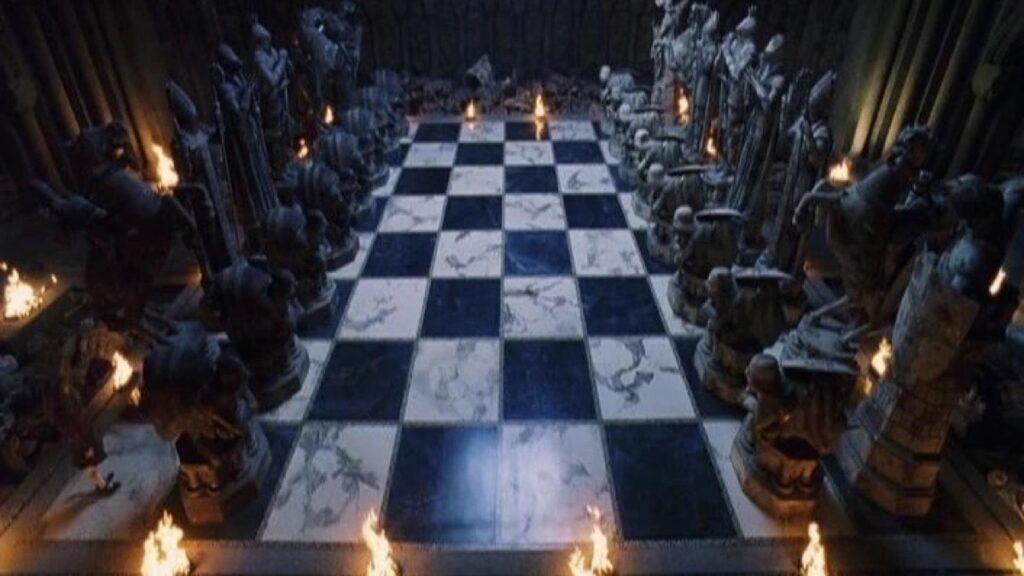
The 2001 film stages the board as one of its three defences, and Wikipedia’s plot summary records it as a giant enchanted chessboard that leaves Ron incapacitated. So the film keeps the shape of the scene: the board, the three players, the sacrifice. What it cannot carry is the book’s arithmetic, because those errors only exist in the sentences. Nobody watching can see a knight move one square.
Why nobody caught it for years
Most readers of Philosopher’s Stone do not play chess, and the chapter does not ask them to. It asks them to watch a boy who has been told all year that he is not good enough work out that his friend can win if he stops protecting himself. That is why the scene reads as one of the warmest in the series even though it is built on moves that would be illegal on any board in the world.
When the series reaches chapter 16 on HBO and HBO Max after its 25 December 2026 premiere, this is the test of whether it has read the book or the film. The chessboard is the one defence where the reader knows the rules better than the characters do.
Image: the giant chessboard in the 2001 film, via the Harry Potter Wiki.
Also read
- The Philosopher’s Stone Film Cuts the 7-Bottle Riddle Only Hermione Solves
- Snape Referees 1 Quidditch Match in Philosopher’s Stone That the 2001 Film Leaves Out
- Neville Longbottom Wins 10 Points and Gryffindor the House Cup
The whole book-by-book run lives in the Structure and story list on the Movies and TV hub.
Sources
- Harry Potter Lexicon, PS16: Through the Trapdoor, hp-lexicon.org/source/the-harry-potter-novels/ps/ps16/
- Harry Potter Lexicon, PS13: Nicolas Flamel, on Hermione and chess, quoted on the PS16 page
- Wikipedia, Harry Potter and the Philosopher’s Stone (film), plot summary