The AI referral number in Google Analytics 4 is a floor, not a total. GA4 now has a channel called AI Assistant for visits that arrive from tools like ChatGPT, and four common kinds of AI-driven visit land somewhere else in the same report.
That matters when somebody asks what AI search is worth. The honest answer is that the report cannot see the visits that never happened, and it also does not see a fair share of the ones that did.
What the AI Assistant channel actually counts
Google’s default channel group defines AI Assistant as traffic from tools such as ChatGPT, Gemini, DeepSeek, Copilot or Grok, and it says plainly that AI Overviews and AI Mode are excluded from it. The channel fires when the session medium reads ai-assistant, which Analytics assigns when the referrer matches its own list of AI tools.
Everything else about the channel follows from that one rule. If the referrer is not on that list, or the referrer never arrives, the visit becomes something else in the report. The size of the AI number is then decided by Google’s list rather than by how much AI traffic you get.
The 4 kinds of AI visit that land elsewhere
Sort visits by where the click happened, and the gaps become easy to see. Only the first row below is what the AI Assistant channel reports.
| Where the click happened | GA4 channel | Counted as AI |
|---|---|---|
| ChatGPT, Gemini, Copilot, Grok, DeepSeek | AI Assistant | Yes |
| AI Overviews or AI Mode inside Google Search | Organic Search | No |
| An assistant Google does not list | Referral | No |
| A click from an app that sends no referrer | Direct | No |
| A link carrying a campaign source but no medium | Unassigned | No |
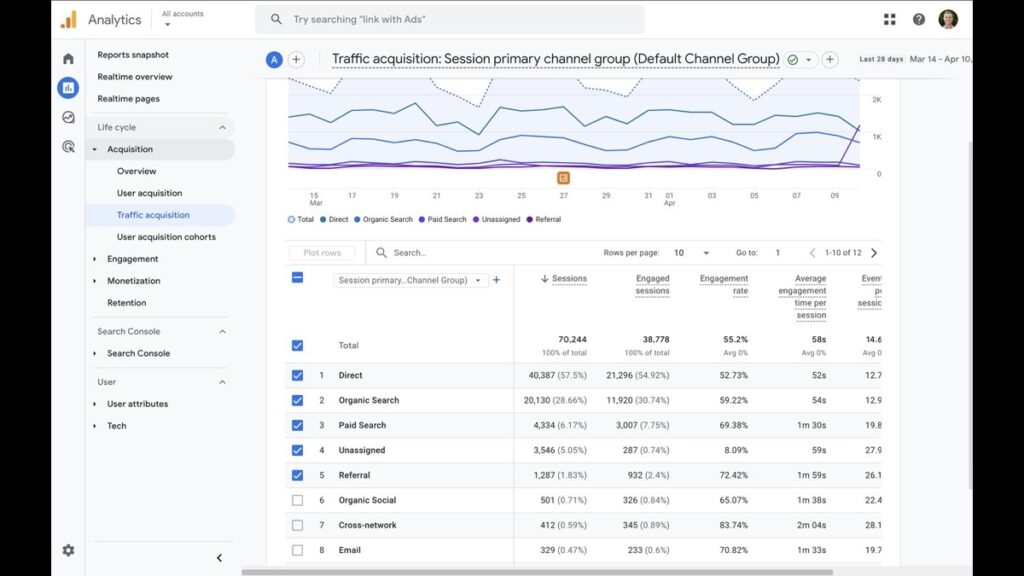
The fourth and fifth rows are the quiet ones. Direct is a channel people write off as bookmarks and typed addresses, so an AI click that arrives with no referrer sits inside a number nobody reads closely. Unassigned is where a session goes when it matches no rule at all, which is why a link tagged with only a campaign source disappears from every channel summary.
How big the number is when it is counted at all
Search Engine Journal published a measurement on 5 November 2026 covering 108 million sessions across 57 websites, from 1 January to 2 November 2026. Total AI traffic came to 0.66 per cent of all sessions, which is about 7 AI visitors for every 1,000 that arrive from search engines.
The spread between sites is wide. Some properties in that sample saw 20 to 25 AI visitors per 1,000, so a site with a technical audience can see several times the average and still be looking at a small row in a report.
The same article cites an earlier examination of 145 million sessions across more than 100 websites, where visits from ChatGPT came to under 1 per cent of the volume Google search delivered. It also records the number I would act on: visitors from ChatGPT converted at almost 14 per cent, against 3 per cent for search.
The custom channel that catches unlisted assistants
GA4 will not let you edit its default channel group, so the fix is a custom group with one extra channel sitting above Referral. Google’s own help page on custom channel groups runs through the setup, and it supplies an example pattern that covers the major assistants.
- Open Admin, then Data display, then Channel groups, and create a new channel group.
- Add a channel named AI assistants.
- Set the condition to
Session sourcematches regex, using a pattern such aschatgpt\.com|chat\.openai\.com|perplexity\.ai|claude\.ai|gemini\.google\.com|copilot\.microsoft\.com. - Drag that channel above Referral and save.
- Read it in Acquisition, Traffic acquisition, with the channel group set to yours.
Keep the group in the property rather than in a saved exploration. Explorations get archived, forgotten and rebuilt, and a channel group survives a change of analyst.
Two numbers that measure what the report cannot
A visitor who asks an assistant for a recommendation, reads the answer, and books a demo a week later is credited to brand search or to direct. The click that shaped the decision never appears. Measuring only sessions will always understate the work.
Two substitutes are worth tracking instead. The conversion rate of the AI sessions you can see, because a 14 per cent figure against 3 per cent for search is a reason to fix the pages those sessions land on. And the trend in branded search volume for your own name, which is the closest available proxy for people hearing about you inside a chat window.
Where the AI Assistant channel will keep changing
Google maintains the list of recognised assistants, so the channel’s definition moves without notice and a review each quarter is enough to catch it. The AI search hub carries the rest of this beat, including what happened when 97 per cent of llms.txt files got no requests and why blog posts never show up in AI answers. Both come back to the same habit, which is writing for query fan-out rather than for one keyword.
Start with the two-minute version. Open Traffic acquisition, set the primary channel to Session default channel group, and search the source column for chatgpt. If a row appears at all, an assistant is already sending people, and the page it sends them to is worth more attention than the number beside it.