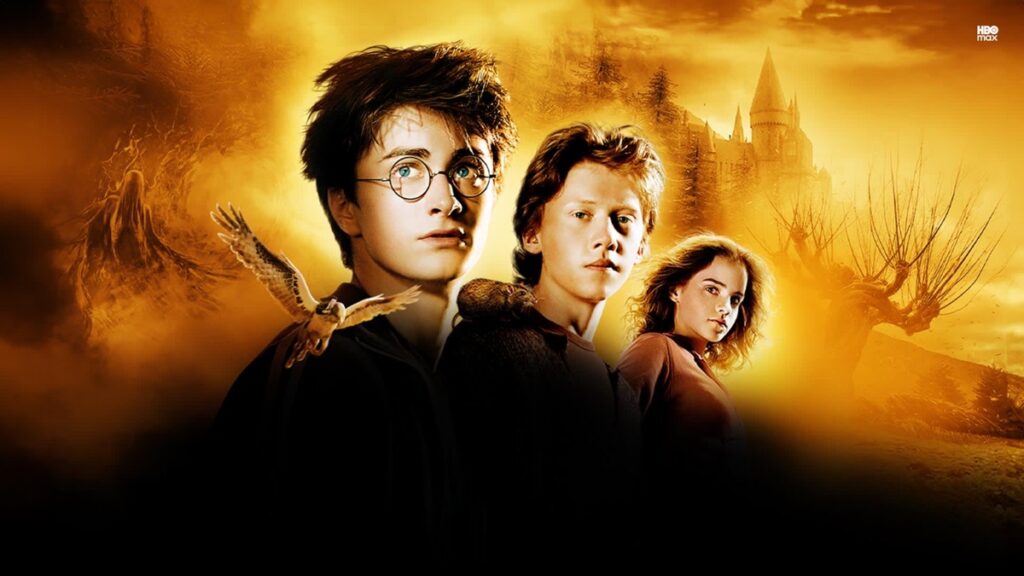
The Harry Potter films peaked in 2004 with the third one, and everything after it is a franchise trying to catch up to a director who left after a single entry.
That is the argument. Here is the ranking, worst to best, and then the case.
8. Chamber of Secrets
The longest of the early films and the one with the least happening in it. Columbus shoots it like a school play with a very large budget: flat lighting, centred framing, every location introduced with a wide establishing shot and a swell of music.
The diary plot is decent and Dobby’s introduction matters later, but the film treats a 12-year-old solving a murder mystery with the same tonal weight as a Quidditch match. Nothing has stakes because everything has the same stakes.
7. Philosopher’s Stone
Ranks above Chamber only because it had a job to do and it did it. You need to establish a world, a school, a friendship and a mythology in one film, aimed at children, without losing anyone. It works.
It is also the most dated. The visual effects have aged badly, the pacing stops dead for every piece of world-building, and the performances are what you would expect from kids in their first film. It is a functional adaptation and not much more.
6. Order of the Phoenix
The longest book turned into one of the shortest films, and you can feel every cut.
Umbridge is the best villain in the series and Imelda Staunton is excellent, but the film has no room to let the slow institutional horror of her regime build the way the book does. It is a film about bureaucratic cruelty that has to sprint.
Dumbledore’s Army works. The Ministry sequence is fine. The death at the end lands less than it should because the film has not had time to build the relationship it is severing.
5. Goblet of Fire
Fun, and structurally a mess.
The three tasks are the best action set pieces the series had managed up to that point, and the graveyard scene is genuinely frightening in a way nothing before it was. That is the film’s real achievement: it is the moment the series stops being for children and tells you so directly.
But the compression is brutal. Entire subplots vanish. The Quidditch World Cup is a cold open. Characters appear because the plot needs them and disappear when it does not. It is a highlight reel of a much longer story.
4. Deathly Hallows Part 2
The best-looking film in the series and the one with the least to actually do.
Splitting the book meant Part 2 got all the payoff and almost none of the setup. That sounds like a good deal and it is not. A two-hour battle needs breathing room, and the film has to keep stopping to remember characters it left in Part 1.
Snape’s memories are the strongest sequence in the entire franchise and I will not hear otherwise. The rest is well-executed spectacle that runs slightly on fumes.
3. Half-Blood Prince
Bruno Delbonnel’s cinematography is doing an enormous amount of work here. The film is desaturated almost to grey, and it makes Hogwarts look like a place where something has already gone wrong. It is the best-shot film in the series by some distance.
What holds it back is that it cuts most of the Horcrux material, which is the actual plot of the last two films, and replaces it with an attack on the Burrow that is not in the book and does not go anywhere. It is a film that looks like it understands the story better than it does.
Still, the teenage material is the funniest and most human the series ever gets, and the ending is properly bleak.
2. Deathly Hallows Part 1
The most divisive entry and I think most of the criticism is wrong.
People complain that it is two hours of three teenagers camping in a field. Yes. That is the point. The whole premise of the final book is that the institution collapses and the safety net disappears, and the only way to make that land on screen is to strip the world away and leave the characters with nothing to do. The boredom is the content.
It also contains the single best directorial decision in the series after Azkaban, which is the animated Tale of the Three Brothers. It changes visual register completely for four minutes and it is the only time the films do something the books could not.
1. Prisoner of Azkaban
Cuarón made one of these and reset what the series looked like permanently.
Start with the smallest thing, which is also the most telling. He put the kids in normal clothes. Robes come off between classes, ties are loose, shirts are untucked. Two films had presented Hogwarts as a costume. Azkaban presents it as a school that teenagers actually live in.
Then the geography. He moved Hagrid’s hut down a hill, added the covered wooden bridge and the stone circle, and started using the Whomping Willow as a seasonal marker to show time passing. None of that is in the book. All of it is now what Hogwarts looks like in your head, and every subsequent director kept it.
The colour grading goes cold and blue. The camera moves. There are long takes that follow characters through corridors instead of cutting between clean setups. After two films shot like a stage production, someone finally directed one.
And the time-turner sequence is the first time the films trust the audience with a genuinely complicated plot. It replays the third act from a second angle and expects you to keep track. Nothing in the first two films assumes you can do that.
The case against my ranking
The strongest objection is that Azkaban is the weakest adaptation in the series. It cuts the Marauders’ backstory almost entirely, so the reveal about Moony, Wormtail, Padfoot and Prongs arrives with no groundwork and means very little if you have not read the book. That is a real failure and it is the film’s biggest flaw.
My answer is that it is a better film for being a worse adaptation. It is the only entry that behaves like it has its own visual ideas rather than a checklist.
The second objection is that ranking Deathly Hallows Part 1 at number two is contrarian for its own sake. Maybe. I would just ask anyone making that argument to rewatch the tent sequence and tell me what else in the franchise is doing something that quiet and that deliberate.
The thing I keep wondering about
Warner Bros. offered Cuarón the fourth film and he turned it down. Yates then directed the last four, which is the most consistent run in the series and also the safest.
I do not know whether a Cuarón version of Goblet of Fire or Order of the Phoenix would have been better or whether his style only worked on the one book that was small enough to hold it. Azkaban is the least plot-heavy of the seven. That might be the reason it breathes.
If you think a different film belongs at the top, I am most interested in hearing the case for Half-Blood Prince, because on pure filmmaking it is closer than most rankings admit.