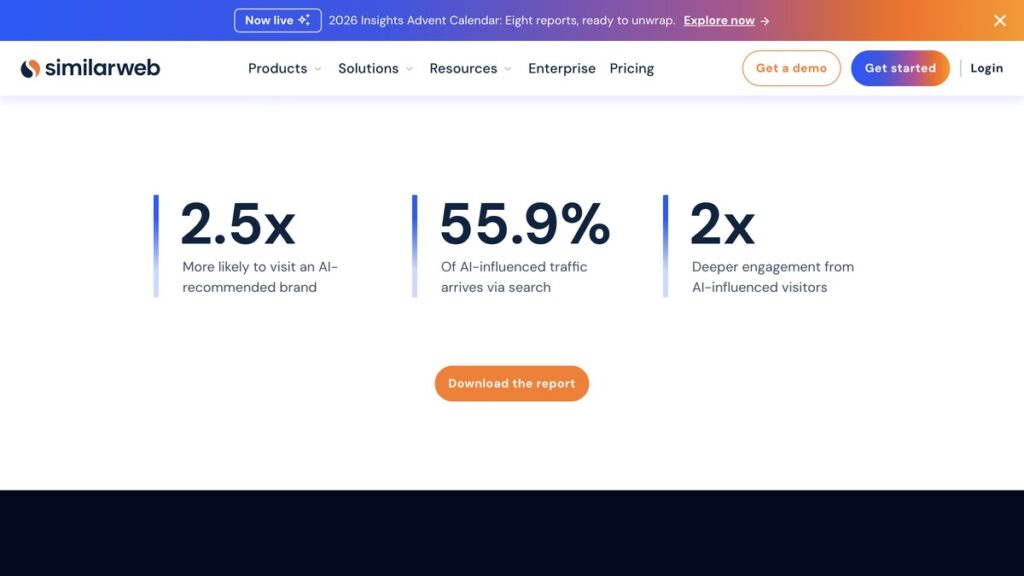
Similarweb’s study of AI recommendations puts a number on the attribution problem everyone keeps describing. Of the visits that followed an AI recommendation, 55.9 per cent arrived through search. Another 19.9 per cent arrived as direct traffic. Only 8.8 per cent showed up with an AI referrer attached.
So the visit was caused by an AI answer and the credit went to Google or to a typed URL. The same study says people who got a brand recommendation from an assistant were 2.5 times more likely to visit that brand’s site within seven days, and that AI-influenced visitors engaged roughly twice as deeply once they landed.
What the study actually measured
Similarweb used its own panel, tracked ChatGPT recommendations, and compared brand pairs inside three verticals. Search Engine Journal’s account of the report names those pairs as American Express and Capital One, Skyscanner and Kayak, and Sephora and Ulta. It gives the window as July to December 2025, with users who named the brand in their own prompt excluded.
That exclusion is the useful part. It means the visits being counted came from people who had not decided on a brand yet, which is exactly the group an SEO or a paid search team claims to influence.
Five numbers and what each one can carry
| The number | What it can support | What it cannot |
|---|---|---|
| 55.9 per cent of AI-influenced visits arrive via search | Search absorbs most of the traffic an AI answer sends | Nothing on paid against organic |
| 19.9 per cent arrive as direct | A typed URL and a returning tab look identical in analytics | Nothing on who sent them |
| 8.8 per cent arrive with an AI referrer | The referrer trail catches a small slice of AI influence | Nothing on the visits that lost their referrer |
| 2.5 times more likely to visit within seven days | Recommendation moves people to the site | Nothing on whether they bought |
| 12 pages a visit against 6.5 | AI-influenced visitors read more once they arrive | Nothing beyond six brands in three verticals |
The IAB built a framework around this gap
On 12 November 2026 the Interactive Advertising Bureau published its AI-Era Attribution Blueprint. It sorts every conversion into one of three pathways. Human-Owned means AI did not create the intent, shape the choice or complete the purchase. AI-Assisted means AI narrowed the options and a person decided. AI-Executed means a person authorised an agent to buy.
The line the IAB keeps repeating is that a claim is not credit. A claim only earns a brand the right to be evaluated for credit, and the pathway decides what evidence that evaluation needs. The trade body also published the reason it bothered. In its own September 2026 buyer study, 45 per cent of ad buyers named comparing AI-driven and traditional customer journeys as their top measurement challenge. Another 44 per cent said they use branded search and direct traffic as proxies for AI influence they cannot track.
The headline is public and the method is behind a form
The 2.5 times figure and the 55.9 per cent figure sit on Similarweb’s own report page, next to a download button. The panel description, the brand list and the date range do not. If you plan to quote this study in a client deck, quote the numbers and name where the method description came from, because I could not read the report itself without handing over an email.
What this says about a brand selling in India
Nothing directly. The panel is United States desktop traffic and the assistant studied is ChatGPT, so there is no Indian reading in the data and no mobile reading either. Treat the percentages as the shape of a problem rather than a forecast for your market.
Google Analytics does have an AI Assistant channel in its default group, added in May 2026, and it works on referrers. A shopper who reads a ChatGPT answer, opens a new tab and searches your brand never touches that row. They land in organic or in paid, which is the behaviour the Similarweb numbers describe.
The change I would make this month
Report two columns instead of one. Put the platform’s claimed conversions in the first, and whatever a holdout or a lift test says in the second. When they disagree, say so in the meeting rather than picking the better number. Google Ads now lists Search and Performance Max as supported for conversion lift, with a floor of 1,000 observed conversions and a $5,000 study budget, and a smaller account can still run a geo holdout on brand terms.
Then add one question to whatever form already asks people how they found you. “Did an AI assistant mention us?” with the assistants listed costs nothing and gives you a self-reported share to sit beside the modelled one.
The interesting number here is 8.8 per cent, not 55.9 per cent. It is the size of the only slice of AI influence that analytics can currently prove, and every other claim about AI driving revenue is an estimate built on top of it. The AI search hub has the rest of the measurement pieces I have written on this.
I would rather report an honest estimate and name its weakness than defend a channel split I cannot explain to the person paying for the ads.
Also read: 6.9% of 41,961 ChatGPT Conversations Showed Purchase Intent in a US Panel. Google’s New Referrer Page Answers 3 Questions Your Analytics Get. 4 Checks Before You Change a Page That Lost an AI Citation.
Sources: Similarweb’s report page on the downstream impact of AI visibility, the IAB release from 12 November 2026, and Search Engine Journal’s write-up for the panel detail.