Rank Math picked up 16 vulnerabilities in 2026, and my own install runs it, so this one was close enough to check properly. The fixes arrived in four separate releases, and the last of them is a version number most summaries leave out.
I read Search Engine Journal’s tally and then went through Wordfence’s vulnerability database for the plugin row by row, because a summary that gets the version wrong sends people away thinking they are safe when they are one release short.
What the count actually is
Sixteen vulnerabilities were disclosed in 2026, which is more than any other SEO plugin that year. The plugin reports 4,000,000 active installs and just over 204 million downloads, so the exposure is not small.
The disclosures came in a burst. Eleven of the sixteen landed between 27 August and 14 October 2026, and eight of those inside a single eight-day window from 27 August to 3 September. For comparison, Yoast SEO had four in the free version and two in the paid one over the same year.
Two of them reach remote code execution
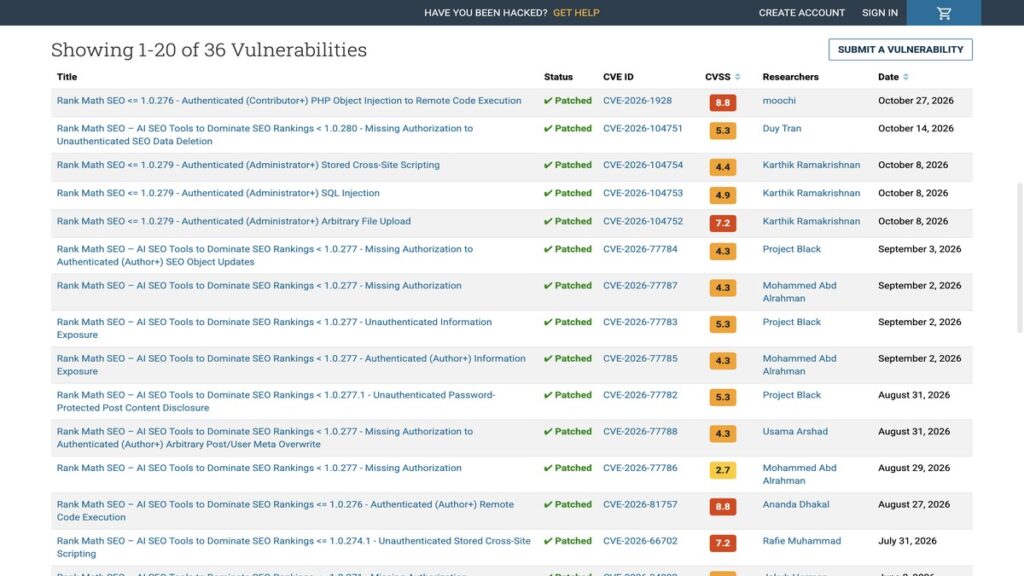
The worst pair both carry a CVSS score of 8.8. CVE-2026-1928 is a PHP object injection that turns into remote code execution for anyone holding a Contributor account, disclosed 27 October 2026. CVE-2026-81757 is remote code execution for an Author, disclosed 27 August 2026.
Contributor and Author are the two roles people hand out casually, to a guest writer or an intern, which is why these two matter more than their scores suggest. A site that lets anyone register with a draft article gets that exposure for free.
The patch ladder
Each fix went out in its own release, so a site sitting on an old number collects several of these at once. These are the rows worth knowing, straight from the Wordfence database.
| Affected up to | CVE | What it allows | CVSS |
|---|---|---|---|
| 1.0.276 and earlier | CVE-2026-1928 | Contributor-level PHP object injection to remote code execution | 8.8 |
| 1.0.276 and earlier | CVE-2026-81757 | Author-level remote code execution | 8.8 |
| 1.0.274.1 and earlier | CVE-2026-66702 | Stored cross-site scripting with no login needed | 7.2 |
| 1.0.279 and earlier | CVE-2026-104752 | Administrator-level arbitrary file upload | 7.2 |
| Below 1.0.277.1 | CVE-2026-77782 | Reading password-protected post content with no login | 5.3 |
| Below 1.0.280 | CVE-2026-104751 | Deleting SEO data with no login | 5.3 |
The version number I checked on my own site
Wordfence lists the fix for the October deletion flaw as 1.0.280, which is one release past the 1.0.279 that most write-ups stop at. That matters because 1.0.279 was the last affected version for three other flaws, so a site that updated to 1.0.279 in early October was still exposed to the one disclosed two weeks later.
You can read the number without logging in. Open siddharthvira.com/wp-content/plugins/seo-by-rank-math/readme.txt on any WordPress site and look at the Stable tag line. Mine reads 1.0.281 this morning, so the install is past every threshold on that table.
The pattern that matters more than the count
Seven of the sixteen entries come down to the same failure, a missing permission check before an action runs. Five could be triggered without an account at all. That is a different problem from one clever bug in a parser, because it repeats.
My rule for a plugin with this record is boring and it works. Update it within a week of any release. Keep the Contributor and Author accounts at a number you can name out loud. And treat a nulled or bundled copy of an SEO plugin as a decision to hand your database to a stranger.
Wordfence publishes the whole list through a free API as well as the web page, so you can pull the affected version range for every plugin on a site instead of reading one article at a time. That is worth building once if you look after several client sites.
I keep the plugin and server work together under WordPress Care, because this is the same kind of task as the core update I wrote about earlier today.
Sources
Wordfence’s vulnerability database for the plugin, read 20 November 2026 for the CVSS scores, affected version ranges and disclosure dates. Search Engine Journal’s tally, 18 November 2026, for the yearly count, the Yoast comparison and the breakdown of what each flaw type allows.
Also read: 3 WordPress 7.1.5 Flaws That Need No Login to Exploit, What a Compromised WordPress Site Looks Like, and How to Check Yours and 4 Checks That Prove Your Sitemap Still Works in Chrome 158.