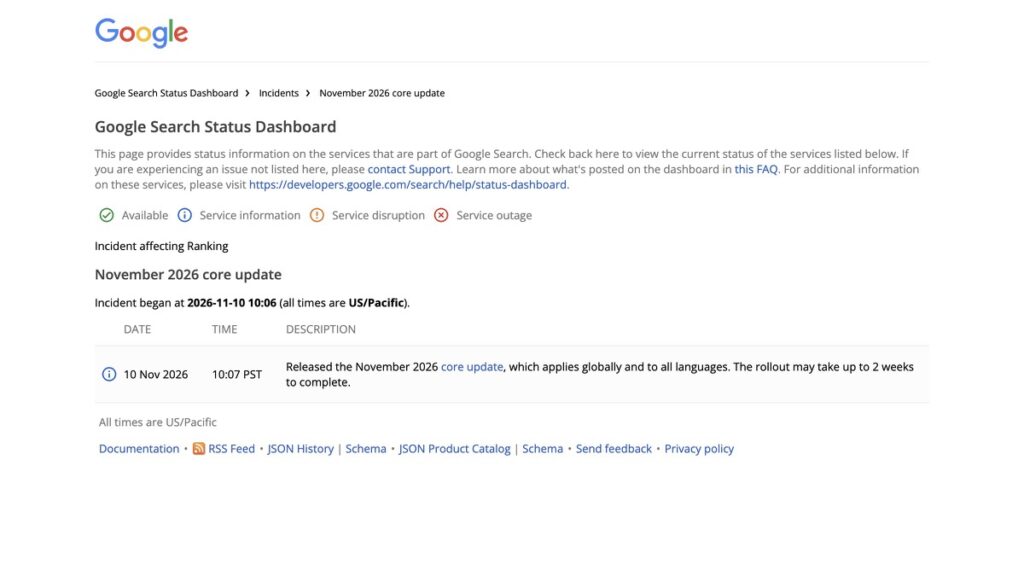
Google started rolling out the November 2026 core update at 10:06 a.m. Pacific on 10 November 2026. It applies globally and to every language, and Google says the rollout may take up to two weeks. Nothing you read in Search Console today will tell you what it did, so the useful work is making the next month of data readable. Four moves do that.
What Google actually posted
The Search Status Dashboard entry reads: “Released the November 2026 core update, which applies globally and to all languages. The rollout may take up to 2 weeks to complete.” Search Central’s LinkedIn account added that this is “a regular update designed to better surface relevant, satisfying content for searchers from all types of sites”. There is no blog post on Search Central about it, and the core updates documentation page still carries a revision date of 10 December 2025.
This is the third core update of 2026 and the eighth ranking update listed on the status dashboard this year. The dates and durations of the earlier ones are the best guide to what two weeks feels like in practice.
| 2026 update | Window | How long it took |
|---|---|---|
| March core update | 27 March to 8 April 2026 | 12 days, 4 hours |
| May core update | 21 May to 2 June 2026 | 11 days, 21 hours |
| June spam update | 24 June to 26 June 2026 | 2 days, 1 hour |
| August spam update | 18 August to 21 August 2026 | 2 days, 16 hours |
| September spam update | 24 September to 8 October 2026 | 13 days, 16 hours |
| November core update | from 10 November 2026 | in progress, up to 14 days |
Google’s own comparison window
Google’s core updates guidance asks for at least a full week after the rollout completes before you look at anything. Then it asks you to compare that week with a week before the rollout started. For this update the baseline is the week before 10 November 2026, which means 3 November to 9 November.
That instruction is the whole method. I have watched teams break it for years by reading day three against the previous month average and calling the result a penalty, and the numbers are never clean enough to support the sentence anyway. A week against a week is boring and it survives being checked by somebody else.
Move 1: save the baseline week today
Export clicks, impressions, position and click-through rate for 3 November to 9 November 2026, by page and by query, and write the export date on the file. Data lands late, so the same week will read slightly differently a fortnight from now. A saved copy with a date on it is the only version you can defend when a client asks which number you used.
Move 2: put every change you shipped into one dated list
Two weeks of your own edits and two weeks of a core rollout produce the same shape on a chart. Every title rewrite, template change, redirect and migration that went live after 10 November 2026 belongs on one list with a date next to it. Without that list you cannot tell a Google refresh from your own Thursday.
This is the same problem as a page whose speed score moved on its own. A PageSpeed score can shift without a single page edit, because the tool and the field data move too, and the only way to know which one moved is to have written down what you changed.
Move 3: read the data by template, not by site average
A sitewide average is where patterns go to hide. Pull the same week for one template at a time. On most sites that means product pages, category pages, blog posts and the homepage as four separate lines, and then the query groups inside whichever line moved.
The reason is mechanical. Core updates change how pages are judged against each other, so a shift usually shows up as one page type losing ground to another within the same site. If your product pages dropped and your guides held, the sitewide number will read like a small wobble while the business problem is entirely inside one template.
When the diagnosis is that pages are being crawled and left out rather than lost, that is a different job. The four checks for crawled but not indexed cover the order I run them in, and none of them involve the word penalty.
Move 4: wait for the finish line before changing anything
Google says core updates do not target a specific site or a specific page, and that the systems are refreshed rather than pointed at anyone. If that is true, then a change made on day four of a fourteen-day rollout is a change you cannot measure, because the thing you are measuring against is still moving.
I would not ship a title rewrite, a redirect map or a migration between now and the completion time. Ship the boring fixes that were already queued, keep the log, and hold anything you would want to take credit for.
The holiday trap sitting in the next comparison week
If this rollout runs the full two weeks it finishes around 24 November 2026. The week after that contains US Thanksgiving, Black Friday and Cyber Monday. A retailer comparing that week with 3 to 9 November is comparing holiday demand with an ordinary week, and the difference will look like a ranking event. Indian brands selling into the United States walk into this one every November.
Fix it by adding a second comparison: the same week last year. If the year-on-year shape matches, the update is not the story.
What is worth checking in week one
- Impressions before clicks. If impressions held and clicks fell, you lost position or the results page changed shape above you. If impressions fell too, the page left the set Google considers relevant.
- Queries that were already at 11 to 20. Core updates move the middle of the results page more visibly than the top three, and the middle is where most of the recoverable traffic sits.
- Pages with no internal links. A page nobody links to is the first thing a reshuffle drops.
- The date of your last real change. If nothing changed on the site since October, your list is empty and the data is clean.
The dashboard will post a completion time when the rollout ends, and Google says it will update the ranking release history page then. Put that date in the calendar, compare the week after it with 3 to 9 November 2026, and treat every reading before it as provisional. The search and SEO hub keeps the measurement pieces together.
One last thing, because it comes up every cycle. A test that cannot fail is not evidence that the update spared you. Most SEO tests are built so that any result proves the point, and the week-after comparison is the version that can actually come back negative. Use the core updates documentation as the reference for what Google says it is doing, and keep your own log as the reference for what you did.




Pingback: 3 Checks That Show 2 Pages Fighting for the Same Query - Siddharth Vira