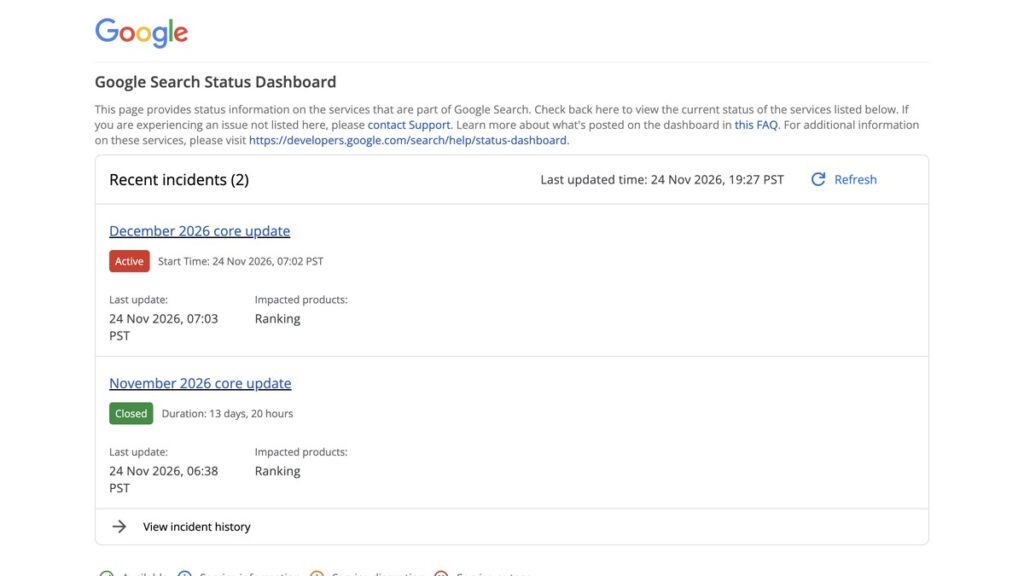
Google preannounced its December 2026 core update at 7:02 a.m. Pacific time on 24 November. At 6:38 a.m. the same dashboard marked the November 2026 core update closed, 24 minutes earlier. That is as close as two core updates have ever sat on Google’s own timeline, and the preannouncement does one thing the earlier ones did not: it says what the update is for.
The entry says the update brings “multiple improvements to how our systems understand and rank relevant content (including for longer and more complex questions)”. It also improves personalised results for anyone who has personalisation switched on. Google adds that the update applies to every location and language where Search runs, and that it is scheduled for release in December 2026.
What the two dashboard entries say
The November update ran from 10 November and closed after 13 days and 20 hours. The December one is announced and waiting. Side by side, the difference is in what each entry promises.
| Entry | November 2026 core update | December 2026 core update |
|---|---|---|
| Announced | At rollout start, 10 November | Before rollout, 24 November |
| Status on 24 November | Closed | Active, awaiting release |
| Duration or window | 13 days, 20 hours | December 2026, no dates |
| What it says it changes | Scope stated at launch, no focus area | Content understanding for longer and complex questions, plus personalised results |
| Where it applies | All locations and languages | All locations and languages |
The comparison week Google asks for falls on Black Friday
Google’s core update guidance says to wait at least a full week after a rollout ends, then compare a week of post-rollout data with a week from before it started. On these dates the post-rollout week runs 25 November to 1 December. The pre-rollout week runs 3 to 9 November. That first week holds Thanksgiving, Black Friday and Cyber Monday for every retail site in the US.
Two more things muddy it. Marie Haynes wrote that the click spike many sites saw in Search Console between 31 October and 2 November was not human traffic, which is why a 3 November baseline start matters. Google’s data anomalies page also lists lower impression counts in the Generative AI performance report for 9 to 11 November, and 9 November sits inside the baseline week.
If December’s rollout starts on 1 December, it opens on the last day of the week Google just told you to compare. Any week after that carries both updates at once.
The notice comes from a UK rule
Google published a new ranking section on Search Central the same day. It says two kinds of change get advance notice: actionable policy updates, where site owners may have to edit pages or markup, and significant ranking changes like core updates that move results across many queries.
The timing driver is the Competition and Markets Authority. Its fair ranking conduct requirements ask Google for at least 30 business days’ notice before changes publishers could act on, and at least 15 business days where Google can explain what is changing. Both requirements come into force on 17 December. Google’s own page says it explains “our advance notice timelines” and then does not list a number of days.
What is new for everyone else is the feedback route. A verified site owner can submit feedback on any update listed on the dashboard, through Submit Feedback in Search Console, with the change named as a hashtag, for example #NovemberCoreUpdate2026. Google suggests attaching a snapshot of the Performance report, the queries and URLs that moved, and the URLs that now rank in error. It also says engineering teams read submissions as a group and do not make manual URL level ranking changes from them.
From 17 December a site serving UK users that has been removed from Google’s index entirely can also appeal. That is a UK route. A site in India gets the notice and gets no appeal.
What this looks like from India
Half of the December entry is personalisation. Google’s documentation says a signed-in account’s Search Services History can change the order of individual results, or move whole groups of results, such as videos appearing before web links for someone who prefers video. A ranking check run from a signed-out browser in Jaipur sees none of that. On the client sites I look after, the personalised layer shows up mostly in branded and product queries from Android phones, which is where the signed-in traffic is.
The other half is content understanding for longer questions, which is the same direction every AI answer surface has been pushing. Posts that answer a long question in the first paragraph already do better in those surfaces, and I have written about that pattern in the search and SEO hub.
My read
I would publish one chart from November, not five. Put a page path filter in the Performance report and compare product pages with one templated content folder, which is the split Lily Ray showed on six sites dropping since 10 November. Every folder in her example repeated one template thousands of times, a page per word or per area code, aimed at searches outside the business.
Then set the Search Console annotations now, one on 24 November for the close and one for December’s start date when it is known. If December does start on 1 December, the seven-day window Google asks for closes the same morning the next update opens, and the annotation is the only clean marker you will have.
Also read
- 3 Filters the Search Analytics API Added on 16 November 2026
- 1 Rank Tracker Got 11.6% of Its Usual Google Data for 10 Hours
- 14 B2B Advertisers Paid 21% More for the Same Keywords in 2026
Sources
- Google Search Status Dashboard, entries of 24 November 2026
- Google’s core update guidance
- Google Documents Advance Notice For Significant Ranking Updates, Search Engine Journal, 24 November 2026
- Google Confirms November 2026 Core Update Is Complete, Search Engine Journal, 24 November 2026