Rank tracker Nozzle received 11.6 per cent of the Google results it would normally collect across 10 hours on 18 November 2026, and that day sat inside Google’s November core update. If your rankings fell that week, the first thing to check is not the update. It is whether your tool was getting data at all.
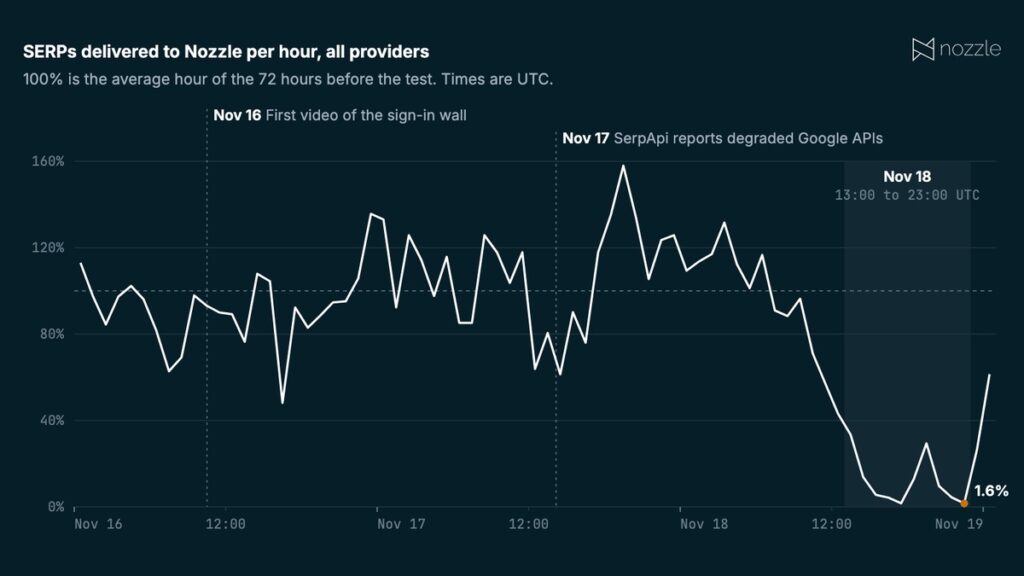
Nozzle published its own hourly chart, and the trough is 1.6 per cent of a normal hour. The drop ran from 13:00 to 23:00 UTC, which is 18:30 to 04:30 India time.
What Nozzle recorded
Nozzle buys search results through five data providers, so the count it publishes is its own collection, not Google’s. The chart sets 100 per cent as the average hour across the 72 hours before the test, then plots every hour from 16 November to 19 November.
Collection was normal until late morning UTC on 18 November. After that every provider fell at once. In each provider’s worst hour it delivered 2 per cent or less of its normal volume, which is why the chart reads like a switch rather than a slope.
| Measure | 18 November 2026 |
|---|---|
| Results collected over the 10-hour window | 11.6% of normal |
| Lowest hour on the chart | 1.6% of normal |
| Worst hour, per provider | 2% or less of normal |
| CAPTCHA rate on iPhone requests, one provider | about 19% before, about 90% during |
| Blocked attempts that landed on Google’s sign-in page | 31% of a sample, the rest on CAPTCHA |
Phone requests took the hit
Searches from desktop computers were hardly affected, according to Nozzle. The phone side failed in two ways. One provider reported that CAPTCHAs went from roughly 19 per cent of iPhone requests to roughly 90 per cent. The other block was a Google page headed “Sign in to continue”, with a line saying you need to sign in to verify you are a human and see more results. The button did not lead to the results.
That page is the part a tracker cannot work around. A CAPTCHA can be solved and a delay page can be waited out. A sign-in wall has no path through it.
For an Indian site this is worth a second look, because most of the search traffic here arrives on a phone. If the tool you rely on collects on mobile user agents, its 18 November gap was wider than the desktop dashboard suggests. That is my read of the numbers, not something Nozzle measured by country.
Google’s own answer
Brodie Clark of SERPalerts posted a video on 16 November showing the sign-in page appearing before any results, in an incognito window. Rajan Patel, Google’s VP of Engineering for Search, replied the next day that he did not believe it was meant to happen on the first page of results, and that Google may be testing something.
The wall did not disappear when the volume came back. Nozzle’s Derek Perkins says the sign-in page still appeared on a little under 1 per cent of page loads at the provider that reported the phone CAPTCHAs.
3 checks before you blame the core update
The November core update started on 10 November. Google’s dashboard said the rollout could take up to two weeks, and there was no completion entry when Search Engine Journal checked on 22 November. So a drop on 18 November landed in the middle of a rollout, which is the hardest week to read.
- Ask the tool whether it collected normally that day, and ask about mobile separately from desktop. A tracker that lost 90 per cent of its phone requests will report a fall that never happened on your site.
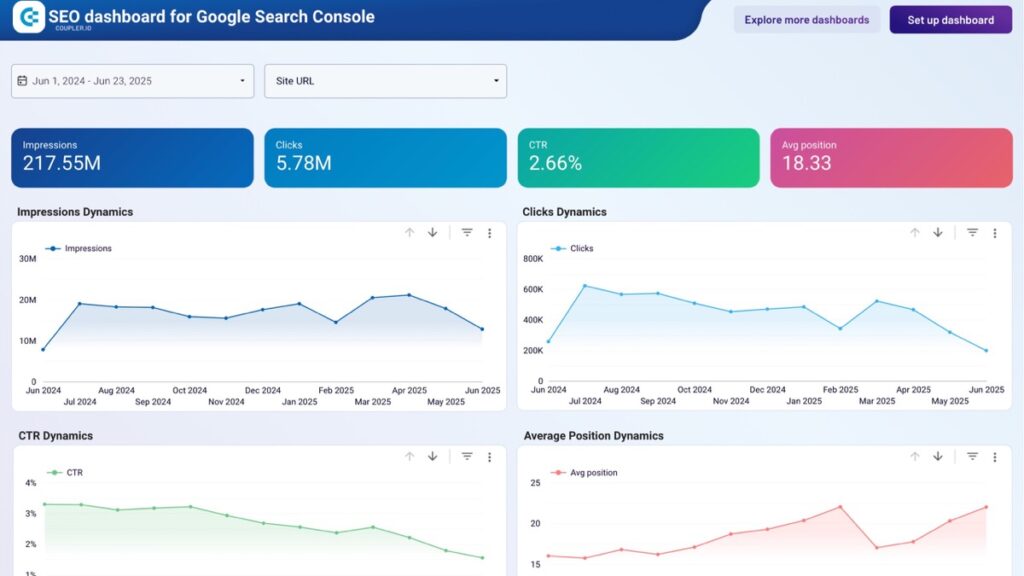
- Read Search Console rather than a rank tracker for the same days. It is Google’s own record of impressions and clicks, and it does not depend on a third party getting through.
- Wait a full week after the rollout is marked complete, then compare that week with the week before the update started. That is Google’s own instruction for reading a core update, and it rules out the days when data was thin.
One number deserves caution. Nozzle can only report what its own five providers delivered, so it cannot prove other tools had the same gap. The check is cheap though. Ask your provider for a daily delivery count before you rewrite anything.
The measurement side of search gets more attention on the search and SEO hub, which collects the reporting and data posts together.
Also read:
- 3 Filters the Search Analytics API Added on 16 November 2026
- Open Web Traffic Fell 12% Since 2022. 3 Checks Before You Blame AI
- 5 Numbers in Salesforce’s Own SEO Guide That Its CEO’s Post Leaves Out
- 33 of My 156 Blog Posts Have No Internal Link Pointing at Them
Sources: Google Killing Incognito Searches? on the Nozzle blog, and Check Your Nov. 18 Rank Data Before Blaming The Core Update, Search Engine Journal, 23 November 2026.