On 16 November 2026 Google added appointment finding to Ask Maps, the chat inside Google Maps. In the US it looks for open slots at beauty, pet care, auto and home repair businesses, then phones them to confirm a time. The booking runs through a Business Profile setting that most owners have never opened.
What Google shipped on 16 November 2026
Google’s own post describes three additions to Ask Maps, and only one of them changes anything for a business with a phone number. All three started rolling out on Android and iOS that day.
- Trip itineraries. Ask Maps builds a day-by-day route with numbered pins, and the itinerary can be exported to Google Docs on desktop.
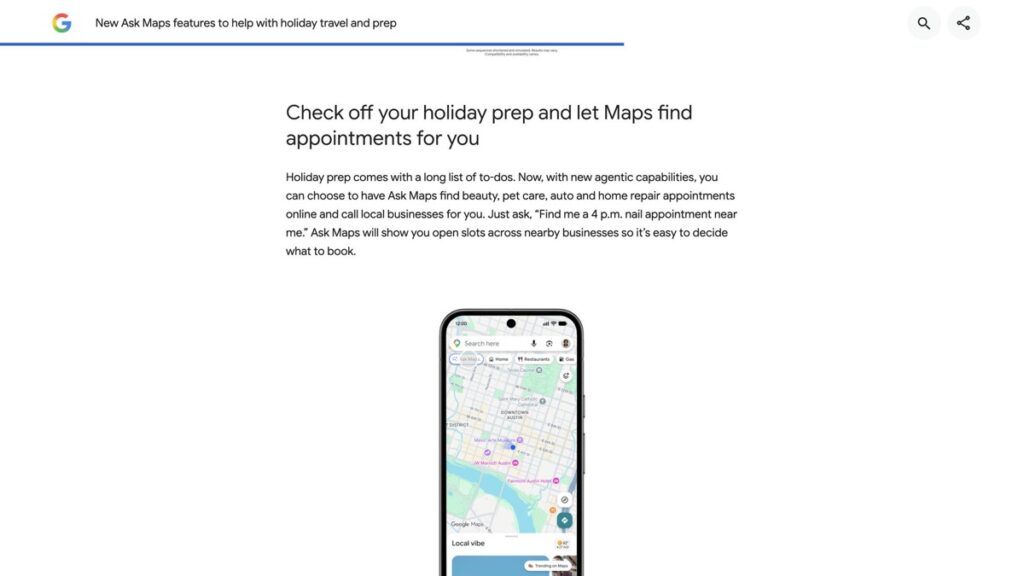
- Appointment finding. You ask for “a 4 p.m. nail appointment near me” and Ask Maps shows open slots across nearby businesses. Google’s wording is that it can “find beauty, pet care, auto and home repair appointments online and call local businesses for you”.
- List search. A question like “which spots saved in my lists have availability for five people in the next 30 minutes” gets answered from the places a user has already saved.
The regional detail matters more than the feature list. Ask Maps expanded to 30 countries across Europe, including Spain, Germany and the UK, which takes it past 200 countries and territories. Itineraries and list search are available everywhere Ask Maps runs. Appointment finding and the route tips launch in the US first, with more regions promised and no dates named.
The 3 settings that sit under the phone call
Google already documents calls it makes to businesses on a customer’s behalf, and the help page lists the requests it covers: appointment bookings, restaurant wait times, and confirming a product or service with prices. The controls live in one place, under More, then Business Profile settings, then Advanced settings, in a section called “Google automated calls and text messages”.
- Bookings and inquiries from customers. This is the one that decides whether Google may call about a booking at all.
- Keep your profile up to date. If Google confirms your hours or services on a call, it can update the profile from what it heard. Those updates arrive as “Pending” and can take up to 5 business days to be reviewed, and you can remove them afterwards.
- Post to your profile on your behalf. The same call content can become a post on your profile. This is the toggle that leaves a stale update sitting under your business name when nobody is watching it.
Google’s help page also says the calls are monitored and recorded for quality, that they cost the business nothing, and that Google limits repeat calls for the same information and avoids late night and early morning. It does not say what happens to a slot when a business has turned the booking toggle off, so the honest reading is that the call cannot confirm and the opening is not held.
The call is recorded, and the answer decides the booking
Whoever picks up the shop phone is now quoting a price to a customer, on a recorded line, at the hour Google chooses. The person most likely to answer is the busiest one in the building. If the counter says “we are fully booked” while the salon’s own booking page shows 4 pm free, the customer takes the next shop in the same list.
When the version in Search launched in July 2025, the person who asked Google to check pricing got an email with the quotes from the businesses that answered. The booking in Ask Maps is the same phone call with the answer turned into a slot, which is why the price on the phone now decides something a day later.
A one-page answer sheet covers what the call needs. State the service name, the length of the appointment, the price range, and the next slot that is genuinely free. Add the sentence that should not be said, which is usually “let me check and call you back”, because the agent is talking to a customer who is already choosing between four shops on one screen.
Google’s demo shows Ask Maps confirming service, location and preferred time before it checks availability, so the call opens with a specific request rather than a vague one. That is easier to answer than a normal enquiry, provided the person answering knows today’s prices and today’s empty slots. Writing that down takes one page, and it is the cheapest preparation for this feature.
Why a business in India can wait on this one
Appointment finding is US-only for now, and Google’s help page says the automated call features run in select regions and languages. Inside the US it works in every state except Indiana, Louisiana, Minnesota, Montana and Nebraska, which is the kind of list that only exists because the feature is still being rolled out. A salon in Jaipur has no new button to press this week.
What changes now is the standard the next customer arrives with. A profile with wrong hours or a missing service list is still the profile that loses the booking when the call does come. The mistakes that get Indian businesses suspended are the ones that cost visibility first. The search and SEO hub keeps the local work together, and the Business Profile rules for Indian businesses cover the suspension side, which hurts long before an agent ever phones.
Google did not say how it picks the shops
Search Engine Journal’s 17 November 2026 write-up makes the gap plain. Google’s post does not explain how Ask Maps chooses which businesses to check or call. The earlier version of this feature, which arrived in Search in July 2025 under “Have AI check pricing”, picked businesses using traditional local search rankings according to a Google spokesperson at the time.
If that carries over, the entry ticket stays the same one local businesses already chase: the map pack, review count and recency, correct categories and hours. An AI agent calling the third result instead of the first is not a fresh ranking system. It is the old one with a phone. The same pattern showed up in how ads behave in AI Mode in India, where the new surface sat on top of the existing auction rather than replacing it.
What to change in Business Profile this week
Five fields do the work when a call or a booking arrives. Check each one against what the shop would actually say on the phone.
| Field | Where it is | What to set |
|---|---|---|
| Bookings and inquiries from customers | More, Business Profile settings, Advanced settings | On, if you want Google to call about a booking |
| Post to your profile on your behalf | Same section | On only if someone checks the profile weekly |
| Phone number | Profile, Contact | The number a person answers in business hours |
| Hours | Profile, Hours | Today’s hours, including holidays |
| Services and prices | Profile, Services | Real price ranges, not “call us” |
The two toggles are the part nobody audits. A profile that allows Google to post on its behalf, with nobody reading the profile, collects updates that were accurate on the day of the call and wrong a month later.
Open Business Profile, walk the three toggles, and write down which one is off. That is five minutes of work, and it is the whole of what Google has left a business to control on this surface.