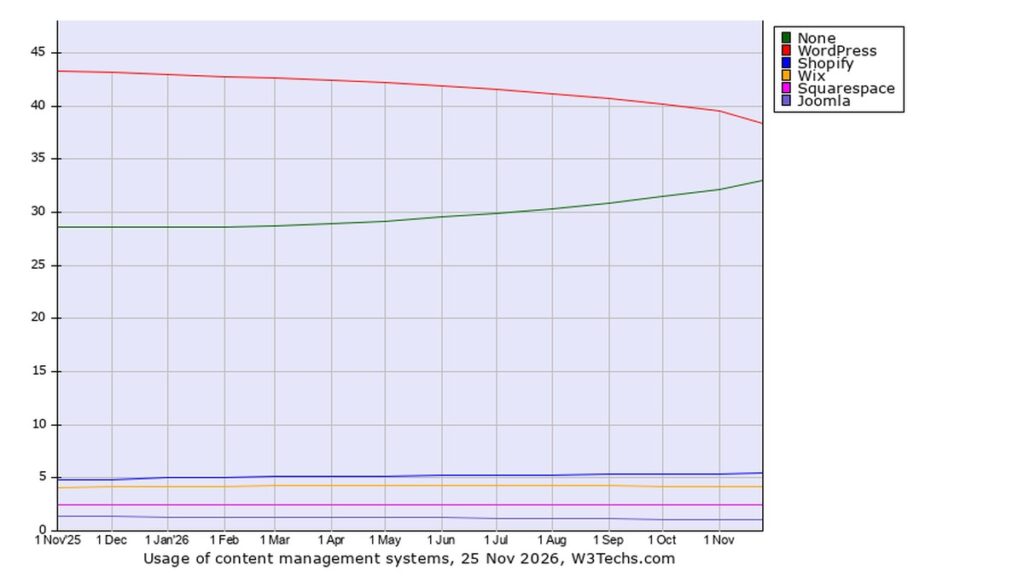
WordPress runs on 38.4 per cent of all websites as of 23 November 2026, down from 43.2 per cent a year earlier. That is 4.8 points gone in twelve months, and no other platform picked them up. The share of sites running none of the content management systems W3Techs tracks rose 4.4 points in the same window, from 28.6 to 33.0 per cent.
The number worth taking to a client is the second one. A third of the web now has no CMS whose defaults can set a title tag, a canonical, a robots directive or a sitemap. An audit that opens with “install an SEO plugin” is describing software that a third of sites do not run.
What W3Techs measured
W3Techs tracks technology on more than 20 million websites and updates the figures every single day. Its 23 November reading puts WordPress at 38.4 per cent of all sites and the no detected CMS group at 33.0 per cent. Shelley Walsh’s November CMS update used the 13 November figures, when WordPress stood at 39.2 per cent, which shows how fast the line is moving inside one month.
Matt Southern wrote the Search Engine Journal report on 24 November 2026. He also caught the detail that makes the year strange. Usually a platform’s loss lands somewhere, and here it did not.
The year in one table
The gap between WordPress and the no detected CMS group was 14.6 points a year ago. It is 5.4 points now.
| Share of all websites | November 2025 | November 2026 | Change |
|---|---|---|---|
| WordPress | 43.2% | 38.4% | -4.8 points |
| No detected CMS | 28.6% | 33.0% | +4.4 points |
| Shopify | 4.9% | 5.5% | +0.6 points |
| Wix | 4.1% | 4.2% | +0.1 points |
| Squarespace | 2.4% | 2.4% | flat |
| Joomla | 1.4% | 1.0% | -0.4 points |
| Drupal | 0.8% | 0.6% | -0.2 points |
The fall inside November is the fastest of the year
WordPress has given up 1.1 points since 1 November. No complete month this year was that bad. For the first seven months it lost less than half a point a month, then half a point in August and September, and 0.7 points in October. In May it sat at 41.9 per cent, which was the sixth consecutive monthly fall.
There is a quieter number behind all of it. W3Techs now lists Lovable, described as an AI powered platform for building websites, in this table. It reads 0.6 per cent on 25 November, level with Drupal, and the row is empty for every month before that. An AI site builder has appeared beside platforms that have been tracked for a decade and it has arrived at Drupal’s number.
Two measures give two different WordPress numbers
WordPress also fell on W3Techs’ market share measure, which counts only sites that run a CMS the survey detects. That pool shrinks as the no detected CMS group grows, and the result is a milder drop, from 60.5 to 57.3 per cent. Wix rose from 5.7 to 6.2 per cent on the same measure while moving 0.1 point as a share of all websites. Most of that gain is arithmetic.
So if someone sends you a chart showing WordPress still above 57 per cent, they are not wrong. They are counting a different denominator. Ask which one before the argument starts.
What I check when the CMS is missing
A site with no CMS has no plugin to lean on and no theme to inherit from. Four things get checked by hand on those, and they are the same four I would check on any WordPress site after a big change.
- Titles and meta descriptions, rendered, not planned. If the builder generates them from a heading, the heading is the title.
- Canonical tags on every template, including the paginated ones, which is where static exports duplicate most.
- Robots directives on staging copies. A site built in a tool and pushed live often carries the tool’s preview rule.
- Sitemap existence and freshness. A missing sitemap on a no-CMS site is common and easy to prove.
On the WordPress side of the same audit, this month is crowded. WordPress 7.2 lands on 8 December, so the checks before that release matter more than the market share chart. I keep the release checks together in the WordPress care hub. If sitemaps are the gap, the crawler test is the fastest way to find it.
What this looks like from India
W3Techs samples large sites. A Jaipur clinic’s five page site and a D2C store doing forty orders a month sit far below that cut, so this figure is a read on the head of the market and not a census of it. What does travel is the shape of the problem. When a client site turns out to be a static export from a site builder, the plugin advice I would give on WordPress does not apply, and the fix is a template level edit that someone has to own.
My read
The WordPress share slide is not a WordPress quality story. People are leaving hosting stacks and page builders for tools that produce a site without a CMS at all, and the number that proves it is the no detected CMS line, up 1.5 points since 1 October alone. Watch that line on 1 December. If it keeps the pace, the audit question changes from “which plugin” to “which layer of this stack writes the tags”.
I would also stop quoting WordPress share as a sign of health in a pitch. Down 4.8 points in a year, and inside November alone down 1.1, is a market telling you where new sites are being built. The work is still there. It has just moved one layer down the stack, where nobody sells a plugin for it.
Also read
- Before WordPress 7.2 Lands on 8 December, Run 4 Checks
- 4 Checks That Prove Your Sitemap Still Works in Chrome 158
- Error Establishing a Database Connection: 5 Checks in Order
Sources
- W3Techs CMS usage history, readings of 23 November 2026
- WordPress Drops To 38.4% Of The Web, Down Nearly 5 Points In A Year, Matt G. Southern, Search Engine Journal, 24 November 2026