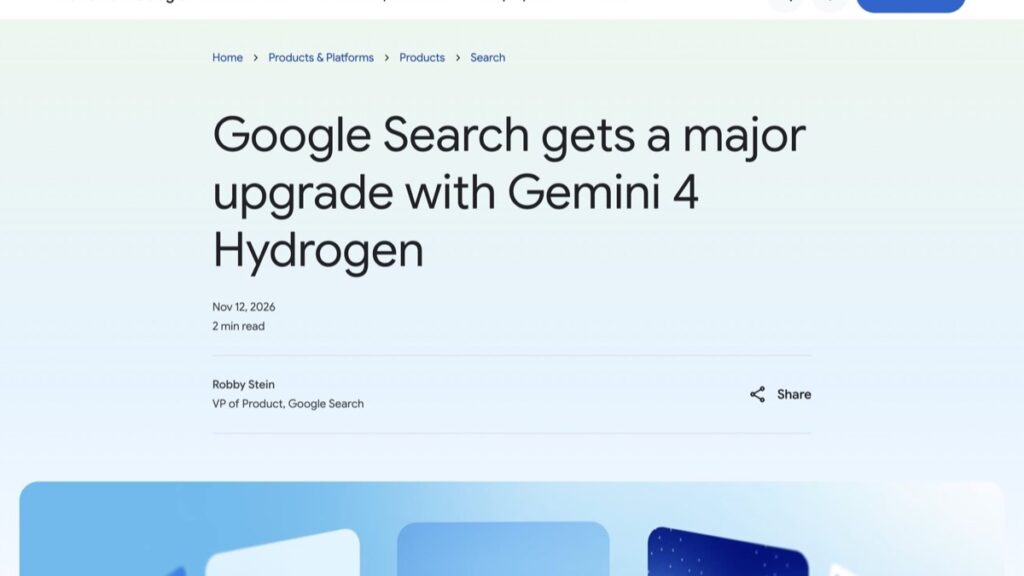
Google made Gemini 4 Hydrogen the default model in AI Mode for every user worldwide on 12 November 2026. The switch came 2 days into the November broad core update, which was still rolling out while Search Engine Journal reported it. Any citation data you compare across this week now carries two changes at once, and only one of them was announced in advance.
What Hydrogen changes in AI Mode
Google’s Search post names 4 changes. Search handles multi-part questions, typos and highly specific requests better. Query fan-out is stronger, so answers point at a wider range of sites. Answers carry more images, comparison tables and custom tools. Wording gets more nuanced in every supported AI Mode language.
- Intent. Questions with several parts, hard-to-read typos and narrow requests are handled with more instruction following.
- Query fan-out. Google describes “connecting you to a broader range of helpful links than before”, including sites a user might never have found.
- Visual answers. More images, structured responses, comparison tables and tools built for the question.
- Language. “More highly nuanced and helpful responses across all supported AI Mode languages.”
One line matters more than the rest for anyone tracking citations. Robby Stein, Vice President of Product for Google Search, said on X that Hydrogen is also “being used for your hardest questions in AI Overviews”. AI Overviews are the summary blocks above the results, and they were not part of the Search post at all.
Which Gemini 4 model does what
Google now ships 3 Gemini 4 models into Search, and only one of them is the default. The other two are paid options aimed at longer thinking.
Google’s Search announcement opens by calling Hydrogen the biggest model upgrade to Search yet and says it is available globally for all users. It does not say which model it replaced. Neither does Stein’s thread. What is on record is that Gemini 3.5 Flash became the AI Mode default at I/O in May 2026, and that Google’s AI Mode help page still lists Carbon for Ultra subscribers with a daily usage limit.
Why 12 November splits your data in two
The core update started on 10 November. The model changed on 12 November. A report that compares the first week of the month with the third week is measuring both at once, and the 4 moves worth making before comparing core update traffic only cover half the picture now.
AI Overviews moved as well, at least in part. Stein’s thread says the hardest AI Overview questions go to Hydrogen. Which questions count as hardest has not been published, so a drop in AI Overview citations on a technical query and a rise on a simple one may both belong to the model rather than to your page.
What to do with the numbers this week
- Split every comparison at 12 November rather than at the start of the month, and label the two windows with both dates.
- Read AI referral separately. GA4 misses 4 kinds of AI referral visit, so a flat line there is not proof that citations did not change.
- Fix a set of 10 to 20 prompts today and keep the raw answers plus the URLs Google quotes. Running that same set next week is the only like-for-like measure you control.
- Watch for new URLs. A stronger fan-out means the end of one page per keyword shows up as your pages being cited on queries you never targeted.
The claim Google left without a number
“A broader range of helpful links” carries no count. Neither the Search post nor Stein’s thread gives a figure for links or sites, and Search Engine Journal said the same thing directly. So the only number that exists is the one you can measure on your own site. Treat the wider linking as a direction to test, not a gain to report.
Hydrogen is live in every market Google Search serves, India included. The AI Mode ads that reached India this week now run beside answers written by a different model, which is the same surface with two changes stacked on it.
The older problem has not gone anywhere either. Blog posts still fail to get cited in AI answers for reasons that a better model does not fix, and a model swap changes which pages get quoted rather than whether a thin page deserves to be. Everything else on this beat sits in the AI search hub.