Google expanded ads in AI Mode to more than 10 new countries in English and turned on multiturn ads in the United States on 9 November 2026. India is on the country list, with text ads only in Pakistan. The part that changes your monthly client report is what Google still refuses to separate out.
What Google changed this week
The Google Ads account posted the expansion on 9 November 2026, after an October announcement that named the countries. Three things moved at once. Countries with English inventory went from a short list to more than 10. Multiturn ads started in the United States, which means an ad can appear against a follow-up question rather than only the first one. And Brazil, Mexico and the United Kingdom were named as Q4 2026 markets rather than part of this round.
| What changed | Detail | What it means for a campaign |
|---|---|---|
| Countries | Australia, Canada, India, Kenya, Malaysia, New Zealand, Nigeria, Pakistan, Philippines, Singapore | Existing Search, Shopping and Performance Max campaigns can serve there without a new build |
| Pakistan | Text ads only | Shopping and Performance Max inventory will not show |
| Multiturn ads | United States only for now | Ads can follow a conversation past the first question |
| Reporting | No separate AI Mode line | Impressions, clicks, cost and conversions sit inside campaign totals |
Why follow-up questions change the buy
AI Mode is built for questions that need exploration, comparison or several steps of reasoning, and Google says it may run query fan-out behind one question, issuing related searches across subtopics. Multiturn ads put a sponsored line inside that conversation once it turns commercial. A person comparing four options now generates several moments where an ad can appear, and most of them happen before anyone types a product name.
That is the same mechanism that makes organic visibility in AI answers hard to predict. Query fan-out is why one page per keyword stopped working, and the paid version of the same shift means a broad match term is doing work it was never asked to do.
What is missing from reporting
Google’s own documentation says AI Mode impressions, clicks, conversions and costs are included in standard campaign reporting, with search terms combined with other traffic. There is no AI Mode segment. You cannot calculate an AI Mode cost per acquisition, and you cannot show a client what share of spend landed inside a conversation.
The documentation also warns that reported search terms for experiences like AI Mode may approximate what the user meant rather than quote it. Anyone who builds a report on the literal search term strings is building it on a paraphrase.
What I would tell a client this week
Four sentences cover it, and none of them promise a number you cannot produce.
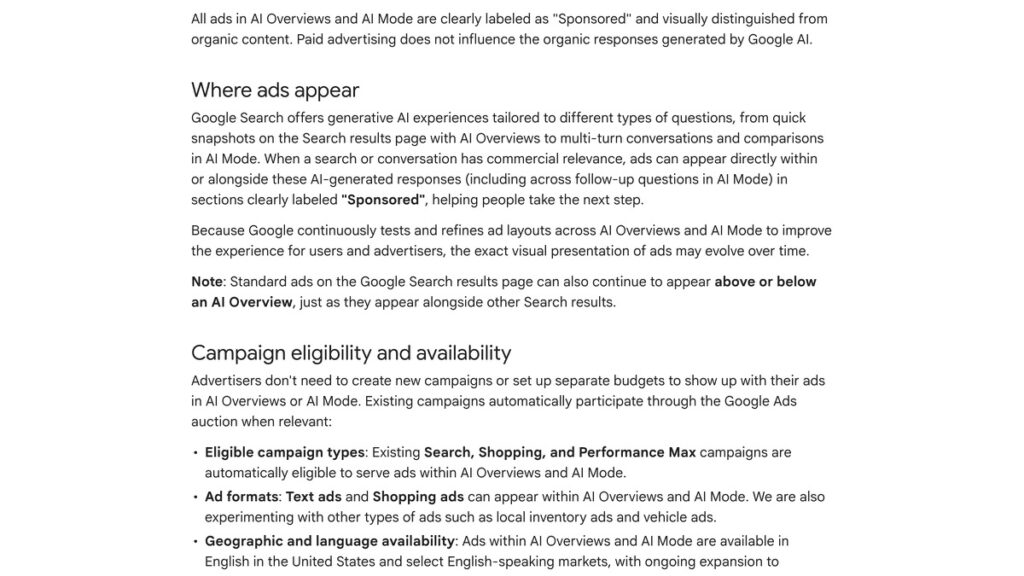
- You are already eligible. Search, Shopping and Performance Max campaigns enter the AI Mode auction without a new campaign or a separate budget.
- The results are in your totals. There is no separate AI Mode line, so any claim about AI Mode performance is an inference from campaign-level data.
- Watch lead quality rather than placement. Conversions and lead quality are still visible per campaign, so compare those instead of chasing a placement report that does not exist.
- Timing is not causation. If performance shifts after the expansion, the calendar alone does not prove AI Mode caused it. Something else shipped that week too.
The gap has an upside nobody mentions
When a placement cannot be measured separately, it also cannot be optimised against. That is annoying for reporting and useful for budgeting. The campaign that wins is the one whose landing page and offer survive a longer question, because the ad is arriving mid-decision rather than at the end of a search. In practice that means the page has to answer the comparison, not just the keyword.
I have argued before that a paid slot in an AI surface can win an auction and still produce nothing. A ChatGPT ad can win the auction and never be shown, and the AI Mode version has the same shape of risk on top of a reporting gap.
Add the organic half to the same slide
AI surfaces break referral reporting as well. Direct visits, app opens and visits attributed to the wrong channel all hide inside the same numbers, which is why GA4 undercounts AI referral traffic in four ways. If you are putting AI Mode on a client slide, put the organic measurement gap next to it, or the paid half will look like the only thing that moved.
What to do before the next report
Three checks, all doable today. Open the campaign settings and confirm the countries you actually sell into are not excluded from the expansion. Pull the last four weeks of conversions by campaign so you have a pre-expansion baseline dated 9 November 2026. Then look at the search terms report and note the proportion that read like questions rather than phrases.
That question-shaped share is the closest proxy you have for AI Mode spend until Google gives you a segment. The AI search hub keeps the rest of these pieces together, and Google’s own documentation on ads in AI-powered experiences is the page to read before answering a client question about it. The expansion was reported by Search Engine Journal on 10 November 2026.