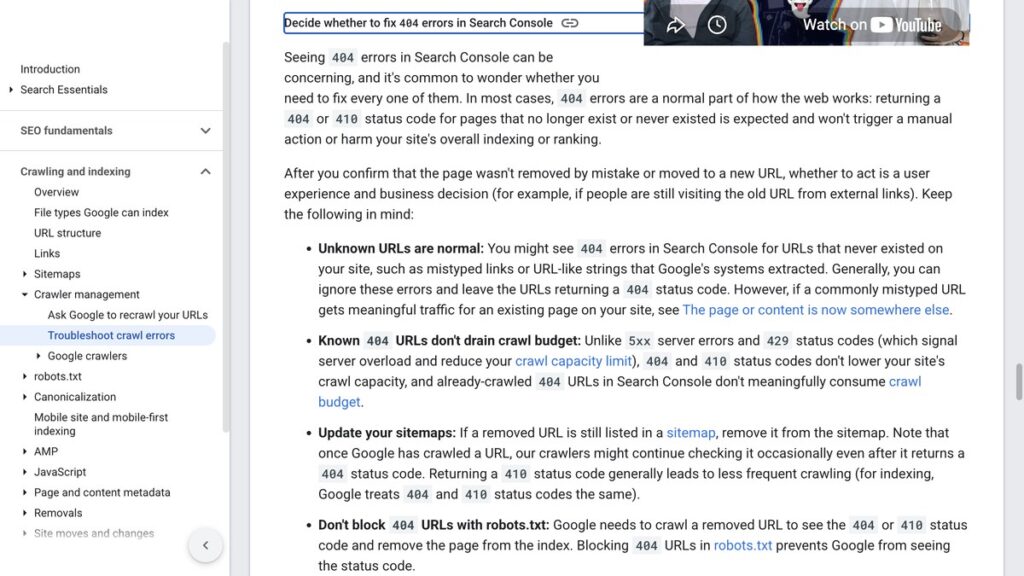
Google moved its 404 guidance into the Search Central documentation on 27 November, and one sentence in the new section settles an argument that has run for years. A page returning a 410 (Gone) “generally leads to less frequent crawling” than one returning a 404, while indexing still treats both codes the same.
That line is the only practical difference Google now names between the two codes. The rest of the section repeats advice that lived on a Search Console Help page until this week, and that page now redirects to the guide.
What the new line actually says
Google writes that its crawlers might keep checking a 404 URL occasionally after crawling it once. Return a 410 instead, and that checking slows. Indexing does not care which code arrives, so the difference sits in how often a dead URL gets revisited rather than in what happens to the page.
The retired page was blunt about the old position. The version archived on 9 November 2026 read, “Currently Google treats 410s (Gone) the same as 404s (Not found).” That sentence no longer exists in the documentation Google asks people to read.
404 and 410 side by side
| What happens | 404 (Not found) | 410 (Gone) |
|---|---|---|
| Indexing of a URL that was indexed | Removed from the index | Removed from the index |
| Crawling after the first hit | Occasional checks may continue | Generally crawled less often |
| Site crawl capacity limit | Not lowered | Not lowered |
| Crawl budget already spent | Not meaningfully consumed | Treated the same |
| URL still in a sitemap | Take it out | Take it out |
| Blocking it in robots.txt | Do not block it | Do not block it |
| Redirecting it to the home page | Counted as a soft 404 | Counted as a soft 404 |
What the 410 does not buy you
The same section knocks down the louder claim people make about 410s. Google writes that neither status code lowers a site’s crawl capacity limit, and that already-crawled 404 URLs “don’t meaningfully consume crawl budget”. So a 410 does not widen your allowance. It stops repeat visits to pages that are not coming back.
Google also never says how much less often it crawls a 410. The guide leaves the size of the effect unstated, which means any percentage quoted at you is somebody’s guess dressed as a finding.
Where the extra work pays off
One page, one 404, forget it. The line only matters when a block of URLs dies at once, the way an archive of discontinued products does. That is the shape where repeat checks add up, and it is the only place I would bother writing 410 into a server rule.
The reading that would settle it sits in access logs, not in a dashboard. Send a 410 for one group of retired URLs and leave a similar group on 404, then count how many times Googlebot asks for each over a month. Two groups of the same size and age give you a result. One group gives you a hunch.
Google publishes no country split for crawling, so a site in Jaipur works this out from its own server logs and from nowhere else.
Fix these two things first
The status code sits at the end of a list of cheaper fixes. A removed URL still listed in a sitemap is the first item, and it survives longest because the sitemap rebuilds itself while nobody prunes it.
Blocking dead URLs in robots.txt is the second. Google has to fetch a URL to see its status code, so a block hides the 404 or the 410 and leaves the page sitting in the index where it was. The search and SEO hub carries the rest of the indexing checks I keep coming back to.
My read
This is a documentation change that tidies an old ambiguity, and the tidying is worth more than the tactic. For years the honest answer to 404 versus 410 was that it did not matter. Now the answer is that it matters only if you are retiring URLs in bulk and can measure the difference yourself.
Clean the sitemap, leave robots.txt alone, and reach for the 410 when the dead pages arrive in hundreds rather than one at a time.
Also read: Crawled but Not Indexed: 4 Checks in the Right Order. 4 Checks That Prove Your Sitemap Still Works in Chrome 158. 4 Checks Before You Add Noindex to a Page. What a 503 Status Code Does to Your Rankings During PHP Patching.
Sources: Google’s crawling errors guide, the 27 November entry in the Search Central documentation updates, and the archived Search Console Help page from 9 November 2026.