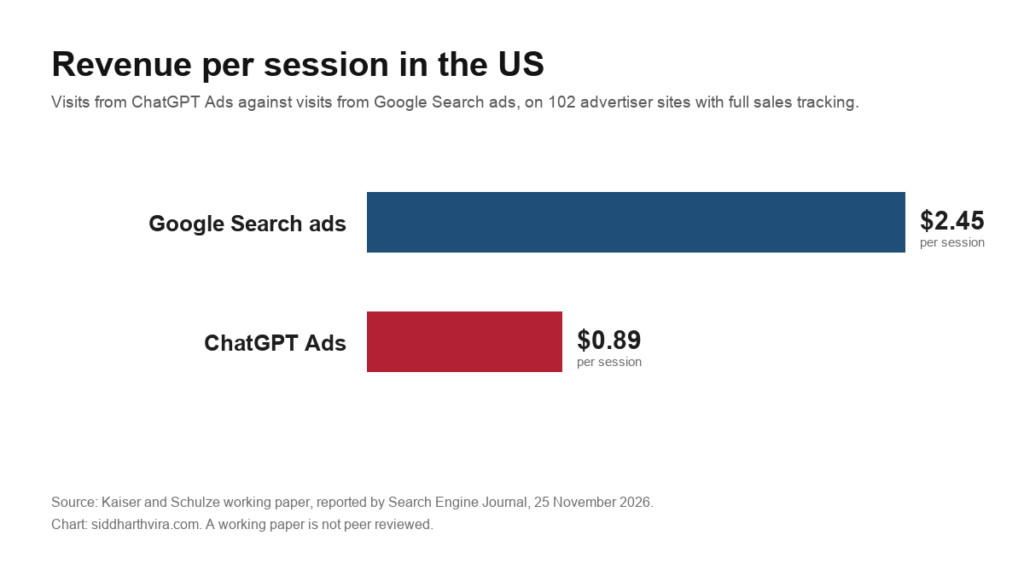
On 102 advertiser sites with full sales tracking, a visit from ChatGPT Ads produced $0.89 in revenue per session in the US. A visit from a Google Search ad produced $2.45. That is the cleanest number in this whole debate, and it is still only half a number, because revenue per session says nothing about what the session cost.
The figure comes from a working paper by Maximilian Kaiser and Christian Schulze, as Brooke Osmundson reported in Search Engine Journal on 25 November 2026. A working paper is not peer reviewed, so treat the direction as the finding and the exact gap as provisional.
The size of the channel is not in doubt. OpenAI says more than 100,000 advertisers have run ads on ChatGPT, and that the ad business reached a $1 billion annualised revenue run rate less than 200 days after launch. Plenty of money is moving. The open question is whether it comes back.
The 30 brands that had to decide
Adthena looked at 30 enterprise brands that shared results between July and September. Of those, 52% struggled to recover what they spent, 26% matched or beat Google Ads, and 22% reported mixed results. That is the most useful split in the piece, because it is the only one where the same measurement was applied across a group of advertisers.
It is also the softest number, and Osmundson says so herself. Adthena gives little detail on how each brand measured returns or which Google campaigns it compared against. A brand measuring cost per lead and a brand measuring closed sales would land in different buckets from identical campaigns.
Four data points, four different measurements
Read the table this way: none of these numbers contradict each other, because none of them measure the same thing. Revenue per session, return on ad spend, conversion rate and a poll of practitioners can all be true at once.
| Source | What it measured | Sample | Number |
|---|---|---|---|
| Kaiser and Schulze working paper | Revenue per session in the US, ads versus Google Search | 102 advertiser sites with full sales tracking | $0.89 against $2.45 |
| Adthena | Ability to recover spend, July to September 2026 | 30 enterprise brands | 52% could not recover it |
| OpenAI’s Evernote case study | Trial to paid conversion | One advertiser | 10% to 20% above its historical average |
| Osmundson’s LinkedIn poll | What advertisers did after testing | 21 respondents | 8 still spending, 7 stopped |
What agencies are actually seeing
Oakpool has run ChatGPT Ads for clients in boutique hospitality, B2B services and entertainment since spring. Its co-founder James Hamilton told Osmundson that most clients in the pilot are still spending, that return on ad spend is lower than on Google, and that the budget is small enough to keep running. He also said clients ask far more often about appearing in ChatGPT’s organic answers than about buying a place in them.
The cautionary version is an agency that spent about $15,000 on its own ads in the first month, watched results fall off, and now spends about $800 a month as branding. About half its clients who tried the channel moved their budgets back to Google, citing conversion tracking and an inability to see where the ads appeared.
The sharpest example is a bankruptcy lawyer who got up to 20 conversions a month at a low cost per lead and no paying client after two months. The inquiries were real and related, and they were outside the cases the firm takes. Cheap leads are not the same as good ones, and no click price fixes a targeting mismatch.
Why the cost side is so hard to read
One agency reported clicks under $1 in the first week and early delivery skewed toward lower-income markets the client had not planned to test. Another said approvals took weeks and sometimes months before campaigns went live. Cheap clicks in the wrong geography give you a cost per click that looks excellent and a cost per customer that does not.
That is why I would not compare a first ChatGPT test against a Google account someone has spent years improving. The useful comparison is within the same business: tag ad clicks separately from organic ChatGPT referrals, keep the source in the CRM, and follow the lead past the demo request to a paid invoice. Your ChatGPT Ad Can Win the Auction and Still Not Show explains why the impression count is a weak denominator on its own.
There is no India number in any of this
Every figure above is US or unspecified, and none of it covers rupee pricing, cash on delivery or the return rates that decide whether an Indian ecommerce campaign made money. The closest India-specific news is that Ads in AI Mode Reach 10 New Countries and India Is on the List, which is a Google surface rather than an OpenAI one. An Indian brand testing this channel is working without a local benchmark, and the only honest plan is to run a small budget and measure its own close rate.
If the spend is real, the first number to distrust is the click price. The second is revenue per session without the cost beside it. The third is any comparison against a campaign that has had years of optimisation behind it. The wider marketing archive, ads included, sits in the digital marketing hub.
Also read:
- Your ChatGPT Ad Can Win the Auction and Still Not Show
- 14 B2B Advertisers Paid 21% More for the Same Keywords in 2026
- 5 Numbers in Salesforce’s Own SEO Guide That Its CEO’s Post Leaves Out
Sources: Search Engine Journal’s report by Brooke Osmundson, 25 November 2026, which cites the Adthena findings, the Kaiser and Schulze working paper and OpenAI’s Evernote case study.