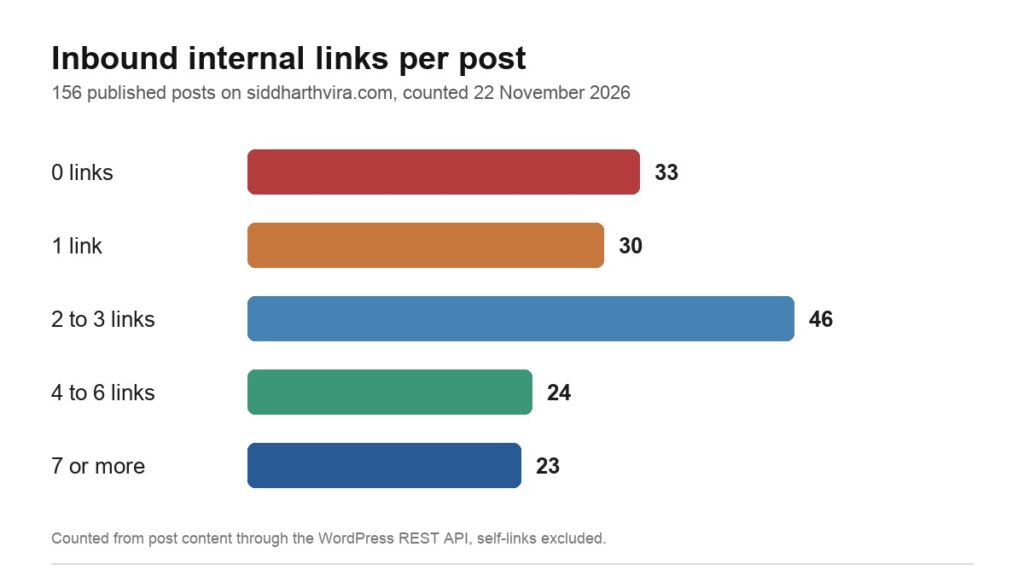
I counted the links between every post on this blog this morning. Of 156 published posts, 33 have no internal link pointing at them from another post. Another 30 have exactly one. That is 63 posts, or 40 per cent of the archive, reachable only from a hub page, a category page or the sitemap.
The pull ran at 10:50 IST on 22 November 2026, when the site had 156 published posts. Every number below comes from that one read.
I read the saved content of all 156 posts through the WordPress REST API, extracted every link to siddharthvira.com, matched the slug against the published list, and ignored links a post makes to itself. The result is inbound links from other posts only. Pages, menus and anything a plugin injects are outside it.
5 buckets, and the average sits in the middle
Most posts do get linked, and the average post carries 4.06 outbound internal links. The most linked page on the blog takes 17 from other posts. The problem is concentrated at the bottom, where a third of the archive has a single link or none.
| Inbound internal links | Posts |
|---|---|
| 0 | 33 |
| 1 | 30 |
| 2 to 3 | 46 |
| 4 to 6 | 24 |
| 7 or more | 23 |
22 of the 33 orphans were published this month
That surprised me. I expected the unlinked posts to be old ones from 2022 that nobody had opened since. Instead 22 were published in November 2026, nine in October, one in May 2025 and one in August 2022.
The mechanism is obvious once you see it. A new post links out, so it adds an inbound link to older posts. Nothing links forward, because the older post was written before the newer one existed. Publishing four posts a day makes this worse rather than better. Each day adds four pages that no existing page knows about.
The hubs carry the rest
Links from posts into the hand-built hubs, counted the same way. These are counts of links, not posts.
- Movies and TV: 39 links
- Anime: 36
- Book notes: 21
- WordPress care: 18
- AI search: 16
- Search and SEO: 13
- Career and craft: 5
- Digital marketing: 3
Four of the last 40 posts carry no hub link at all, which is how an orphan happens even when the writer is being careful. The Search and SEO hub has the fewest links of any hub I post to weekly, which is its own signal.
Why this matters more on a small site
Google’s own guidance on links says the words inside a link help it understand the page being linked to, and that it uses both internal and external links to work out what a page is about. On a blog with more posts than external links, an internal link is the only vote most pages will ever get. There is no outreach, no guest post and no press mention arriving to do the job.
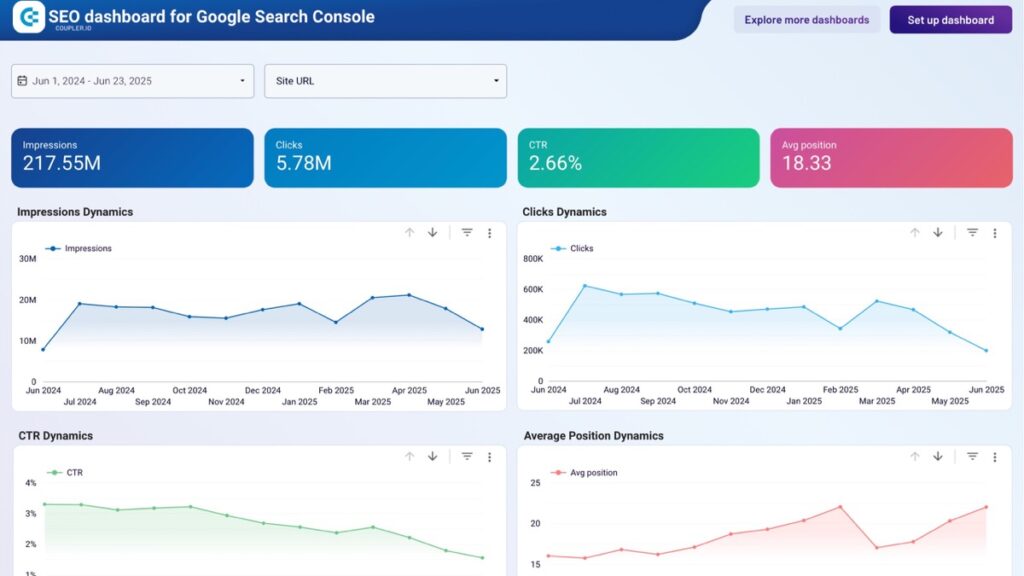
Practically, that shows up as pages that sit at position 20 with impressions and no clicks. The content is not the problem on those pages. Nothing points at them, so they never gather enough signal to move. I have watched this on two hundred posts now, and the pattern is that the pages which get quoted in AI answers are the ones with several internal links, not the longest ones.
3 changes I am making
- Every new post links to two posts older than a month, not only to this week’s arrivals. Anchors carry the target’s title rather than a phrase like “read more”.
- Every post carries its hub link before it goes out. The 4 posts without one are the case for making that a check rather than an intention.
- A monthly pass over the zero list. The pull above takes one API call, so there is no reason to guess which pages are orphans.
The third one is the one that fixes the 2022 post. An editor reading a new draft has no reason to think about a piece from four years ago, and a list of unlinked pages puts it in front of them at the moment they are choosing anchors anyway.
What this count does not show
It does not count links from pages, and several of the 33 are reachable from a hub page that lists them. A hub link is a real path for a reader and for a crawler, so none of these posts is truly unreachable. What a post does not have is a link from another post, which is the kind that carries topical context.
It also says nothing about ranking. Link count is a proxy, and Google does not publish how it weights an internal link against an external one. Treat the 33 as a list of pages to look at, not a list of pages that are failing. For the wider version of that idea, A Test That Cannot Fail Proves Nothing About Your SEO is the argument I keep coming back to.
Also read:
- Why Your Blog Posts Never Show Up in AI Answers
- 3 Checks That Show 2 Pages Fighting for the Same Query
- 4 Checks That Prove Your Sitemap Still Works in Chrome 158
Sources: Google Search Central’s documentation on link best practices for crawling and indexing, and my own count from the WordPress REST API on 22 November 2026.