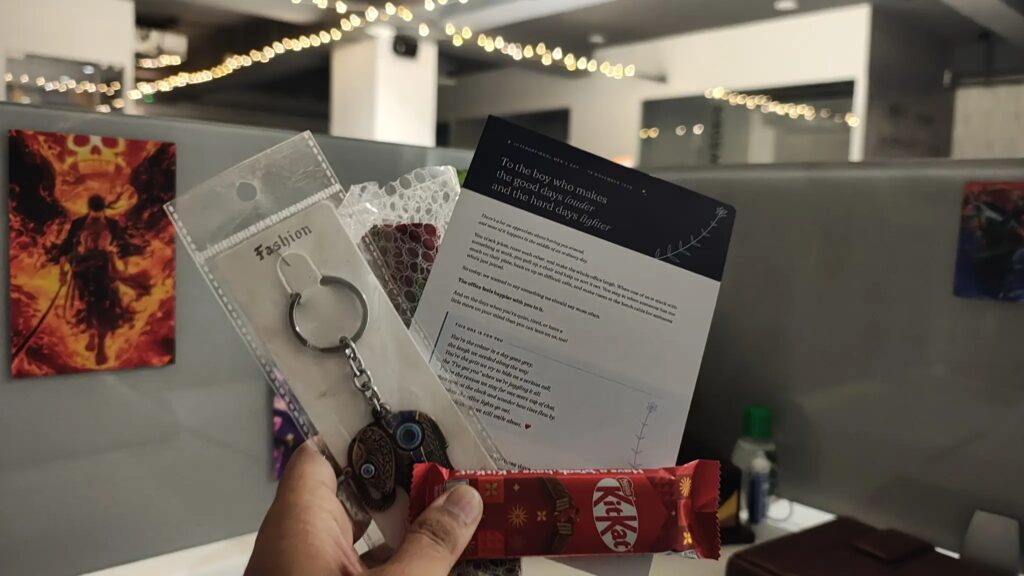
Today was International Men’s Day.
It’s a fun day, really. People get excited. Brands come up with campaigns, companies organise celebrations, social media gets flooded with appreciation posts, and for a day, it almost feels like a one-day festival. Everyone makes a big deal about men.
I sometimes wonder when this became customary and how we reached a point where an entire day is dedicated to celebrating men. I’m not denying that it’s required. In fact, I think it’s good to have an international day for it. There’s nothing wrong with celebrating people, appreciating them and making them feel valued.
But today, somewhere between scrolling through Instagram and looking at all the Men’s Day campaigns, I started thinking about something else.
Something much bigger than a day, a campaign or a commercial.
I remembered a dialogue from Dhurandhar. When R. Madhavan’s character, Ajay Sanyal, tells Jaskirat:
हम मर्द हैं, जसकीरत। पैदा होने से मौत तक, हमारा कर्तव्य है लड़ना। अपने मकसद के लिए, अपने सपनों के लिए, अपने हक़ के लिए, अपनों के लिए। यह हमारा धर्म है। और इसके लिए हमें कोई शाबाशी या मेडल नहीं मिलता।
I think a lot of men across the world will relate to these words. Not necessarily because everyone has the same responsibilities or fights the same battles, but because there’s something familiar about continuing to fight for your dreams, your rights and the people you love, often without expecting recognition for it.
And I think that’s where my thoughts about manhood begin.
First, you’re taught to walk on a road. Then you’re expected to create one.
There’s something interesting about growing up as a boy.
For most of your childhood, someone is telling you what to do. You’re taught how to walk, how to cross the road, how to ride a bicycle, how to make decisions and how to deal with the world. There’s always someone a little ahead of you, showing you the way.
For me, my father was that man. And after him, my elder brother.
I was the boy. I could ask for things, try things, make mistakes and change my mind. I remember wanting a cycle, wanting to join different classes, wanting to learn dance or singing. I wasn’t interested in sports. I chose engineering, and eventually I even decided to drop out.
And somehow, my father would just say, “Okay” or “Fine.”
Looking back, I sometimes wonder what he was thinking. Did he agree because he trusted me? Did he think those decisions were right? Did he consider some of them irrational but still let me figure things out?
I don’t really know.
But all those decisions, good or bad, eventually became a part of who I am today. And perhaps that’s what being guided looks like. Someone gives you enough room to make your own choices, even when they don’t know exactly where those choices will take you.
Then, somewhere along the way, something changes.
The people who once guided you start expecting you to become someone others can turn to. You go from being the person asking for directions to the person expected to know the way.
You spend your childhood learning how to walk on the road, and suddenly, you’re expected to create the road for someone else.
Nobody really tells you when that transition happens. There’s no ceremony, no certificate, no announcement. One day, you just realise that people are looking at you for answers.
The transition I started noticing in myself
I think I started noticing this change somewhere around 2022–23.
Back then, I would hop from one café to another, watch anime, explore places and spend my salary without thinking too much about savings. If I wanted something, I’d probably find a reason to buy it. If I wanted to go somewhere, I’d go.
Savings? Responsibilities? Planning for the future? Those things didn’t occupy my mind in the same way.
I thought that was independence. And in many ways, it was. I was earning, making my own decisions and enjoying the freedom that came with it.
But gradually, the way I looked at money, time and decisions started changing.
You begin thinking about savings. Not just because you want something for yourself, but because there are people and responsibilities attached to your life. You start thinking about your team, your family, the people you love and the things they might need tomorrow.
Sometimes, you don’t even enjoy something today because you’re already planning how you could enjoy it with someone else later.
You might postpone watching a movie because you want to watch it with someone. You might save a little because you want to take your people somewhere. You might think about buying a video game, planning a trip or exploring a new place, but the excitement isn’t only about doing it yourself anymore.
It’s also about sharing it.
And I don’t think that necessarily means you’re becoming less independent. Perhaps your definition of independence is simply changing.
The extra roti
There’s one small thing I’ve noticed about fathers, and it has stayed with me.
Imagine sitting at a restaurant with your family. There’s one extra roti on the table. Your father says, “You take that extra roti.”
He might already be full. He might genuinely not want it. But sometimes, you realise that he could have had it too. He simply chose to let you have it.
As a child, you don’t think much about it. You just take the roti.
But years later, you find yourself doing the same thing. You let someone else have the extra piece. You make sure someone has eaten before you. You pick something up for someone because you know they’ll like it.
And suddenly, you understand that little gesture a little differently.
Maybe it wasn’t always about sacrifice. Maybe it was simply about finding happiness in someone else’s happiness.
I think that’s one of the quieter changes that comes with growing up. You start noticing the little things that people did for you, and without consciously deciding to, you begin doing them for others.
But I also think there’s something important here: caring for people shouldn’t mean that you must always go without. You can offer someone the extra roti and still deserve one yourself. Being responsible doesn’t mean forgetting that you, too, have needs.
The strange responsibility of thinking ahead
I sometimes feel that being a man means thinking four miles ahead. Sometimes 4,000 miles ahead. Maybe even a light-day ahead.
You don’t just think about what is happening right now. You think about what could happen next, what might go wrong, what needs to be prepared for and how a decision today could affect someone tomorrow.
And perhaps that’s why certain decisions become heavier with time.
When you’re younger, you can make a decision and deal with its consequences later. As you grow older, you start thinking about the consequences before making the decision.
You begin calculating things that nobody has asked you to calculate.
And while that can be exhausting, it also makes you realise how much your choices can affect the people around you.
I don’t know whether this is maturity, responsibility or simply the natural progression of life. Maybe it’s all three.
Solitude, expectations and the boy inside me
There’s another thing I’ve been thinking about: solitude.
I genuinely appreciate being by myself. I enjoy having my own space, watching movies, reading, exploring my interests, and spending time with my thoughts.
But lately, I’ve also started thinking about what happens when that solitude is no longer just yours.
What happens when someone relies on you? When someone expects something from you? When your decisions are no longer just about your own convenience?
And I think what I struggle with sometimes is not necessarily the expectation itself. It’s the expectation that remains unspoken.
I have this particular mentality. I often tell people:
“If you have any kind of expectations from me, just throw them at me. Don’t keep attaching those expectations to me without telling me. I want to be clear. I want to understand what you’re expecting, what I might say, what I might think, and what I can actually do.”
I would rather someone tell me what they expect than have me constantly guessing.
Because I understand that people sometimes walk on eggshells around me.
And honestly, I don’t like that.
I want people to communicate. I want them to be comfortable telling me what they need, what they think and what they expect.
Maybe this, too, is part of growing up: understanding that relationships come with their own expectations, responsibilities and compromises. You cannot always operate as if you’re the only person whose feelings and convenience matter.
But it also makes me wonder something.
Is this growth? Is this the transition from being a boy to becoming a man? Or is it the slow disappearance of that boy who could live without constantly thinking about consequences, responsibilities and expectations?
Sometimes I wonder if I’m losing a little bit of that freedom.
And then I think, maybe that’s life. Maybe growing up isn’t about losing the boy inside you. Maybe it’s about learning how to take him along while becoming someone others can rely on.
Two Men’s Day stickers and a whole lot of perspective
Here’s something funny that happened today.
I was scrolling through Instagram, trying to post a story, and I searched for Men’s Day stickers.
Only two stickers came up.
The rest of the stickers were for Women’s Day.
If this had happened to the boy I was a few years ago, I might have been offended.
“Hey, what is this? I’m literally searching for Men’s Day. There are sixteen stickers, and only two are for men. What kind of thing is this?”
I might have questioned the platform, the campaigns, the representation and everything else.
But today, I didn’t really care.
Not because I don’t think men deserve appreciation. They absolutely do.
But because I’ve started realising that a sticker doesn’t define how appreciated you are.
Sometimes, appreciation comes from places where you weren’t even looking for it.
And something happened at our office today that made me think about this even more.
The rose, the KitKat and the evil eye
Our CEO, Divya Gandotra, and the entire girls’ team came up with a lovely little Men’s Day celebration.
They printed cards with beautiful things written on them, gave us a rose, a KitKat and an evil-eye charm to protect us from all that nazar in the world.
It was a genuinely sweet gesture.
And I appreciated it.
But what struck me was that the gesture itself wasn’t the only thing that made me feel appreciated.
I started thinking about how the girls’ team shows their appreciation every day, often without even realising it.
Someone asks you, “Hey, can you help me book a Rapido to my home?”
Someone asks you to walk with them to a particular location.
Someone feels safe around you.
Someone comes to you just to rant.
“Hey, you know what that person did?”
“Hey, I’m having a headache. Could you take over my work?”
These are ordinary conversations. They happen in offices every day.
But think about what they communicate.
Someone trusts you enough to ask for help. Someone feels comfortable enough to share a problem. Someone believes you’ll be there when they need you.
And sometimes, someone simply wants to know that they don’t have to figure everything out alone.
I think there’s a certain beauty in that.
You don’t always need a campaign to tell you that you’re appreciated.
Sometimes people show it by relying on you, trusting you, feeling safe around you and making you part of their everyday lives.
And honestly, that hits.
It hits more than not having enough stickers for Men’s Day.
Perhaps the boy in me wouldn’t have understood this distinction. He might have looked for appreciation in the number of posts, stories or campaigns.
But today, I find myself looking at the little things.
And sometimes, those little things mean a lot more.
A small compliment in December 2024 that stayed with me
There’s another incident I remember, and this one has stayed with me.
One of my interns once complimented me.
She said something along the lines of:
“You are a good man. You know when to appreciate and when it’s due.”
I don’t remember the exact wording perfectly, but I remember the feeling behind it.
Here’s what happened.
She was interning with us for the very first time. She was new to the corporate world and had to send a voice note in a group where there were several people above manager level. Her team lead was also present.
For someone who was experiencing this environment for the first time, I could imagine how intimidating it might have been.
She apparently took seven attempts to send a one-minute voice note.
Seven takes for sixty seconds.
And I appreciated that.
Not necessarily the voice note itself, but the courage it took to send it.
Think about being new to a professional environment, surrounded by people who are much more experienced than you. You’re trying to communicate something, and you’re probably overthinking every word.
You record it once. You don’t like it.
You record it again. Something sounds wrong.
You try another time.
And then another.
Seven attempts later, you finally send it.
I could have simply listened to the message, understood what she was saying and moved on.
But I wanted her to know that I recognised the effort.
I wanted her to understand that sending that voice note took guts, especially in a group where everyone was much more senior.
And I think that’s what she appreciated.
Her compliment stayed with me. I vaguely remember it coming back to me again and again.
Not because someone called me a good man, but because I started thinking about what that actually meant.
When do you appreciate someone?
When do you encourage them?
When do you make someone feel that their effort matters?
And when do you recognise that someone needs a little confidence rather than another instruction?
And what about our fathers?
The more I think about becoming a man, the more I think about my father.
For most of our childhood, we see our fathers as the men who have everything figured out. They are the ones who make decisions, handle problems, arrange things and somehow keep the family moving.
We rarely stop to think that they were once boys, too.
They had their own dreams, their own uncertainties, their own plans and probably their own versions of the questions I’m asking myself today.
Maybe they didn’t know what they were doing all the time either. Maybe they were figuring things out as they went along, just like we are.
I sometimes wonder what my father thought when I made all those decisions. When I wanted to learn something new, when I changed my mind, when I chose engineering and when I decided to leave it.
Perhaps he was figuring out his own way of being a father while I was figuring out my way of being a boy.
And maybe that’s something we understand only when we start growing up ourselves.
The people we once thought had all the answers were also learning along the way.
But what happens to the boy?
I keep coming back to this question.
Is this growth? Is this maturity? Is this the transition from being a boy to becoming a man?
Or is it the death of a boy who once lived without constantly thinking about tomorrow?
I don’t think I have a definite answer.
But I do think there’s something we should remember.
That boy doesn’t necessarily have to disappear.
The boy who wanted a bicycle, who wanted to join dance classes and singing classes, who wanted to study engineering and then drop out, who hopped from one cafe to another and watched movies without thinking too much about savings.
He’s still a part of you.
He is the reason you enjoy exploring new places. He’s the reason you get excited about a new movie, a new game, a new experience or something completely random.
Growing up shouldn’t mean losing that person.
You can be responsible and still be spontaneous.
You can save money and still spend it on something that makes you happy.
You can be someone’s guidance and still need guidance yourself.
You can be the person everyone relies on and still call your father when you don’t know what to do.
You can enjoy solitude without making it a permanent condition.
And perhaps the biggest thing is that you can take care of people without forgetting to take care of yourself.
There’s a thought I particularly like: don’t prepare for the end of your solitude. Prepare for the possibility of sharing your life.
There’s a difference.
The first makes responsibility sound like the end of freedom. The second makes it sound like an expansion of life.
You don’t have to stop being independent to become responsible. You don’t have to stop exploring to become dependable.
You can still be the boy who wants to watch a movie on a random Tuesday, while also being the man who makes sure everyone around him gets home safely.
Both can exist.
Maybe we’re all figuring it out
I don’t think I have a final definition of what being a man means.
I don’t think it’s just about earning money, protecting people, taking responsibility or being strong. Those things can be part of it, but they cannot be the whole definition.
A man can be ambitious and still be playful. He can be responsible and still want to spend an entire evening watching a movie. He can be someone’s support system and still need someone to support him. He can make decisions for others and still be unsure about his own life.
He can save money for tomorrow and still enjoy today. He can be dependable without being permanently available. He can guide someone and still need guidance himself.
And perhaps that’s what I’m slowly learning.
A few years ago, I thought independence meant being able to do whatever I wanted, whenever I wanted. Today, I find myself thinking about the people who might be affected by what I do.
I don’t necessarily think one version of me was right and the other is wrong. They’re just different stages of the same journey.
I still want to be that boy who enjoys movies, anime, manga, books, random plans and the freedom to do absolutely nothing sometimes. I don’t want to become so occupied with responsibilities that I forget the things that make me happy.
But I also want to become someone people can rely on. Someone who makes people feel safe, someone who notices their efforts, someone who can offer guidance and someone who doesn’t take the trust people place in him lightly.
Maybe the real challenge is learning to be both.
And coming back to that Dhurandhar dialogue, I think what stays with me is not just the idea of fighting. It’s the idea of fighting for something beyond yourself, while understanding that you don’t always need applause for doing what matters to you.
But I hope we also remember that men deserve appreciation, affection, rest and understanding. We don’t have to wait until someone has carried the weight of the world to tell them that they’re doing well.
Sometimes, a small compliment, a thoughtful gesture, an extra roti or simply asking someone how they’re doing can mean a lot.
Maybe being a man isn’t about becoming someone who never needs anyone.
Maybe it’s about becoming someone people can count on, without forgetting that you’re also someone who deserves to be counted on.
And somewhere in all of this, I hope I don’t lose that boy who once held his father’s hand while crossing the road.
Because today, I might be learning how to hold someone else’s hand.
But I’m still that boy, figuring out the road.